These abiotic vs biotic factors worksheets for 6th grade give science teachers something more useful than vocabulary reinforcement — they surface the reasoning gaps that show up when students try to explain, not just name, the living and nonliving parts of an ecosystem. Each worksheet combines classification tasks with at least one explanation prompt, so teachers can see who has internalized the concept and who has only memorized a list. The set covers four common ecosystem settings and includes the borderline examples that make the biggest difference in formative assessment.
The Once-Living Problem — and Why It Belongs in the Lesson
The question that consistently trips 6th graders is not "is grass biotic?" — students settle that quickly. The harder question is what to do with a dead leaf, a fallen log, or a decomposing beetle. Students who think "living equals biotic" land those items in the abiotic column without hesitation, because they are clearly not alive. What they need is the fuller definition: biotic factors include anything living or once-living. Mushrooms feeding on a rotting stump, bacteria breaking down organic material, the layer of leaf litter covering a forest floor — all biotic, even when nothing in the image looks like what a student pictures when they hear the word "organism."
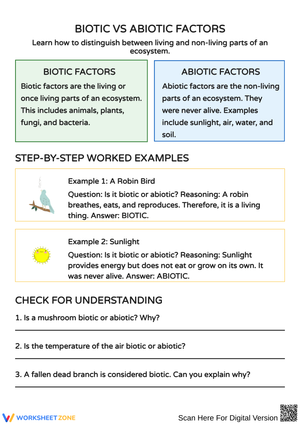
These worksheets include items built to surface that confusion. When a student marks a fallen log as abiotic and then has to write a sentence justifying the choice, the teacher gets a direct look at the gap — not just a wrong checkmark, but the reasoning behind it. That kind of diagnostic information is hard to get from a matching activity alone.
What Students Practice Across the Set
The worksheets address four task types that reflect the progression 6th graders need during an ecology unit.
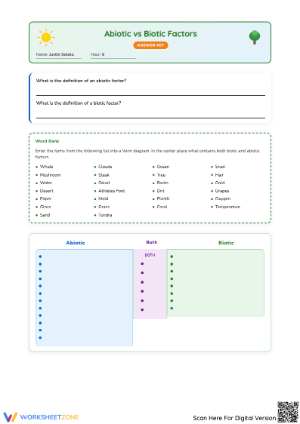
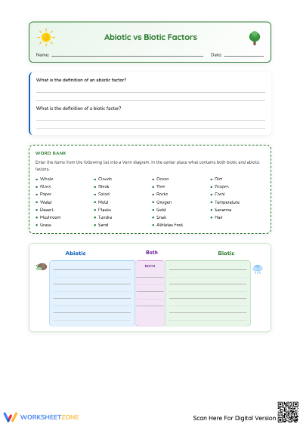
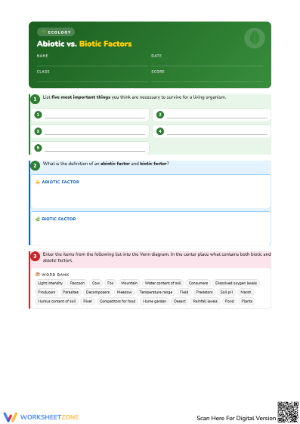
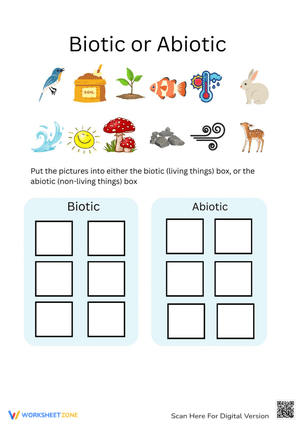
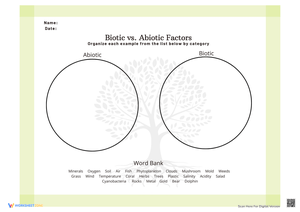
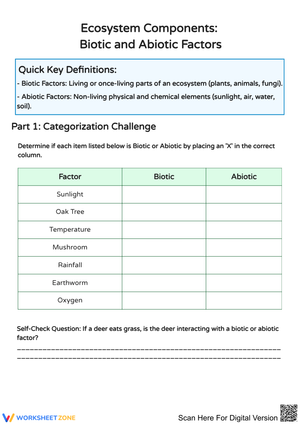
- Sorting and classifying: Students assign terms and images to biotic or abiotic categories, starting with clear examples — sunlight, algae, temperature — and moving toward tricky ones like soil, animal waste, and decomposing bark.
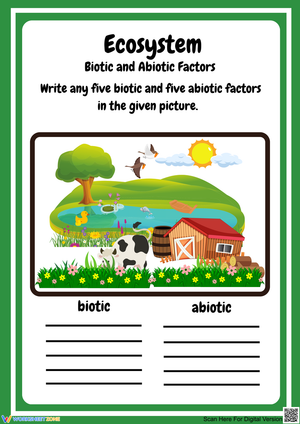
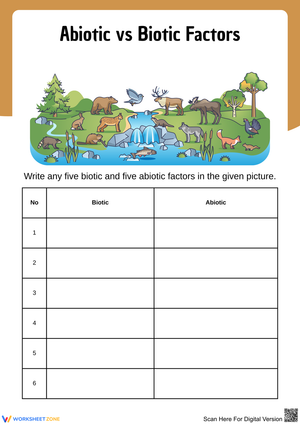
- Ecosystem labeling: Students identify which factors appear in a specific habitat — pond, desert, forest, grassland — and mark which are living conditions versus physical ones.
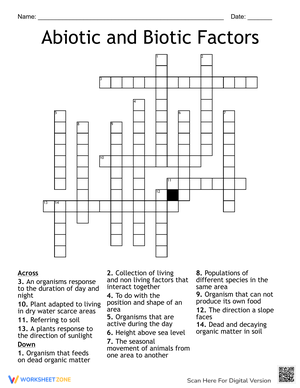
- Written justification: Students explain their classifications in one or two sentences using terms like once-living, organism, and nonliving condition.
- Cause-and-effect analysis: Students trace how a change in one factor — less rainfall, rising water temperature, reduced canopy light — ripples through an ecosystem and affects the organisms that depend on it.
The cause-and-effect items separate students who see ecosystems as systems from those who see them as category lists. A student who can write "if dissolved oxygen drops due to warmer water, fish populations in the pond will shrink" has moved well past the vocabulary level of this topic — and that distinction matters for where you go next in the unit.
Mistakes Students Make That These Worksheets Help You Catch
Three errors appear in student work on this topic consistently enough to address directly, rather than waiting for them to resolve on their own.
The first is the once-living problem. Students default to "dead equals nonliving equals abiotic." A worksheet that asks them to classify a fallen log and then write one sentence explaining their reasoning makes that error visible far faster than reteaching the vocabulary would. The written justification is where the misconception shows up in writing, not just in a wrong answer bubble.
The second involves soil. Students often mark it abiotic because it resembles rock and does not move. In reality, soil contains decomposed organic matter, living bacteria and fungi, and active root systems — making it both biotic and abiotic depending on which component you examine. Worksheets that ask students to name the biotic and abiotic parts within soil, rather than classify soil as one or the other, push students toward that more accurate, systems-level thinking.
The third error is undercounting abiotic factors. Students list water and sunlight, then stop. Wind, soil pH, atmospheric pressure, and seasonal temperature shifts are also abiotic — and often more influential in determining which organisms survive in a given habitat. Ecosystem comparison tasks, where students contrast a desert and a rainforest, make those overlooked factors obvious because the most striking differences between the two habitats are physical, not biological.
How to Work These Worksheets Into a Science Block Effectively
In a typical 50-minute class period, teachers reach for abiotic vs biotic factors worksheets for 6th grade at three distinct moments. A sorting-only worksheet works well as a five-minute warm-up before introducing food webs or population dynamics — it reactivates prior knowledge without pulling attention away from new instruction. A reasoning-heavy worksheet with written justification belongs in guided practice, where teachers complete the first two items with the class before releasing students to work independently. The cause-and-effect worksheets fit best in the second half of an ecology unit, after students have had at least one lesson on how changes in physical conditions trigger biological responses.
Station setups work well with this topic. Running three concurrent stations — picture sorting at one, an annotated ecosystem paragraph at another, and student-generated examples at a third — gives students three repetitions of the same concept in three different formats within a single class period. The third station, where students must write their own example that does not appear on the worksheet, reliably catches students who can sort correctly but cannot transfer the concept to a new context.
For an exit ticket in the last eight minutes of class, project two borderline examples — a mushroom on a log, a handful of soil — and ask students to write their classification with a one-sentence defense on a sticky note or in their science notebook. No setup required beyond the worksheet itself, and the written defenses tell you exactly what to address the next day.
Standard Alignment
The primary standard these worksheets address is NGSS MS-LS2-1, which asks students to analyze and interpret data about the effects of resource availability on organisms and populations in an ecosystem. To do that work, students need to understand which ecosystem factors are living — and therefore capable of reproducing, competing, and adapting — and which are physical conditions that set the outer limits of survival. The worksheets also connect to MS-LS2-4, which addresses how changes in physical or biological components disrupt existing ecosystem conditions and how those disruptions propagate through the system.
In terms of classroom placement, this content typically lands in the opening weeks of a middle school ecology unit — before food webs, population dynamics, or carrying capacity arrive. Teachers who establish biotic and abiotic factor thinking early find that students have sharper language for describing ecosystem change when those later topics come into focus. The vocabulary and the reasoning habits transfer directly.
Adjusting the Work for a Mixed-Ability Classroom
The classification tasks in this set are accessible to students who are still building science vocabulary, but they do not need to be simplified for that group — they need different entry points. Emerging learners benefit from a word bank alongside the sorting task, plus sentence frames like The ________ is biotic because it is living / once-living. That approach reduces the language load without lowering the science expectation. Those students are still working on the same concept; they just have more structure for getting their thinking onto the worksheet.
Students who are ready for more challenge get the most from the cause-and-effect items. Ask them to write their own ecosystem scenario: choose a habitat, identify three biotic and three abiotic factors, then predict what happens when one factor changes. That task requires integrating everything the classification work builds toward, and the responses tend to show genuine ecological reasoning rather than category matching.
For English language learners, the labeling worksheets that pair terms with ecosystem diagrams significantly reduce the text-decoding burden while keeping the science task intact. Students classify what they see in an image of a pond or forest rather than interpreting dense written descriptions, which lets them demonstrate conceptual understanding without hitting a language wall first.
Frequently Asked Questions
Are these worksheets aligned to the Next Generation Science Standards?
Yes. The skills in this set connect directly to NGSS MS-LS2-1 and MS-LS2-4, which address resource availability, biotic and abiotic interactions, and ecosystem disruption. The abiotic vs biotic factors worksheets for 6th grade format fits naturally in the opening third of a middle school ecology unit, before food webs and carrying capacity become the primary focus.
How do the worksheets vary across the set — are they all the same task type?
No. Each worksheet is a standalone resource with a different task structure. Some focus on sorting and labeling, others on written justification, and others on cause-and-effect analysis. That variety lets teachers assign individual worksheets based on where their class is in the unit rather than working through a fixed sequence.
Can these work as formative checks rather than just practice?
The reasoning-prompt worksheets function well as formative assessments. A worksheet that asks students to classify a fallen log, explain why soil is complicated, and predict how a drought would affect a forest ecosystem gives a richer picture of student understanding than a sort-and-match item. Many teachers collect those written responses ungraded and use the justifications to plan the next day's instruction.
What about students who struggle with reading-heavy materials?
The sorting and labeling worksheets have minimal reading demand and work well for students who find text-heavy tasks overwhelming. The short-response worksheets can be supported with sentence frames. When teachers need a low-text starting point, the abiotic vs biotic factors worksheets for 6th grade with picture-based sorting tasks are the best option for that group — students demonstrate what they know about ecosystems without hitting a reading bottleneck first.












 Interactive Worksheet Maker
 Quiz Maker
 Word Search Maker
 Crossword Puzzle Maker
 Word Scramble Generator
 Sentence Scramble Generator
 Handwriting Worksheet Generator
 Name Tracing Generator
 Fill In The Blank Generator




 BACK TOSCHOOL