


























1 / 2
0
Views
0
Downloads


0.0
0
Save
0 Likes
Share
Food Chains, Food Webs, and Energy Pyramid Worksheet
0 Views
0 Downloads
Paste this activity's link or code into your existing LMS (Google Classroom, Canvas, Teams, Schoology, Moodle, etc.).
Students can open and work on the activity right away, with no student login required.
You'll still be able to track student progress and results from your teacher account.
Information
Description
What It Is:
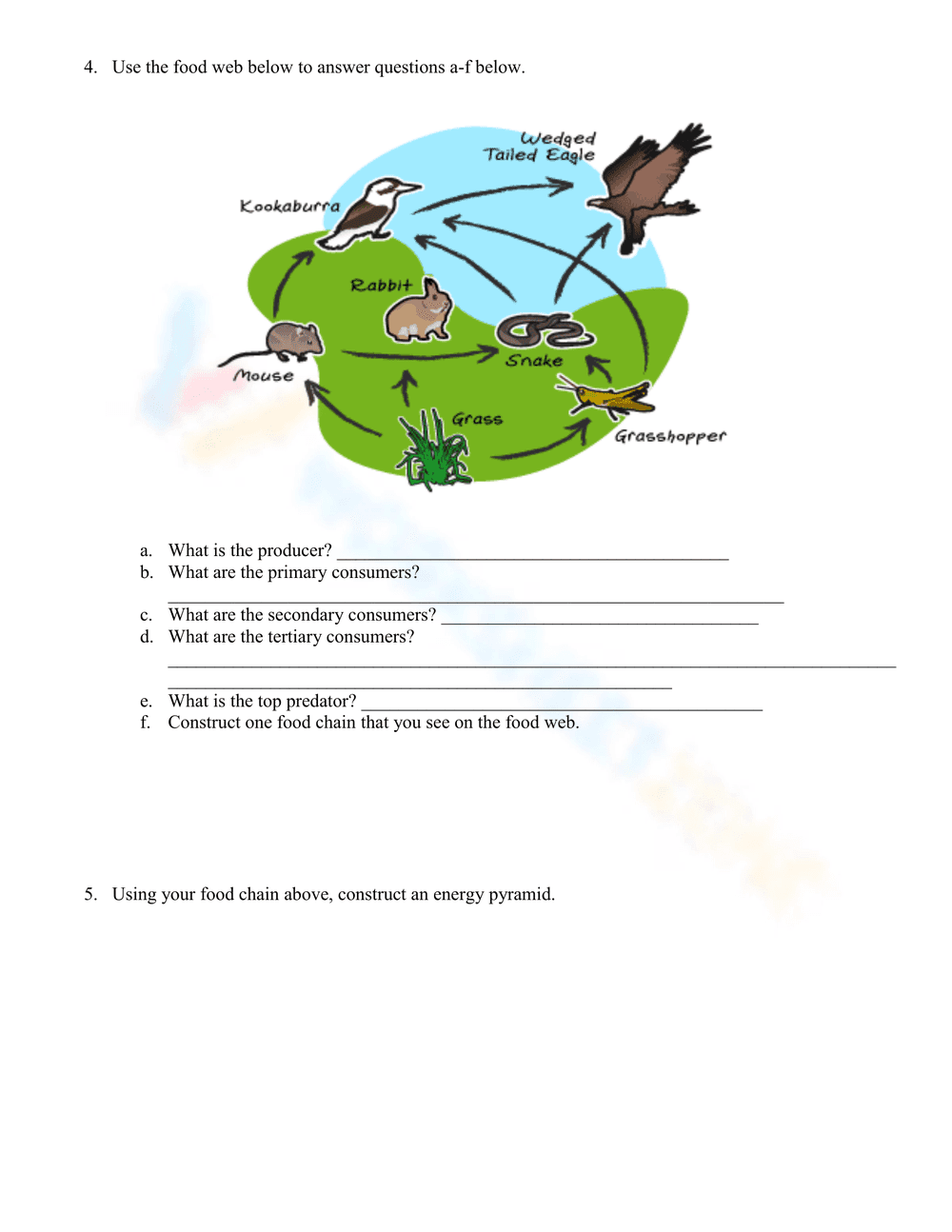
This is an educational worksheet focusing on food chains, food webs, and energy pyramids. It includes questions about a simple food chain (grass -> rabbit -> fox), asking students to identify the type of organism the grass is and which animal is a herbivore. It also asks students to predict the impact of increased fox population on rabbits. The worksheet also requires students to construct a food chain based on the sentence 'An owl eats a snake, the snake eats a squirrel, the squirrel ate a nut,' labeling each organism's role. Finally, students are asked to construct an energy pyramid from the food chain they created and identify which animal has the most and least available energy.
Grade Level Suitability:
This worksheet is suitable for grades 4-6. The concepts of food chains, food webs, and energy pyramids are typically introduced in these grades. The questions are relatively straightforward, and the food chains are simple to understand. The worksheet requires critical thinking about the relationships between organisms in an ecosystem.
Why Use It:
This worksheet reinforces understanding of food chains, food webs, and energy pyramids. It helps students identify producers, consumers (primary, secondary, tertiary), and the flow of energy within an ecosystem. It also encourages critical thinking about the impact of population changes on different species.
How to Use It:
Students should first read the instructions carefully. They should use the provided food chain (grass -> rabbit -> fox) to answer the first set of questions. For question 2, they need to construct a food chain based on the given sentence, labeling each organism. Then, using that food chain, they should draw an energy pyramid. Finally, they should answer the questions about the energy pyramid.
Target Users:
This worksheet is designed for elementary and middle school students learning about ecology, food chains, food webs, and energy pyramids. It is also suitable for teachers looking for supplemental materials to reinforce these concepts.
This is an educational worksheet focusing on food chains, food webs, and energy pyramids. It includes questions about a simple food chain (grass -> rabbit -> fox), asking students to identify the type of organism the grass is and which animal is a herbivore. It also asks students to predict the impact of increased fox population on rabbits. The worksheet also requires students to construct a food chain based on the sentence 'An owl eats a snake, the snake eats a squirrel, the squirrel ate a nut,' labeling each organism's role. Finally, students are asked to construct an energy pyramid from the food chain they created and identify which animal has the most and least available energy.
Grade Level Suitability:
This worksheet is suitable for grades 4-6. The concepts of food chains, food webs, and energy pyramids are typically introduced in these grades. The questions are relatively straightforward, and the food chains are simple to understand. The worksheet requires critical thinking about the relationships between organisms in an ecosystem.
Why Use It:
This worksheet reinforces understanding of food chains, food webs, and energy pyramids. It helps students identify producers, consumers (primary, secondary, tertiary), and the flow of energy within an ecosystem. It also encourages critical thinking about the impact of population changes on different species.
How to Use It:
Students should first read the instructions carefully. They should use the provided food chain (grass -> rabbit -> fox) to answer the first set of questions. For question 2, they need to construct a food chain based on the given sentence, labeling each organism. Then, using that food chain, they should draw an energy pyramid. Finally, they should answer the questions about the energy pyramid.
Target Users:
This worksheet is designed for elementary and middle school students learning about ecology, food chains, food webs, and energy pyramids. It is also suitable for teachers looking for supplemental materials to reinforce these concepts.


