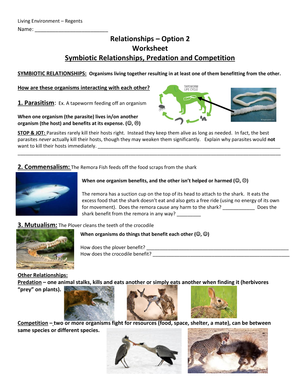
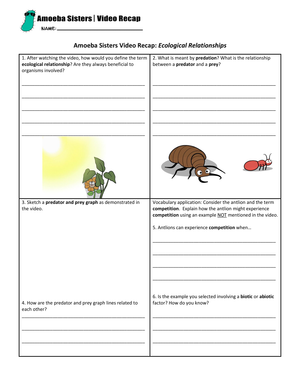
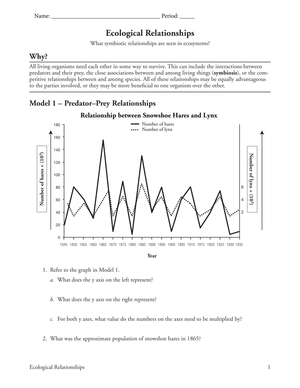
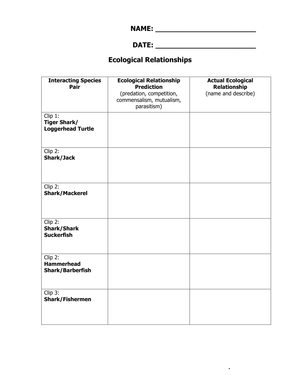
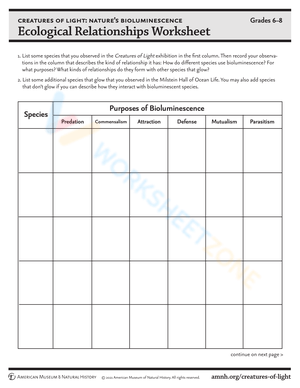
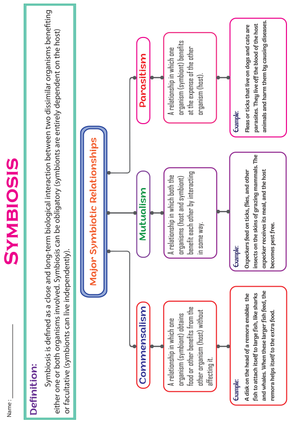
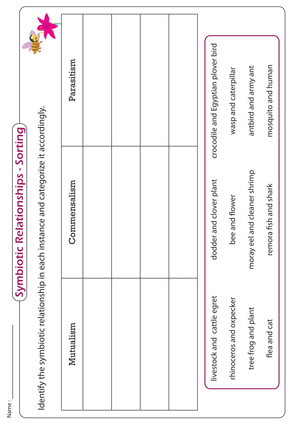
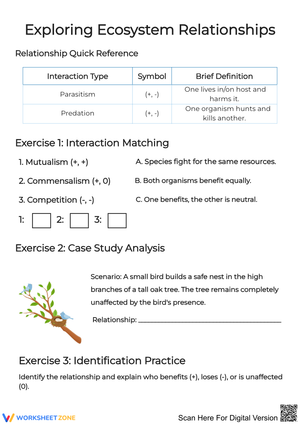
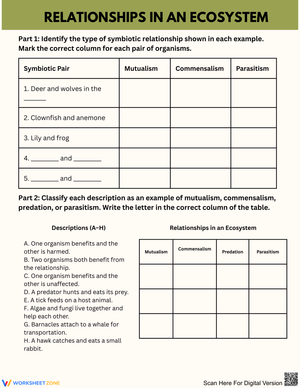
These 6th grade ecological relationships printable worksheets resources cover the five interaction types 6th graders are expected to classify and explain — predation, competition, mutualism, commensalism, and parasitism — and push students past vocabulary recall into evidence-based reasoning. Each worksheet asks students not just to label a relationship, but to name what each organism gains, loses, or competes for in that specific interaction.
The Specific Skills Each Worksheet Targets
At the 6th grade level, the real challenge in ecology isn't defining the terms — students can usually manage that after one direct-instruction lesson. The problem is accurate classification when the scenario is unfamiliar. A student who can confidently define commensalism will still label an egret walking alongside grazing cattle as mutualism because "both animals seem fine." The worksheets address this by pairing scenarios that look nearly identical except for one key detail, forcing students to apply the classification criteria rather than guess from a recognized organism or setting.
The set moves students through three levels of work:
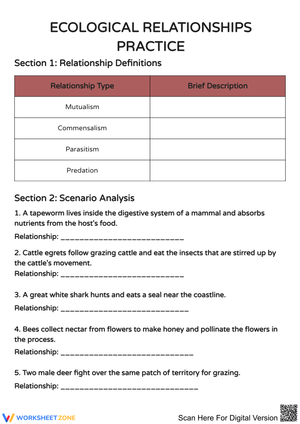
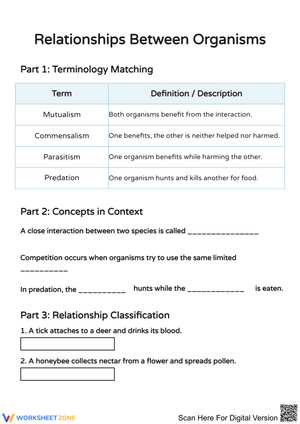
- Vocabulary matching tasks that connect each relationship type to a description of what both organisms experience — not just a one-word label
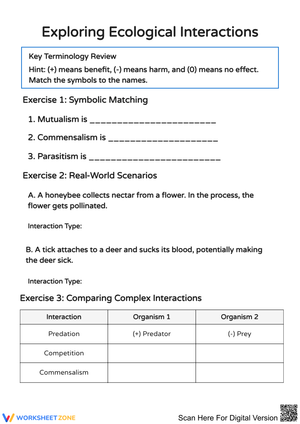
- Short organism-interaction scenarios where students classify the relationship and write a sentence explaining the evidence they used
- Food web analysis questions that require students to identify multiple relationship types operating simultaneously and predict how a population shift would affect other organisms in the system
The food web analysis questions reveal the most about what students actually understand. Sorting definitions from a list is a different cognitive task than reading an ecosystem map and finding predation, competition, and mutualism at work at the same time.
Where Student Thinking Goes Wrong in Ecology Classification
Three predictable errors appear consistently in 6th grade ecology work. First, students conflate proximity with symbiosis — if two organisms appear together in a food web or habitat description, students assume they must share a symbiotic relationship rather than recognizing they may simply be competing for the same resource. Second, mutualism gets over-applied: any interaction that looks positive from the outside gets that label, even when the scenario only describes benefit for one organism. Third, students confuse competition with predation when food is involved. A beaver eating tree bark that a porcupine also depends on is competition. A wolf eating the beaver is predation. Students regularly treat "one organism affecting another's access to food" as a single undifferentiated category, which produces consistent misclassifications on scenarios that turn on exactly that distinction.
Requiring a written justification after every classification answer — even one sentence — does more than slow down guessing. It makes the student's actual reasoning visible. When a student writes I chose mutualism because the bee gets nectar and the flower gets pollinated, that's categorically different from a student who writes I chose mutualism because both organisms are involved. The second answer tells you the student doesn't hold the criterion at all. A blank answer line would never reveal that.
Building These Worksheets Into Your Ecology Unit Plan
Good 6th grade ecological relationships printable worksheets materials work best distributed across the unit rather than held for review day. A practical sequence: use a vocabulary matching worksheet during the second half of the first lesson, right after direct instruction when terms are fresh but not yet practiced. Mid-unit, a short scenario-based worksheet as a class warm-up — two or three classification problems before new content begins — takes about five minutes and activates prior learning in a concrete way. The food web analysis worksheet belongs late in the unit, when students have seen all five relationship types and can apply them together. At that stage it functions well as a 20-minute formative check and doubles as test preparation.
One move that consistently improves the quality of student thinking after independent worksheet work: ask pairs to each choose one answer they feel confident about and explain their reasoning to each other, then find one answer they're less certain of and talk through it. The second conversation is where the real instructional information surfaces. Students who guessed correctly often reveal their uncertainty the moment they have to explain the reasoning out loud — something a completed worksheet alone cannot show.
Standard Alignment
These worksheets align with NGSS MS-LS2-2, which asks students to construct explanations that predict patterns of interactions among organisms across multiple ecosystems. In most 6th grade science sequences, this standard lands in the unit that bridges individual organism biology — common in upper elementary — and community-level ecology. The classification and written-explanation tasks across the set address the evidence-based reasoning requirement directly. The food web analysis worksheet also touches on MS-LS2-4, as students predict how population changes affect community structure. Both standards call for explanation and prediction, not just identification, so worksheets that require written justification are a stronger fit than pure matching or labeling tasks.
Adjusting the Set for Mixed-Readiness Classrooms
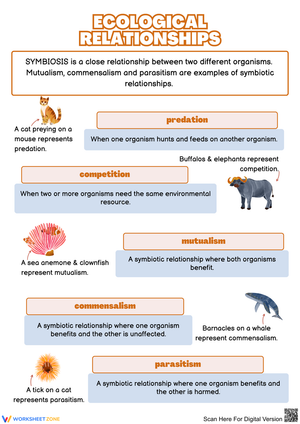
The science content stays the same across all learners; what changes is the amount of linguistic and contextual support built in. For students who struggle with academic reading, pairing each scenario worksheet with a reference chart — a simple two-column table listing each relationship type alongside what happens to each organism — reduces working memory load without reducing the cognitive demand of the task. Students use the chart as a decision framework instead of trying to retrieve five definitions simultaneously while also processing an unfamiliar scenario. That's a meaningful difference for students who freeze in front of dense text.
For students who move quickly through classification tasks, the more productive extension is conditional reasoning: ask them to predict how the relationship might change if a specific variable shifted — the shared food source disappears, a new predator enters the system, or seasonal drought reduces available water. That kind of second-order thinking is where stronger ecology students get genuinely challenged. The 6th grade ecological relationships printable worksheets set supports this tiered approach without requiring separate materials — the same worksheet can serve multiple readiness levels depending on how far into written analysis you ask students to push their responses.
Frequently Asked Questions
What ecological relationship types do these worksheets cover?
All five: predation, competition, mutualism, commensalism, and parasitism. Some worksheets focus tightly on comparing the three symbiosis types — where student confusion is most concentrated — while others ask students to classify across all five categories within a single scenario set or food web.
How much class time does each worksheet take?
Most classification and scenario worksheets take 15 to 20 minutes for the majority of students. The food web analysis worksheet runs closer to 25 to 30 minutes when students write full-sentence justifications. That puts most of the set comfortably within a bell-ringer block, a station rotation, or a short independent-work segment.
Are these worksheets better suited for early instruction or end-of-unit review?
Both, depending on format. Matching worksheets with a word bank work well early in instruction, even after a single lesson. Scenario-based worksheets that ask for written reasoning are better used once students have enough direct instruction to hold all five categories in mind. Saving everything for the final review is the least effective approach — practice distributed across the unit produces better retention than a single end-of-unit session.
Can these be used as sub plans or for independent work days?
The 6th grade ecological relationships printable worksheets materials in this set work well as sub plans because each worksheet includes complete student-facing instructions and the answer keys allow a quick whole-class check that requires no prior teacher explanation. They need no setup and no materials beyond a pencil.












 Interactive Worksheet Maker
 Quiz Maker
 Word Search Maker
 Crossword Puzzle Maker
 Word Scramble Generator
 Sentence Scramble Generator
 Handwriting Worksheet Generator
 Name Tracing Generator
 Fill In The Blank Generator




 BACK TOSCHOOL