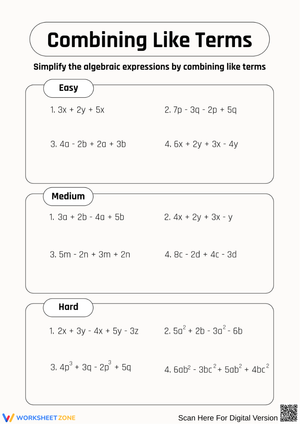
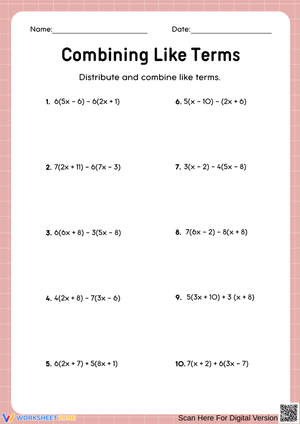
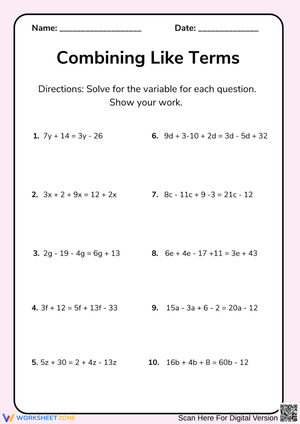
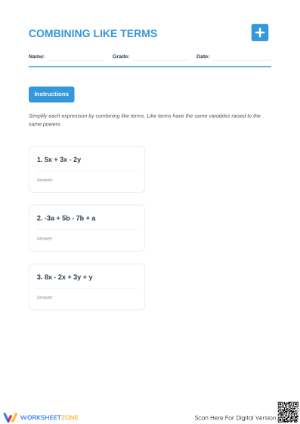
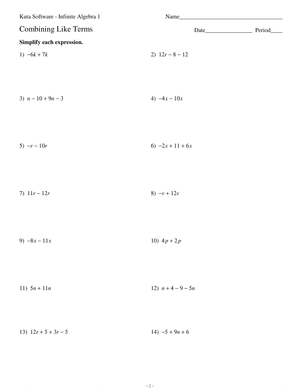
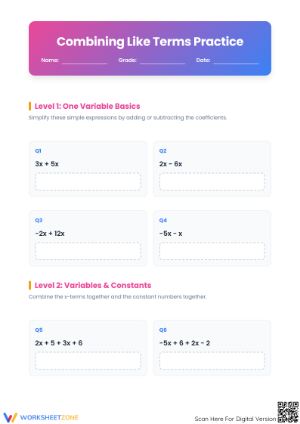
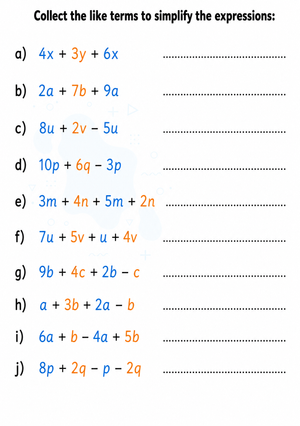
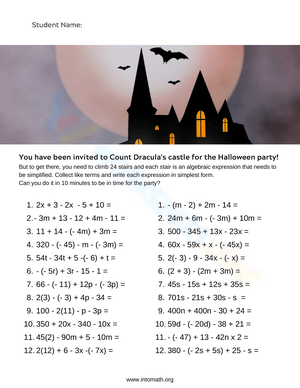
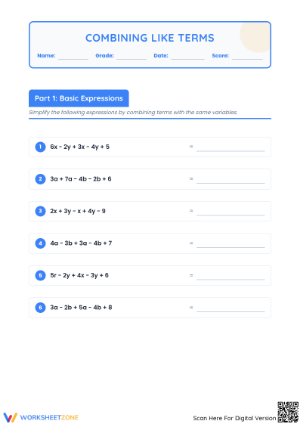
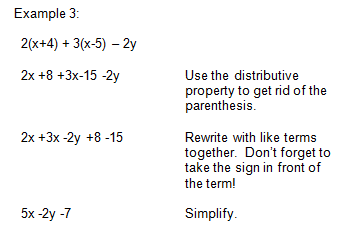
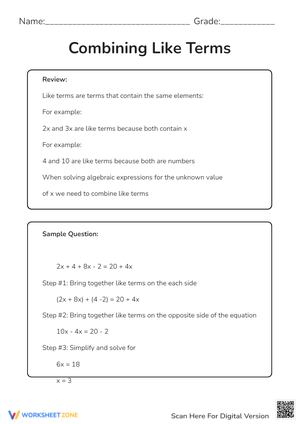
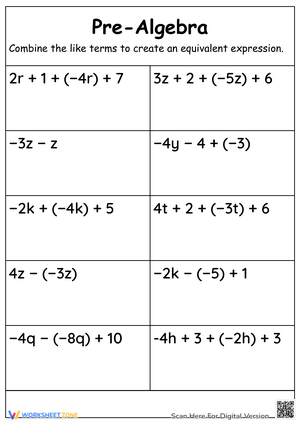
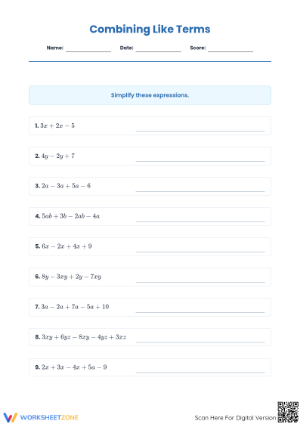
These combining like terms printable worksheets for 6th grade give teachers focused, reusable practice for one of the first genuinely algebraic moves students make in middle school. The set spans identifying which terms share a variable part all the way to simplifying multi-term expressions with mixed-sign integer coefficients — the actual range Grade 6 instruction covers before students move into solving equations.
What Each Worksheet Targets
The skill has more layers than it first appears. Students need to recognize like terms before they can combine them, and they need to handle constants, negative coefficients, and multi-term expressions before the concept fully sticks. Each worksheet in the set addresses one stage of that progression rather than cramming everything into a single attempt:
- Sorting and identifying: Students circle, underline, or color-code terms that share the same variable and exponent — without yet combining anything. This step exists because skipping it produces random combining errors later.
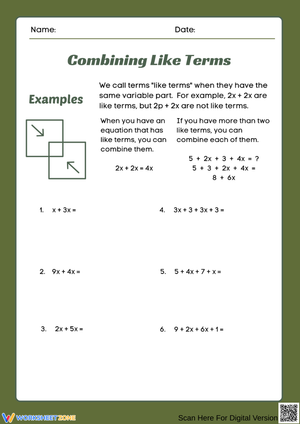
- Simple coefficient pairs: Expressions like 3x + 5x or 8 - 3 give students clean repetitions on the core procedure before signs and constants complicate the picture.
- Expressions with constants included: A form like 4x + 2 + 3x requires students to manage two separate combining steps — variable terms and constants — without conflating the results.
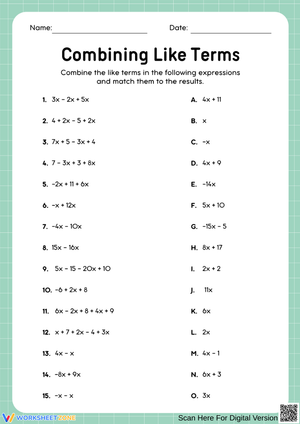
- Mixed-sign integer work: Expressions such as 6x - 9x + 4 - 1, where sign management is the primary challenge.
- Equivalence check items: Students substitute a value for the variable into both the original and simplified expressions to confirm both produce the same result — making the meaning of equivalence concrete rather than procedural.
Keeping identification separate from simplification is a deliberate choice. When both steps appear on the same worksheet too early, students rush through and start combining whatever looks close. A worksheet that asks only "which terms are alike?" forces the recognition step without any shortcut available.
Frequent Student Errors Worth Anticipating Before You Assign These
The errors that show up in Grade 6 work on this topic are consistent enough that teachers can plan for them in advance. The most common one is combining unlike terms — specifically, students who see 3x + 4 and write 7x, treating the constant as a like term because a number sits near a variable. A related version: students treat 2x and 2y as alike because both coefficients are 2. In both cases, students are anchoring on the numbers and not reading the entire term.
Sign errors are the second major category. In an expression like 6x - 9x, students frequently write 15x — they add the coefficients instead of subtracting, often because they haven't internalized that the subtraction sign belongs to the term following it. Rewriting the expression as 6x + (-9x) as an intermediate step, which these worksheets prompt students to do explicitly, reduces this error noticeably. A harder version of the same problem: students who handle the variable terms correctly still drop or flip a sign on a trailing constant, so 7x - 5 becomes 7x + 5 in the final answer.
Two rarer errors are diagnostic when they appear. First, some students simplify 2x + 3x to 5 — they add the coefficients and discard the variable, which signals they see the variable as decoration rather than as part of what the term means. Second, some students believe that rearranging terms changes an expression's value, and genuinely think 4 + 3x is different from 3x + 4. Short exercises where students confirm equivalence through substitution address both of these directly.
Lesson-Planning Approaches That Get the Most From These Worksheets
The identifying worksheets work well as a Monday warm-up or pre-assessment before formal instruction begins. Keep the item count low — three to five problems — and read student responses before moving to any combining work. That five-minute check reveals whether the class needs explicit vocabulary instruction on "variable part" and "coefficient" first, which pays off significantly in later sessions.
During direct instruction, a practical move is to ask students to label each term in writing before attempting to combine: variable term or constant, written small above each piece of the expression. Teachers who build this habit in the first few lessons see fewer random-combining errors in later independent practice because the annotation slows students down at exactly the right moment. These worksheets leave deliberate space above each expression for exactly that kind of marking.
The mixed-sign combining like terms printable worksheets for 6th grade fit naturally into a small-group rotation during the week you introduce negative integers in expression work. One group practices with positive coefficients only while another works through signed versions — both groups address the same core skill at different levels of complexity. A short exit-ticket worksheet at the end of the period tells you which group is ready to move forward.
For spiral review, assign one worksheet every couple of weeks after initial instruction ends. Students who combine like terms fluently in October sometimes start mishandling signs by December when new material competes for working memory. Short reactivation practice keeps the skill intact without consuming a full class period.
Standard Alignment
These worksheets align primarily to CCSS 6.EE.A.3 — apply the properties of operations to generate equivalent expressions — and CCSS 6.EE.A.4, which asks students to identify when two expressions are equivalent. In classroom terms, 6.EE.A.3 is where the procedural work lives: using properties to rewrite and simplify. 6.EE.A.4 is the conceptual anchor — students must understand that combining like terms produces an equivalent expression, not a different one. The equivalence-check items in these worksheets directly target that second standard, which is often undertreated when practice focuses only on getting a simplified answer.
Adjusting the Worksheets for a Range of Learners
Entry-level practice starts with positive integer coefficients, one variable, and short two-term expressions. There is nothing wrong with 2x + 4x as a starting point — it isolates the combining step completely, lets students build procedural confidence, and strips away sign management until students are ready for it. A support version of any worksheet can add visual cues: lightly shaded boxes around groups of like terms, or a partially completed first example that shows the labeling step already done, giving students a model to follow rather than a blank starting point.
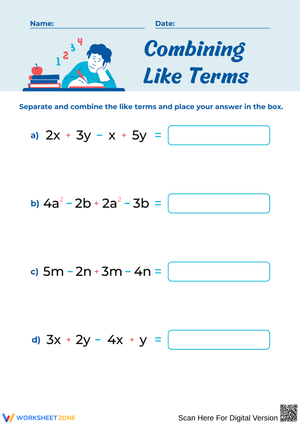
On-level practice brings in constants alongside variable terms and introduces subtraction: expressions like 7x - 3x + 5 or 9 + 4y - 2y - 1. The challenge tier adds a second variable — 3x + 2y + 5x - y — where students must run two separate combining processes simultaneously and resist merging the results. That format also previews the structure students encounter when they simplify like terms on one side of an equation, making it a useful bridge rather than just extra difficulty.
The substitution-check activity works as its own extension tool. Students who finish early plug in an agreed-upon value — say, x = 2 — and confirm that the original expression and the simplified expression return the same number. It adds a meaningful reasoning layer without requiring entirely new content, and it gives early finishers something worth doing.
Frequently Asked Questions
What counts as a like term in 6th grade?
Two terms are alike when they share the same variable and the same exponent on that variable. In Grade 6, the most common cases are pairs like 4x and -2x (same variable, implied exponent of 1) or two constants like 7 and -3. Terms like 3x and 3y are not like terms despite sharing a coefficient, and x and x² are not like terms despite sharing a variable base — both distinctions that students at this level need repeated exposure to get right.
How many worksheets from this set should I assign before moving to equation solving?
Most teachers find that students need three to five targeted practice sessions before equation work feels manageable. The clearest signal is whether students can simplify a four-term mixed-sign expression without losing the variable or mishandling a constant. Use an exit ticket from combining like terms printable worksheets for 6th grade to make that call rather than estimating from a class discussion, where confident students can mask the confusion of quieter ones.
Do these worksheets address two-variable expressions?
Yes — the challenge-level resources include two-variable expressions. That content is appropriate for students who have already mastered single-variable work and benefits from appearing in a low-stakes worksheet format before it shows up inside a multi-step equation task. Students can work through the logic of tracking two separate variables without the added pressure of also solving for one.
Can I use these for intervention with 7th or 8th graders who still struggle with the skill?
The entry-level and on-level worksheets are direct enough to use across grade levels without the content feeling mismatched, especially in a small-group pull-out setting. The underlying skill doesn't change between grades — the same combining like terms printable worksheets for 6th grade that introduce the concept to a 6th grader also give an 8th grader a clean, low-ego way to revisit it before tackling multi-step algebra.













 Interactive Worksheet Maker
 Quiz Maker
 Word Search Maker
 Crossword Puzzle Maker
 Word Scramble Generator
 Sentence Scramble Generator
 Handwriting Worksheet Generator
 Name Tracing Generator
 Fill In The Blank Generator