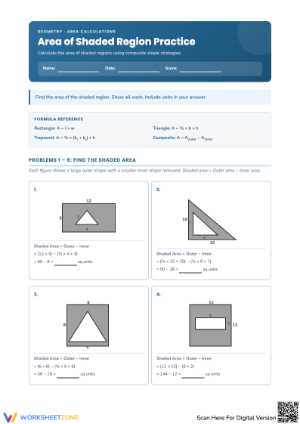
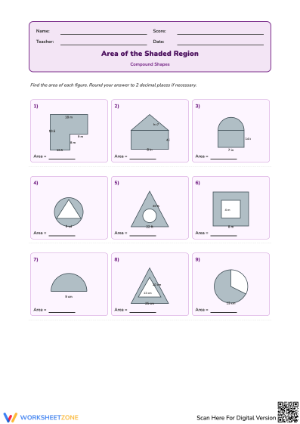
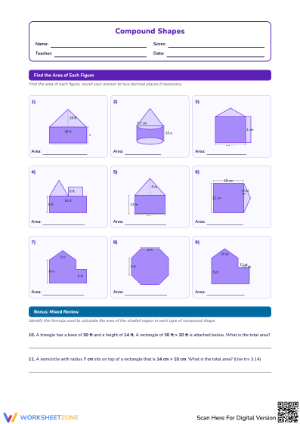
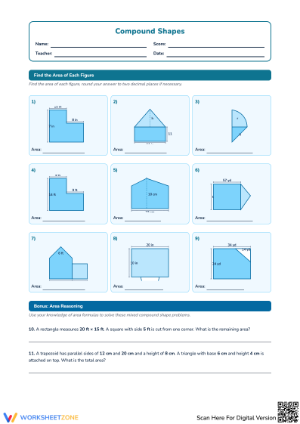
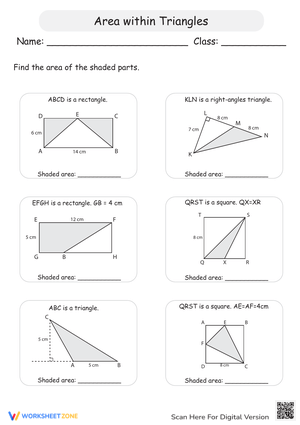
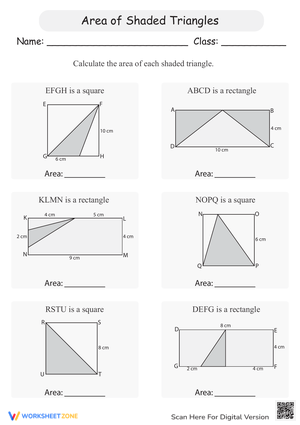
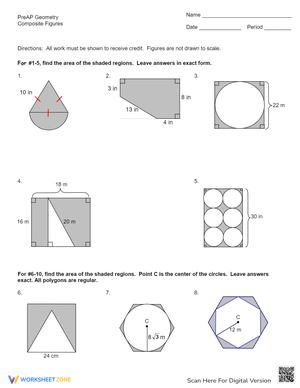
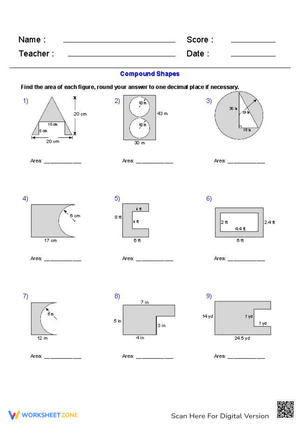
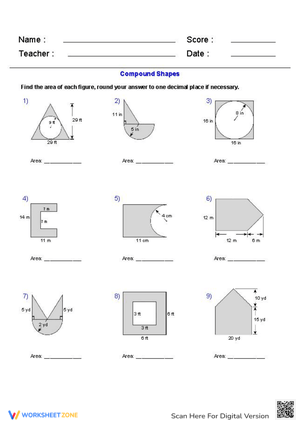
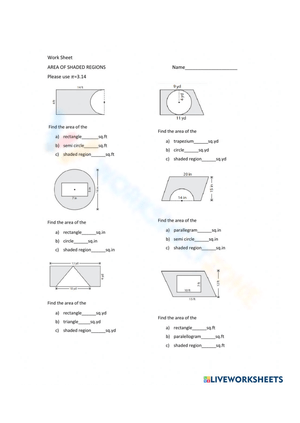
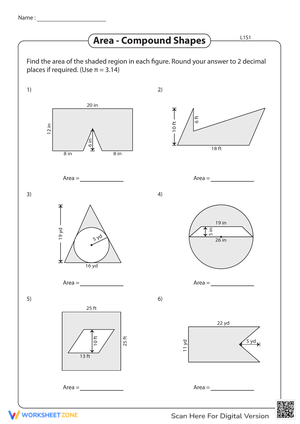
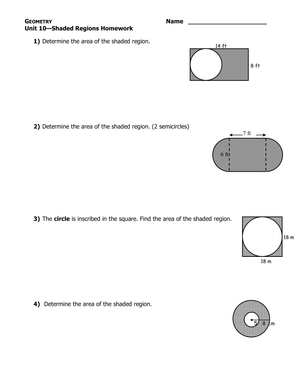
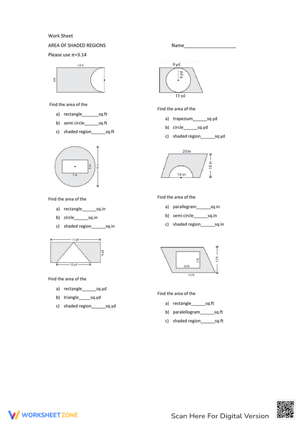
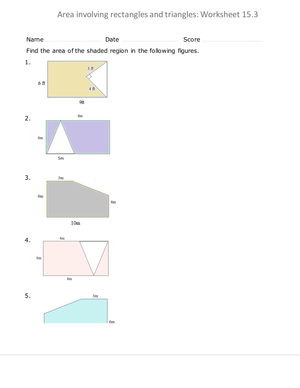
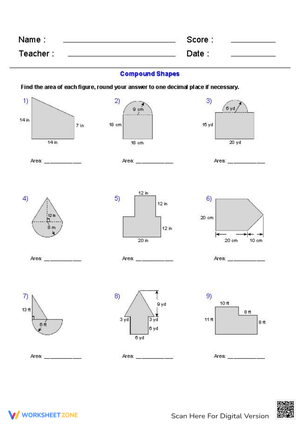
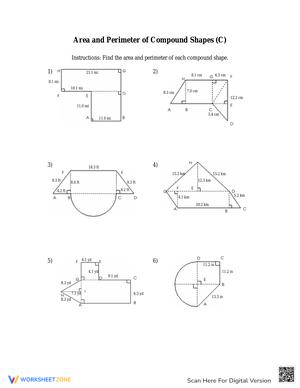
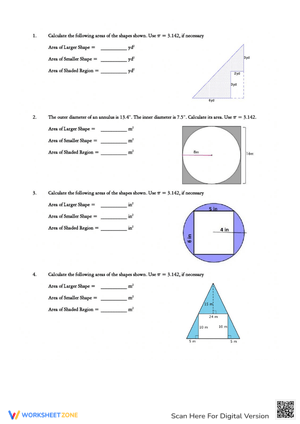
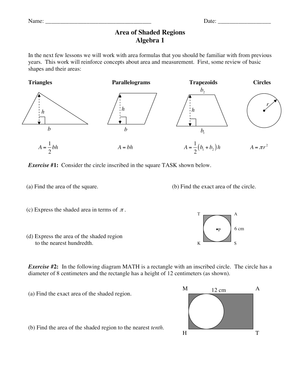
These find the area of the shaded region worksheets for 6th grade give teachers printable practice that pushes past single-formula recall — students must identify which region is shaded, decide whether to subtract an inner shape from an outer figure or split the shaded area into recognizable parts, and track square units through every step. That multi-decision structure is what separates shaded-area work from straightforward formula drills and makes these worksheets a reliable check on whether students understand area relationships or are simply executing memorized procedures.
How Area Formulas Combine in These Problems
The core challenge in every shaded-region task is part-whole reasoning — not just applying a formula, but deciding which pieces of a figure matter and in what order. Students work with rectangles, right triangles, parallelograms, trapezoids, and irregular composite figures depending on where they are in the unit.
Problems fall into two structural categories. In the first, a smaller shape sits inside a larger one and the shaded region is everything in between — students find both areas and subtract. In the second, the shaded region is itself irregular, so students decompose it into smaller recognizable shapes, compute each area, and add. Both structures appear across the set, and which approach a given problem calls for is never signaled in advance. Students have to read the figure before they choose a method, and that reading step is where many sixth graders struggle most.
Grid-based figures appear early in the set so students can count or estimate square units directly. That visual entry point builds spatial understanding before formula-only problems remove the grid entirely. Some students who stall on multi-step formula problems will handle the grid version accurately — that gap gives a teacher concrete information about where the breakdown actually occurs. Once the grid disappears, the conceptual work of part-whole reasoning has to carry on its own.
Where Students Go Wrong in Multi-Step Area Problems
The most common error is stopping after the first area calculation. A student identifies the large outer rectangle, applies the formula correctly, and writes down that number — never addressing the shaded region at all. The prompt asked for the shaded portion, not the whole figure, and the student read past that distinction. This pattern appears especially at the start of a unit, when students are still pattern-matching ("find area" → multiply base times height) before they have developed a habit of reading the figure carefully first.
A second pattern shows up in problems where a triangle sits inside a rectangle. Students apply the triangle formula correctly — half times base times height — then list both areas in their work and circle the triangle's area as if that were the answer. Asking students to trace or lightly shade the target region before doing any arithmetic interrupts that automaticity. When they physically mark what they are solving for, they are less likely to confuse the removed shape with the shaded one.
Unit labeling is where otherwise clean work often breaks down at the end. Students write "36" instead of "36 square centimeters," or, in figures with mixed labels, combine measurements without checking whether the units are consistent throughout the figure. Square units deserve explicit instruction before any assessment context — a correct numerical answer without the correct unit label costs points in ways that feel arbitrary to students unless they understand why the label matters.
Fitting Shaded-Area Practice Into the Weekly Math Block
One shaded-region problem makes a productive bell-ringer during a geometry unit — short enough to complete in seven or eight minutes, dense enough to open a real conversation. When students compare how they set up the same problem, the differences between decomposing the shaded region and subtracting an inner shape reveal thinking that a correct final answer alone would hide.
For partner work, assign two problems back-to-back where one calls for decomposing the shaded region and the other calls for subtraction from a larger shape. Ask students to explain to each other how they decided which method applied. That verbal explanation is where conceptual understanding — or its absence — surfaces most clearly. The computation is rarely where the lesson lives.
When using these worksheets in small-group intervention, start with a figure drawn on grid paper and have students physically trace the shaded region before picking up a formula. That routine, once established on grid figures, carries over into formula-only problems. When selecting find the area of the shaded region worksheets for 6th grade for intervention specifically, prioritize grid-first problems and hold the formula-only composite figures until students are consistently identifying the target region before they calculate — the sequence matters more than the total number of problems assigned.
Spiral review benefits from a short three- or four-problem set revisiting rectangles, triangles, and trapezoids in shaded-region format. Students who return to these problems across different weeks retain the part-whole logic longer than those who practiced intensively for a few days and then never encountered the format again.
Standard Alignment
These worksheets address CCSS 6.G.A.1, which requires students to find area of triangles, special quadrilaterals, and polygons by composing and decomposing into triangles and rectangles. That standard explicitly includes decomposing irregular shapes into known parts — which is exactly the cognitive move shaded-region problems require. Instructionally, this standard lands after initial formula instruction and before summative assessment, when students are ready to combine formulas rather than apply them in isolation. Shaded-area tasks serve as formative practice at that stage: they reveal whether students can transfer formula knowledge to figures that do not look like textbook examples and whether they understand area as a measurable attribute rather than a calculation to memorize.
Using the Set Across Different Readiness Levels
Students who are still uncertain about basic area formulas benefit from a formula reference sheet alongside the worksheet — not because looking one up is a shortcut, but because multi-step problems tax working memory across several decisions at once. When students must retrieve a formula mid-calculation, they often lose track of where they are in the larger problem structure. A reference sheet frees attention for the part-whole reasoning that shaded-region tasks are actually assessing.
When the find the area of the shaded region worksheets for 6th grade set is used with students who are ready to extend beyond grade-level work, try presenting two figures that look different but produce the same shaded area. Asking students to explain why both figures yield the same result — without simply saying "I checked the math" — shifts the work toward geometric reasoning in a way that harder computation alone does not. Sentence frames support that explanation at every level: I found the area of the whole figure first because... or I split the shaded region into these shapes because... In a mixed-readiness class, those frames give hesitant students a place to start and give stronger students a structure for precise explanation.
For students who need a different kind of challenge, reverse the task entirely: ask them to draw a composite figure where the shaded region has a specific area — 30 square inches, for example — and trade figures with a partner to verify. That design task requires the same formulas but puts every decomposition decision on the student rather than presenting a figure to solve.
Frequently Asked Questions
What area formulas should students know before attempting these problems?
Students need the formula for rectangles (base × height), triangles (½ × base × height), parallelograms (base × height), and trapezoids (½ × (b₁ + b₂) × height). Individual worksheets in the set draw on two or three of these at a time rather than all four simultaneously. Students who have the rectangle formula but are still uncertain about triangles can begin with rectangle-and-cut-out problems and build toward more complex figures from there.
What is the recommended step-by-step process for students?
Mark the shaded region first — trace it or shade it lightly before writing any numbers. Then decide on a strategy: subtract an unshaded inner shape from a larger outer shape, or decompose the shaded region into smaller familiar shapes and add. Compute each needed area using the correct formula, combine or subtract those results, and write the final answer in square units. Students who skip that first step and jump directly to formulas are the ones who confidently compute the wrong region.
How should teachers handle the range of difficulty across the set?
Begin lower-readiness students on grid-based figures where counting provides a concrete check on formula-based results. Move students to formula-only problems once they are consistently identifying the correct region before calculating. For students who finish quickly, multi-step composite figures with more than one possible decomposition path provide extension without requiring different materials. The set supports grouping by problem structure rather than by speed, which produces more useful formative information about where specific students are in their understanding.
Do these worksheets include answer keys?
Teacher-ready versions of find the area of the shaded region worksheets for 6th grade include full answer keys that show the setup alongside the final result. For multi-step problems, seeing the worked process matters as much as the numerical answer — a student can arrive at the wrong final number through one arithmetic slip in an otherwise correct approach, or arrive at the correct number through a flawed method that happened to work out. An answer key that shows the setup lets teachers distinguish between those two situations without reconstructing each student's work from scratch.













 Interactive Worksheet Maker
 Quiz Maker
 Word Search Maker
 Crossword Puzzle Maker
 Word Scramble Generator
 Sentence Scramble Generator
 Handwriting Worksheet Generator
 Name Tracing Generator
 Fill In The Blank Generator