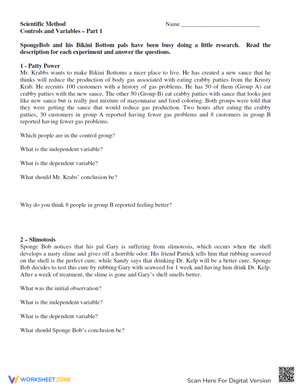
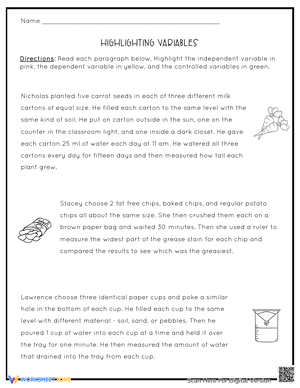
These independent and dependent variables worksheets for 6th grade give teachers a structured path from vocabulary introduction to multi-representation work — scenarios first, then tables, then coordinate graphs, then written rules. The progression matters because students who only sort vocabulary cards rarely transfer the concept when a graph or equation appears without context attached.
What Students Practice Across the Set
Each worksheet targets a distinct layer of the concept rather than cramming every representation into one sitting. The sequence builds meaning deliberately:
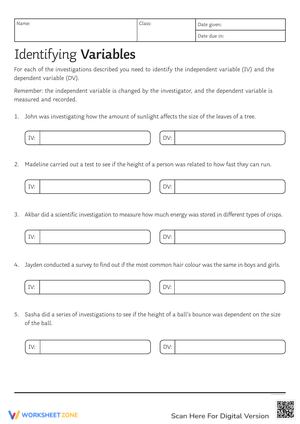
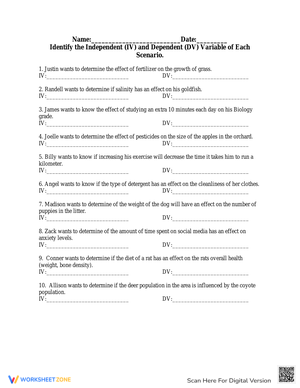
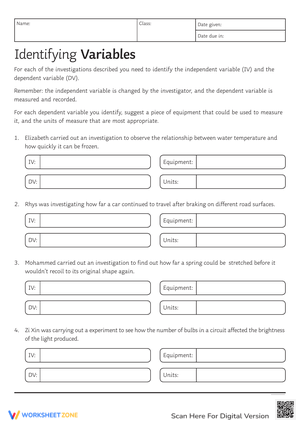
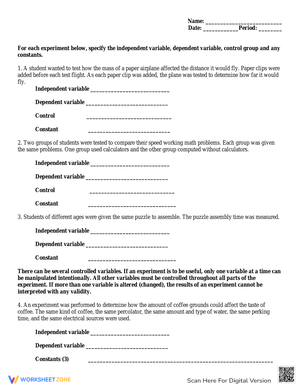
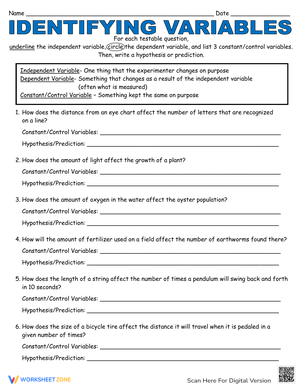
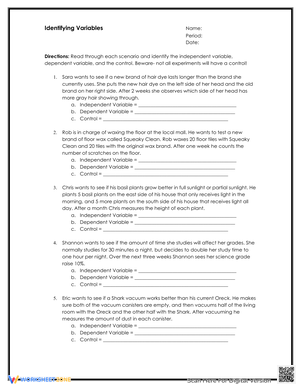
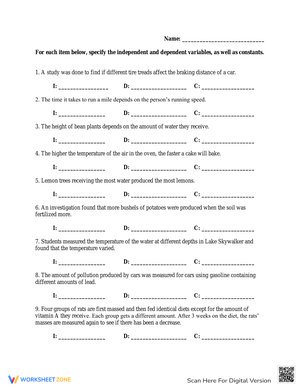
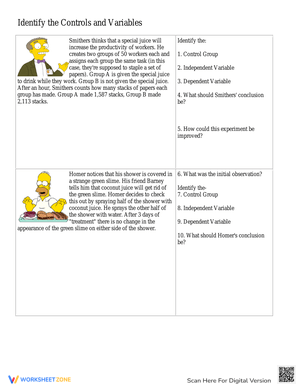
- Scenario identification: Students read a brief real-world situation — hours worked and total earnings, number of apps downloaded and storage used — and decide which quantity is chosen or controlled first.
- Table analysis: Students label input and output columns, trace how the dependent quantity shifts as the independent one changes, and describe the pattern in a complete sentence before moving to any symbolic representation.
- Axis labeling and graph interpretation: Students write what each axis represents in context before plotting or reading points. This step separates students who understand the relationship from those who only remember that x goes horizontal.
- Rule writing: Students express the relationship in words or a simple equation, connecting variable labels to the real-world quantities they stand for.
- Written justification: Several items prompt students to complete a sentence frame: The dependent variable is ___ because it depends on ___. That one sentence, done consistently across problems, reduces the reversal errors that survive multiple-choice practice.
Answer keys accompany each worksheet. Teachers running centers, small-group reteach, or substitute days need answers they can hand off without spending prep time they don't have — and clear keys make it easy to spot which students are still switching the variables before a formal assessment reveals the problem.
Mistakes Students Make That These Worksheets Help You Catch
What separates effective independent and dependent variables worksheets for 6th grade from generic variable practice is item design that forces students to reason about context rather than rely on surface cues. The most common error isn't forgetting the definitions — it's applying them by feel. Students look at a situation involving hours and miles and pick whichever quantity seems "bigger" or "more important" as the independent variable. Redirecting them to a single question — Which quantity can be chosen or set first? — usually corrects this, but they need to apply that question across varied contexts before it becomes automatic.
A subtler problem shows up on graph items. Students who correctly plot (3, 12) and (5, 20) can still explain the axes backward. They've memorized that x is horizontal and y is vertical without connecting those positions to the meaning of input and output. When a worksheet item asks students to write the axis labels in their own words rather than simply marking x and y, the confusion surfaces immediately — and that is exactly the moment when reteaching lands best.
There's also a category of problems — temperature and elapsed time, distance and hours — where students genuinely argue that either variable could be independent. That reasoning isn't entirely wrong, and a well-designed worksheet handles it by specifying who controls the situation. "A scientist records the temperature every hour" tells students that time is being controlled. Items with that level of contextual precision push students toward reasoning about the problem rather than guessing, which is the whole point of the practice.
How to Build These Worksheets Into Your Lesson Plans
The most natural entry point is a short bell ringer — one scenario or one two-column table projected at the start of class. Students write the independent and dependent variable in their notebooks, and the teacher takes two minutes to hear a few responses before moving on. That low-stakes repetition across several days builds more retention than a single extended practice session, and it costs almost no instructional time.
For exit tickets, one item asking students to identify the variables and write the justification sentence provides clearer formative data than five procedural questions at the end of class. If most students reverse the variables on the same type of problem — say, graph items where time appears on the y-axis instead of the x-axis — the teacher knows exactly what to address the next morning rather than moving forward on shaky ground.
Centers work well when each station focuses on one representation: scenario cards at one table, tables at another, graphs at a third. Students rotate through formats rather than encountering all of them on one worksheet in one sitting. That rotation creates natural spacing between representations and reduces the cognitive load of switching modes mid-task — a real concern for students who are still consolidating the core concept.
For intervention groups, start with scenario-only items and hold off on graphs entirely. Students who are still unsure which variable is chosen first won't benefit from coordinate plane practice. They need the underlying concept reinforced in familiar contexts before the visual layer is added.
Adjusting the Set for Students at Different Readiness Levels
Students who are still building confidence do well when the sentence frame is printed directly on the worksheet. The frame — The dependent variable is ___ because it depends on ___ — gives them a structure for reasoning without removing the cognitive work of filling it in. Removing that frame for students who no longer need it is a straightforward adjustment that takes seconds to make when printing.
On-level students benefit from the mixed-format design as written. Moving from scenarios to tables to graphs within one worksheet keeps them from over-relying on any single representation and asks them to transfer the concept across contexts — which is exactly where understanding either holds or breaks down.
Students who have the core concept solid can extend their thinking by writing their own scenarios, then deliberately switching which variable is independent. Turning a "number of gallons pumped determines total cost" problem into a "total budget determines how many gallons can be purchased" problem reveals a depth of understanding that identifying variables in a given context cannot. That kind of reversal task is also a natural lead-in to the function-thinking work that arrives in 7th grade.
Standard Alignment
These worksheets align directly to CCSS 6.EE.C.9: Use variables to represent two quantities in a real-world problem that change in relationship to one another; write an equation to express one quantity, thought of as the dependent variable, in terms of the other quantity, thought of as the independent variable. Analyze the relationship between the dependent and independent variables using graphs and tables, and relate these to the equation.
In classroom terms, 6.EE.C.9 lands near the end of a Grade 6 expressions and equations unit, after students have worked with single-variable expressions and one-step equations. The shift from "solve for x" to "describe how x and y relate to each other" is a meaningful cognitive move — students are beginning to see variables as representing dynamic quantities rather than unknown constants. Independent and dependent variables worksheets for 6th grade that stay anchored to this standard fit exactly where the curriculum places this work, rather than jumping to function notation before students are ready or falling back to pure vocabulary drill once the unit moves on.
Frequently Asked Questions
Can I use individual worksheets from the set without following the full sequence?
Yes. Each worksheet stands on its own and targets a specific representation or skill layer. The recommended order moves from scenario-based items toward graph and rule-writing tasks, but teachers who need to address one representation before a formative check — table analysis before a quiz, for instance — can pull any worksheet without losing coherence.
My students already know the definitions. Will these worksheets still challenge them?
Vocabulary knowledge and conceptual understanding are not the same thing at this grade level. Students who can define both terms often struggle the moment a problem puts time on the y-axis, uses an unfamiliar context, or asks for a written justification instead of a circled answer. The independent and dependent variables worksheets for 6th grade in this set include items built to surface exactly those gaps, not just confirm what students already know.
Are these worksheets appropriate for 7th grade review or 5th grade preview work?
For 7th graders reviewing before a unit on proportional relationships or functions, yes — the mixed-format design works as a focused refresher without feeling like a step backward. For 5th graders, the graph and equation items assume prior comfort with the coordinate plane and basic variable notation, so those worksheets work best with direct teacher support or after confirming that prior knowledge is in place.













 Interactive Worksheet Maker
 Quiz Maker
 Word Search Maker
 Crossword Puzzle Maker
 Word Scramble Generator
 Sentence Scramble Generator
 Handwriting Worksheet Generator
 Name Tracing Generator
 Fill In The Blank Generator