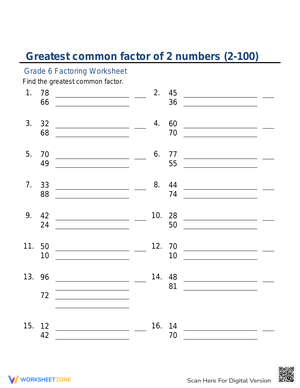
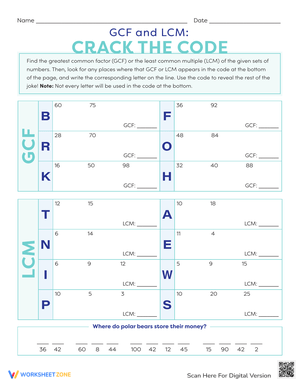
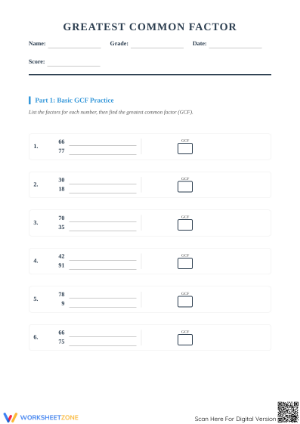
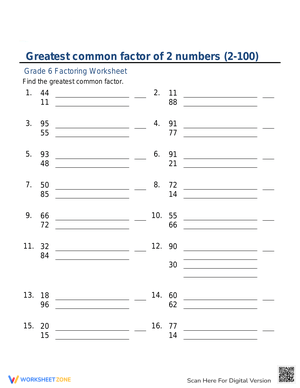
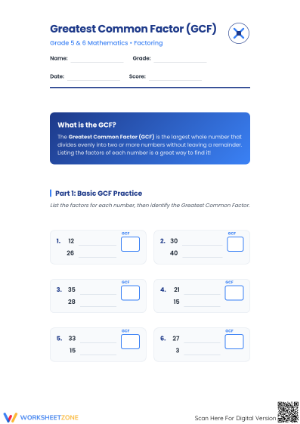
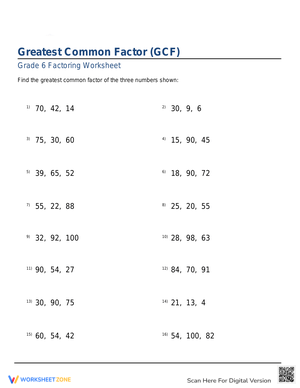
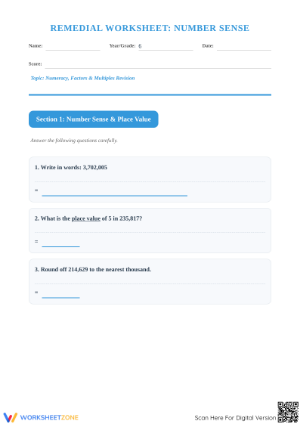
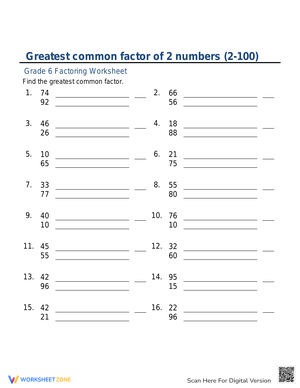
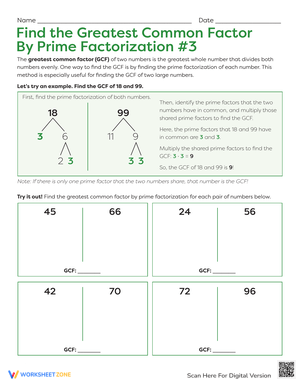
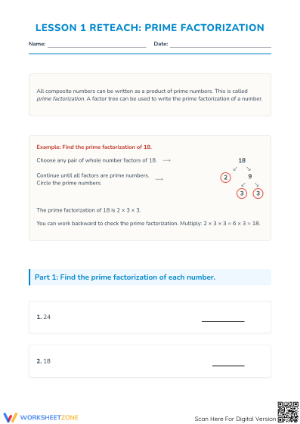
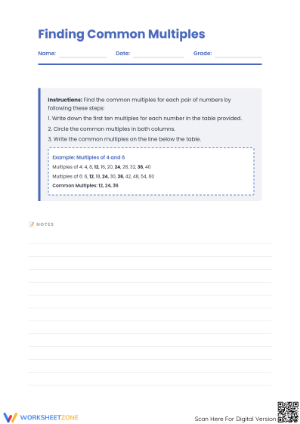
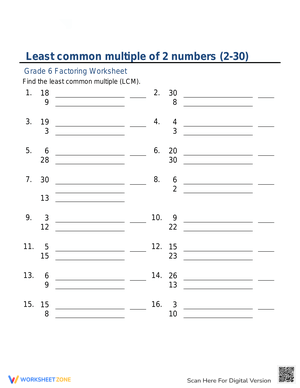
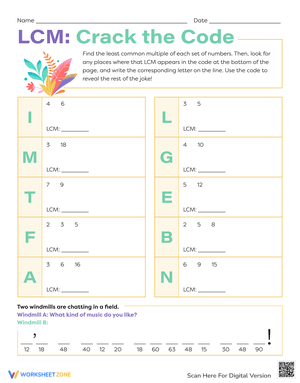
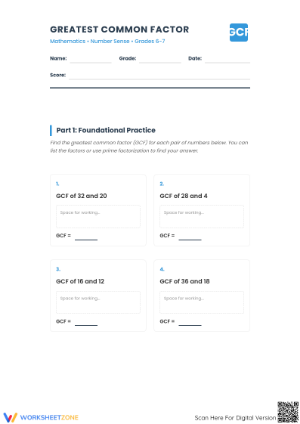
These 6th grade number theory printable worksheets give teachers a focused set of resources for building the factor and multiple fluency students carry into fraction simplification, ratio reasoning, and multi-step problem solving throughout the year. Each worksheet targets one or two specific concepts — factors, multiples, prime and composite numbers, divisibility rules, greatest common factor, or least common multiple — with enough problem variety to support guided instruction, independent practice, and fast review. Answer keys accompany every worksheet.
What Each Worksheet Builds
The set covers number theory in a sequence that reflects how the topics connect and where students most often run into trouble.
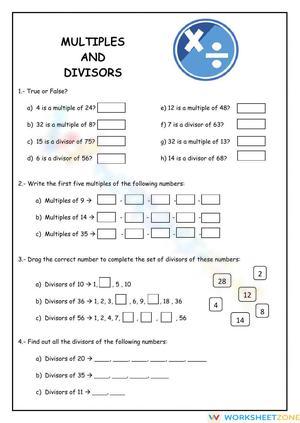
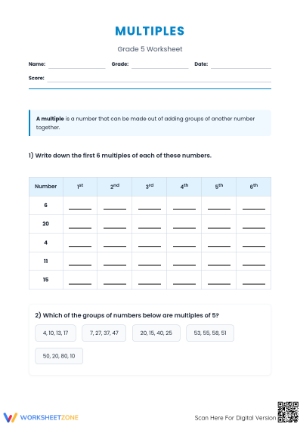
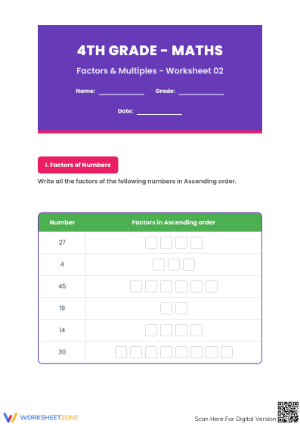
- Factor pairs and multiples: Students list factor pairs for numbers up to 100, identify whether one number is a factor or multiple of another, and compare the two concepts side by side. The comparison step matters — students who confuse factors and multiples at this stage carry that error directly into GCF and LCM problems later.
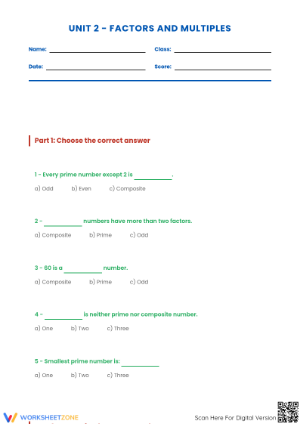
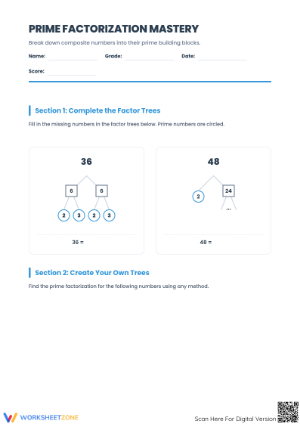
- Prime and composite numbers: Rather than circling primes on a list, students sort, classify, and justify. A worksheet that asks why 51 is composite — because 51 = 3 × 17, and students who skip divisibility-by-3 testing will call it prime — builds more durable understanding than a fill-in-the-blank exercise.
- Divisibility rules: Worksheets address rules for 2, 3, 4, 5, 6, 9, and 10. Students test numbers, identify which rules apply, and in some items work backward from a divisibility condition — given that a number is divisible by 6, what do they know about its digit sum and its last digit?
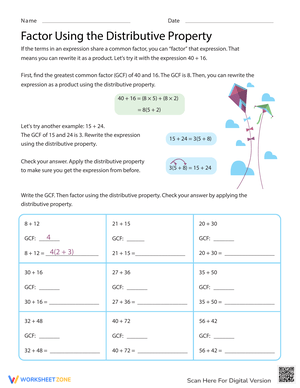
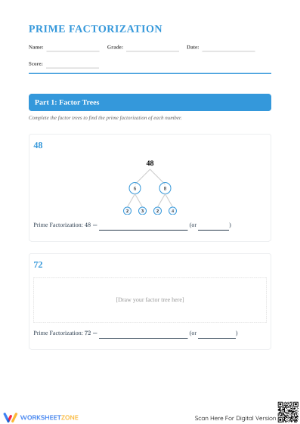
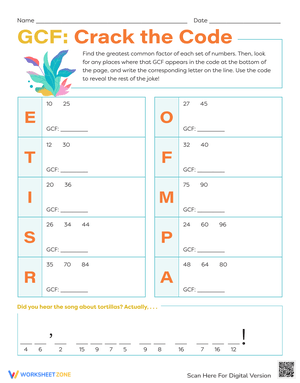
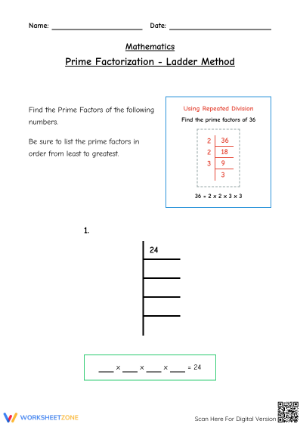
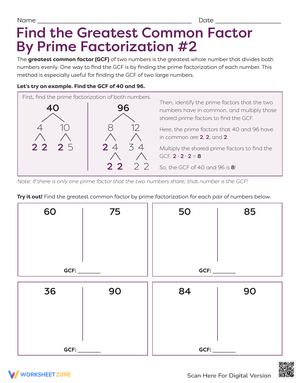
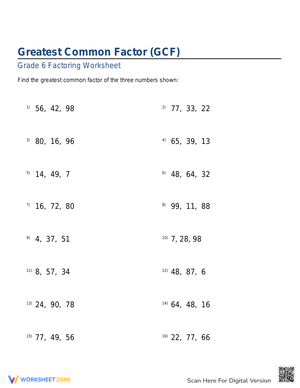
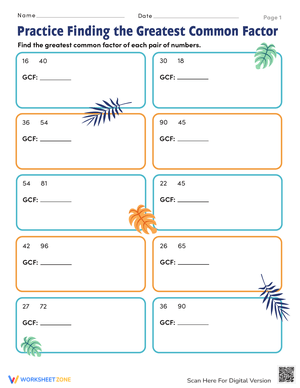
- Greatest common factor: Students find GCF using factor lists, factor trees, and prime factorization, giving teachers flexibility depending on which method has already been introduced during direct instruction.
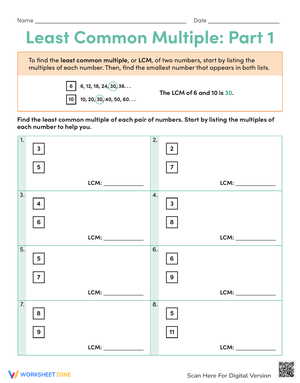
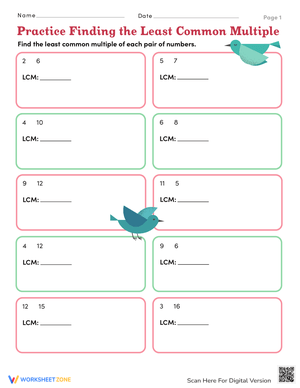
- Least common multiple: Worksheets move from listing multiples by skip counting to applying LCM in short word problems, including repeating-event scenarios where students must recognize that "when do both events happen again?" calls for LCM, not GCF.
- Mixed review: The most diagnostic worksheets in the set ask students to read a problem, identify what it is actually asking for, and then solve. That decision step — before any computation — is where genuine conceptual understanding either shows up or doesn't.
Errors Worth Anticipating Before You Assign These Worksheets
The single most persistent error in 6th grade number theory is the GCF/LCM swap. Students who compute both values accurately when told which to find will still choose the wrong one when problem context determines the operation. A student asked "What is the largest square tile that can cover both a 24-inch and a 36-inch floor without cutting?" will often reach for the LCM because "largest" feels like a signal to produce a bigger number. This error doesn't surface on single-skill practice — it shows up on mixed review, which is exactly why those worksheets belong in the set.
Two other errors appear consistently. Students frequently mark 1 as prime because it "only divides by itself," and worksheets that include 1 on sorting tasks give teachers a clean way to catch that misconception before it calcifies. Separately, students applying the divisibility rule for 6 often apply only the rule for 2, confirming an even number and stopping there. The compound condition — divisible by both 2 and 3 — is a logical structure most students haven't been asked to reason about explicitly. It's worth flagging before they encounter it on an assessment, because the error is invisible until students are asked to justify their answer rather than just circle yes or no.
Building These Worksheets Into Your Lesson Plans
The most effective use of these worksheets is same-day practice immediately after direct instruction, not pre-assessment or end-of-unit review. When students have just received instruction on divisibility rules, assigning the divisibility worksheet that same class period — first four or five items with the class under a document camera, remaining items independently — keeps attention on the concept and gives the teacher real-time data. Waiting until Friday to practice what was taught Monday means students spend days practicing without feedback.
In small-group instruction, targeted worksheets let each group work on exactly what they need. One group works through a GCF worksheet using factor trees while another reviews factor pairs with smaller numbers. Because the directions on each worksheet are self-contained, both groups stay on task while the teacher confers with whoever needs the most support. 6th grade number theory printable worksheets work especially well in this format because the skills are distinct enough that a specific worksheet maps cleanly to a specific need, without hunting for individual problems to cut and reassemble from another source.
For the last ten minutes on a Thursday, the Monday morning warm-up after a school holiday, or the eight minutes before early dismissal, a focused worksheet on prime and composite numbers or LCM fits without requiring any setup. Students who recognize the format don't waste those minutes reading directions — they start working. For substitute plans, pull two or three worksheets that revisit skills students have already practiced. Divisibility rules and factor pair worksheets are the strongest choices here because the tasks are concrete, answer keys are included, and a non-specialist can manage the room without needing content expertise.
Standard Alignment
The primary standard for this set is CCSS 6.NS.B.4, which requires students to find the GCF of two whole numbers less than or equal to 100, find the LCM of two whole numbers less than or equal to 12, and use the distributive property to express a sum as a product with a common factor — for example, rewriting 24 + 36 as 12(2 + 3). The GCF and LCM worksheets in this set target that standard directly, and the number ranges stay within the bounds it specifies.
Prime and composite worksheets extend CCSS 4.OA.B.4, which first introduces those concepts in 4th grade. At the 6th grade level, prime classification functions as a prerequisite skill for prime factorization rather than an endpoint in itself. Students who can decompose numbers into prime factors efficiently arrive at GCF and LCM with less procedural friction. The divisibility rule worksheets don't carry their own CCSS code, but they serve 6.NS.B.4 directly by helping students factorize numbers quickly and verify results without a calculator.
Adapting the Set for Different Learners
For students still consolidating multiplication facts, factor pair worksheets that limit numbers to 50 or below reduce the arithmetic demand enough to keep attention on the concept of divisibility itself. Providing a multiplication reference chart alongside those worksheets is a reasonable classroom support — the learning goal is understanding factor relationships, not retrieval speed. These students may also need the divisibility worksheets divided into stages: rules for 2, 5, and 10 first, then rules for 3, 6, and 9 once the pattern-based logic starts to make sense.
Students who are ready for more challenge benefit from worksheets that raise the decision-making demand. Finding the GCF of three numbers rather than two, working with LCM in word problems that involve three different repeating intervals, or explaining in writing why 36 and 48 share a GCF of 12 — these tasks extend the same concepts without reaching for entirely different content. A short justification prompt is particularly useful at this level because it distinguishes students who have internalized the reasoning from those who have memorized a procedure and can execute it in one context but not transfer it.
The mixed-review worksheets are harder to adjust on the fly because the challenge sits in the decision step, not the computation. For students who find those worksheets overwhelming, one useful intermediate step is to have them sort problems by type — divisibility check, GCF, or LCM — before solving any of them. That separation makes the classification visible and gives the teacher a clear window into where the confusion sits. These 6th grade number theory printable worksheets hold their value across a wide range of students because the concepts themselves span from basic identification to applied reasoning, and the difficulty can be adjusted at the task level without changing the underlying math.
Frequently Asked Questions
Do these worksheets require a specific sequence, or can teachers pull individual ones as needed?
Each worksheet stands on its own and can be assigned without using any others in the set. Teachers planning a full number theory unit will find the arrangement logical — factors before GCF, multiples before LCM — but pulling a single divisibility worksheet for a mid-unit review or reteach works just as well without adjusting anything else.
How many problems does each worksheet include?
Problem counts vary by task type. Skill-focused worksheets — factor pairs, divisibility checks, listing multiples — generally include 12 to 20 items. Mixed-review and application worksheets include fewer problems, typically 8 to 12, because each item requires more student work to complete and the decision-making step adds time.
Are these worksheets appropriate for 5th or 7th grade use?
Fifth grade teachers introducing GCF and LCM as early enrichment or 7th grade teachers using these 6th grade number theory printable worksheets as a prerequisite refresher before rational number units will find the content accessible without modification. The number ranges and problem types are calibrated to the 6.NS.B.4 standard, which is where this content lives in the standard progression.
How do mixed-review worksheets differ from single-skill practice?
Single-skill worksheets tell students which operation or concept to apply. Mixed-review worksheets do not — students read the problem, determine what it is asking for, and then solve. That additional decision layer reflects how these concepts appear on state assessments, where a problem's context signals whether GCF, LCM, or a divisibility check is needed, not a section header. Assigning a mixed-review worksheet the week before a unit test gives teachers concrete data on which skills have transferred and which still need direct attention.













 Interactive Worksheet Maker
 Quiz Maker
 Word Search Maker
 Crossword Puzzle Maker
 Word Scramble Generator
 Sentence Scramble Generator
 Handwriting Worksheet Generator
 Name Tracing Generator
 Fill In The Blank Generator