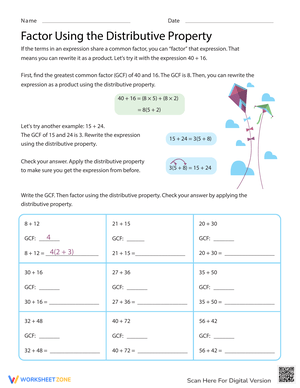
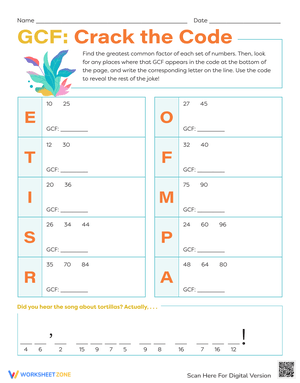
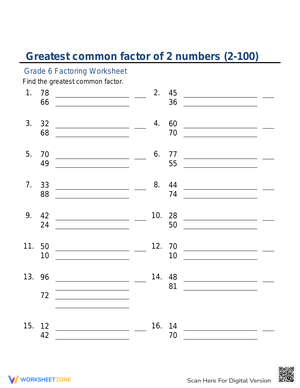
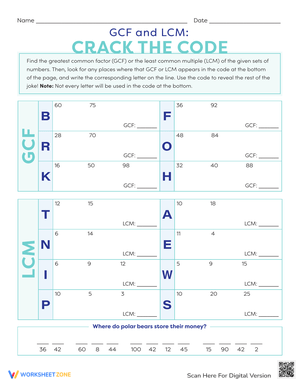
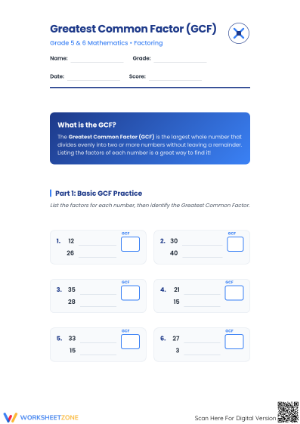
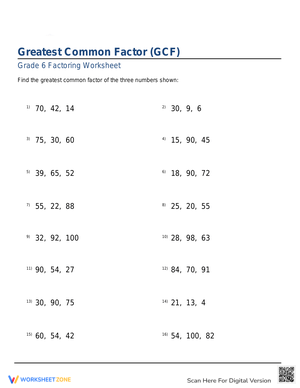
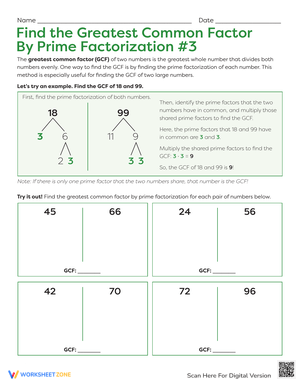
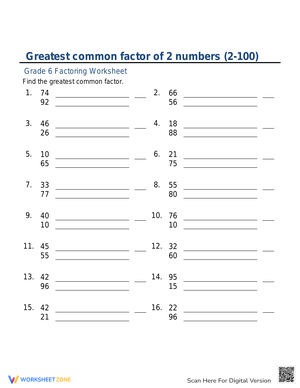
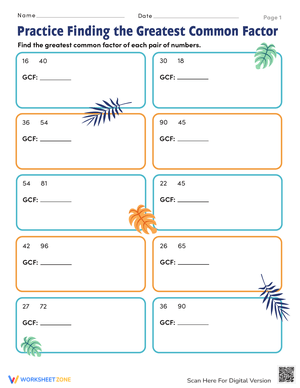
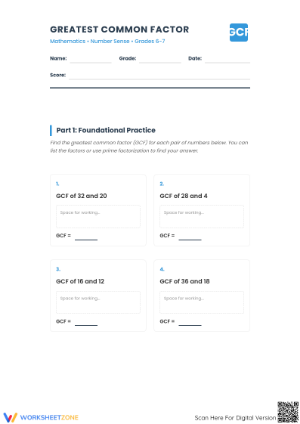
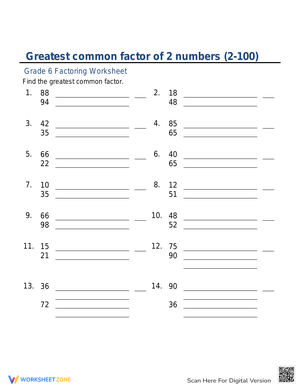
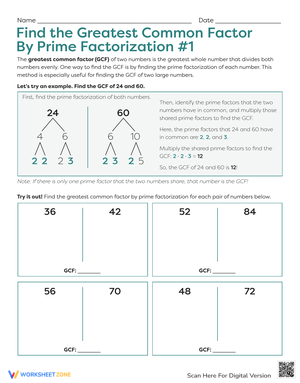
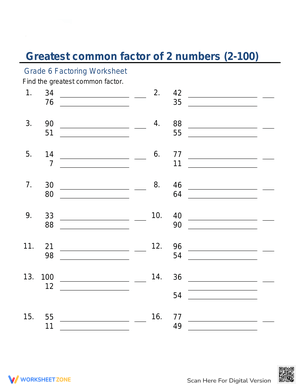
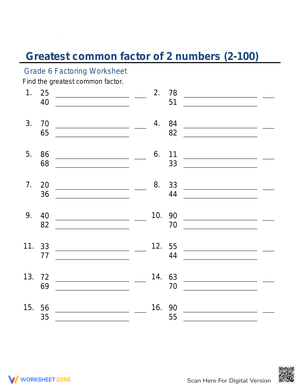
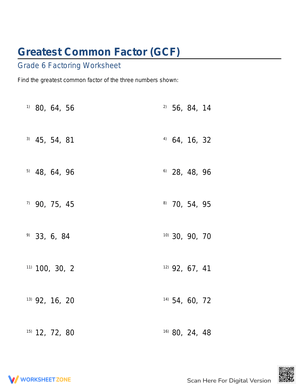
These greatest common factor printable worksheets for 6th grade give teachers a ready set of resources that move students from factor fluency to applied problem solving without requiring separate prep at each stage of the unit. Factor listing, prime factorization, GCF of two and three numbers, and short real-world grouping problems are distributed across the set, so teachers have what they need for several connected days of number theory work.
Grade 6 is when the curriculum asks students to do more than name factors. They need to find the largest factor two or more numbers share, decide which method is more efficient for the numbers in front of them, and recognize when greatest common factor is the correct operation inside a word problem. That's a more layered demand than fourth- or fifth-grade factor work, and it's why practice that builds in deliberate stages matters here — students who skip steps tend to hit a wall once fractions enter the picture.
Skills and Problem Types Across the Set
The worksheets open with factor fluency before introducing GCF methods, because students who can't generate a factor list quickly will struggle with every technique that follows. Each subsequent worksheet increases the cognitive demand in a specific, targeted way:
- Factor review: listing all factors of a number, identifying factor pairs, and distinguishing factors from multiples
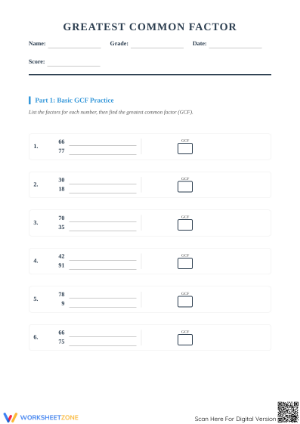
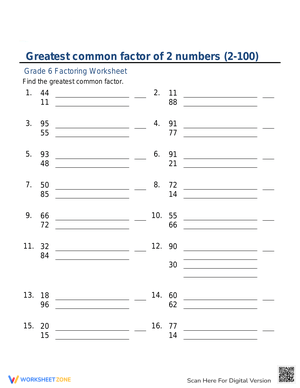
- GCF of two numbers — factor listing: students write out all factors for each number, circle shared ones, and name the greatest
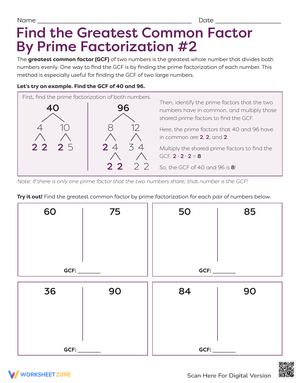
- GCF of two numbers — prime factorization: students identify which prime factors appear in both numbers and multiply only those
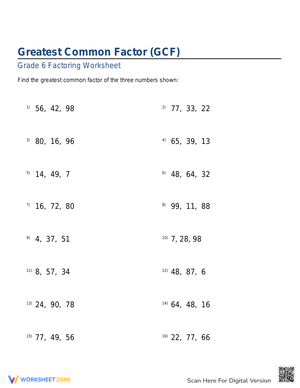
- GCF of three numbers: students extend the same reasoning to a set where all three numbers must share the factor
- Method comparison: students solve the same problem using both approaches and explain which was more efficient for those particular numbers
- Application problems: short grouping scenarios where students decide that GCF is the right operation before solving
- Fraction connection: using GCF to simplify a fraction to lowest terms, bridging directly into later unit work
The later worksheets in the set include error analysis items — a worked problem with a mistake embedded in it. Students identify where the reasoning went wrong and write a corrected solution. These work especially well in partner settings because students have to name the error out loud rather than fix it silently on their paper.
Where Student Reasoning Breaks Down in GCF Practice
The most consistent mistake — and the most persistent one — is stopping at the first shared factor rather than the greatest one. A student comparing 18 and 24 might notice that 2 and 3 are both factors of each number and stop there, writing 3 as the answer. They never checked whether 6 is also shared. Factor listing worksheets expose this immediately because you can see exactly where the student's list ended and whether they compared systematically or grabbed the first match they noticed.
Prime factorization brings a different, equally predictable error: students multiply all the prime factors from both numbers together instead of identifying only the ones the numbers have in common. With 12 (2 × 2 × 3) and 18 (2 × 3 × 3), a student following this misrule multiplies 2 × 2 × 3 × 3 and writes 36 — which is actually the least common multiple. This confusion between GCF and LCM through prime factorization is nearly invisible when students only write final answers. Step-by-step worksheets, where students record factor trees and mark shared prime factors explicitly, surface the error in the work itself rather than leaving it buried under a wrong number.
Three-number GCF problems reveal a third pattern. Students correctly find the GCF of the first two numbers, then treat that result as final without checking whether it also divides the third. They've solved a two-number problem and ignored the added constraint entirely. Dedicated practice with three-number items catches this before it becomes automatic.
Lesson-Planning Moves That Get the Most From These Worksheets
A three- to five-problem factor warm-up at the start of class is one of the lowest-effort, highest-payoff uses of the set. Students reactivate prior knowledge during the first eight minutes of class, and you can see immediately — before the lesson begins — whether factor fluency is solid or whether the class needs more time on that foundation. During direct instruction, project one worked example and have students complete the matching items on a worksheet using two methods simultaneously. The immediate application right after modeling reduces the chance that new steps fade before they're practiced.
Greatest common factor printable worksheets for 6th grade also map well onto center rotations. Place a computation-focused worksheet at the independent station and an application worksheet at the teacher-led table, where you can ask students to explain why GCF applies in each scenario before they solve. For homework, shorter computation worksheets come back more accurate than longer mixed sheets — sending home a focused eight-problem worksheet the night before a fraction simplification lesson means students arrive already thinking about shared factors, which makes the next day's instruction noticeably smoother.
In intervention, start with number pairs that have obvious, large common factors — 12 and 18, 20 and 30 — before moving to pairs like 42 and 56 where the factor lists are longer and the GCF is less obvious. Each worksheet targets a specific number range and problem type, so choosing the right starting point for a small group is a matter of selecting the appropriate worksheet rather than rebuilding materials from scratch.
Tailoring the Set for Students at Different Readiness Levels
For students still building confidence with factor lists, write a factor bank in the margin before printing. The student uses the bank to identify shared factors and determine the greatest, working the same problems as everyone else but without spending mental energy on the listing step itself. This keeps the focus on the reasoning — which factors are shared, which is greatest — rather than the recall task of generating all factors of 36 under time pressure.
For students ready for a challenge, swap the number pairs. Replacing 18 and 24 with 84 and 126 turns a routine item into a problem that rewards careful, organized work. Greatest common factor printable worksheets for 6th grade with larger numbers also serve as a natural bridge toward seventh-grade rational number work, where factor reasoning appears inside multi-step problems. The most advanced students can write their own grouping word problems, choosing numbers intentionally and explaining why GCF is the right strategy — a task that reveals understanding that a standard computation problem never will.
GCF as a Bridge Concept in Grade 6
Greatest common factor lands in the sixth-grade standards because it does real work in the fraction unit that follows. When students understand that dividing numerator and denominator by their GCF produces the simplest form, fraction simplification stops feeling like an arbitrary rule and starts feeling like a logical step. Worksheets that include a few fraction simplification items inside the GCF set let students make that connection while the number theory is still fresh — rather than rediscovering it weeks later when fractions are already the main topic.
The real-world grouping problems carry a different kind of value. A problem asking students to arrange 48 chairs and 36 tables into the largest equal groups — where both quantities divide evenly — gives them a reason to find the GCF that goes beyond completing an assignment. This is what makes greatest common factor printable worksheets for 6th grade worth returning to across the unit: repeated application problems build the habit of asking "Is this a GCF situation or an LCM situation?" before solving — a question that, once automatic, makes subsequent fraction and ratio work more grounded for nearly every student.
Frequently Asked Questions
How many methods do these worksheets cover?
The set covers factor listing and prime factorization. Several worksheets ask students to solve the same problem both ways and note which approach was more efficient for those numbers. Venn diagrams appear in selected worksheets as a visual organizer for prime factorization — particularly useful when students are sorting shared versus unique prime factors before multiplying.
Are these worksheets appropriate to use before students have learned prime factorization?
Yes. The factor listing worksheets come first and don't assume any familiarity with prime factorization. Teachers can assign those worksheets early in the unit, introduce prime factorization through direct instruction, and then move students to the prime factorization worksheets in the set once that method has been taught.
How do these worksheets address the GCF versus LCM confusion?
Several worksheets include both GCF and LCM items in the same problem set, clearly labeled. Students practice identifying which concept a question is asking for — not just computing each one in isolation. Vocabulary prompts built into the directions keep the language of both concepts present during practice, not only on the day each was first introduced.
Can these worksheets function as a formative assessment?
Easily. Because students show their factor lists or prime factor trees rather than writing only final answers, a quick scan of the class set tells you exactly where reasoning broke down. You can see whether students stopped at the first shared factor, whether prime factorization errors point to an LCM-GCF confusion, or whether three-number items are being quietly reduced to two-number problems. That specificity makes these worksheets more useful as a diagnostic than a single-answer check would be.













 Interactive Worksheet Maker
 Quiz Maker
 Word Search Maker
 Crossword Puzzle Maker
 Word Scramble Generator
 Sentence Scramble Generator
 Handwriting Worksheet Generator
 Name Tracing Generator
 Fill In The Blank Generator