


























Views
Downloads

Common Multiples Worksheet | Grade 6 Math Essential
Paste this activity's link or code into your existing LMS (Google Classroom, Canvas, Teams, Schoology, Moodle, etc.).
Students can open and work on the activity right away, with no student login required.
You'll still be able to track student progress and results from your teacher account.
Master common multiples and LCM with this comprehensive Grade 6 math worksheet. Students practice systematic listing and identification of shared multiples between number pairs to build a strong foundation for fraction operations and algebraic thinking. This printable resource ensures students move from basic listing to conceptual mastery of the Least Common Multiple (LCM).
At a Glance
- Grade: 6 · Subject: Math
- Standard:
CCSS.6.NS.B.4— Find the least common multiple of two whole numbers less than or equal to 12- Skill Focus: Finding Common Multiples and LCM
- Format: 4 pages · 7 tasks · Answer key included · PDF
- Best For: Independent practice and formative assessment
- Time: 20–30 minutes
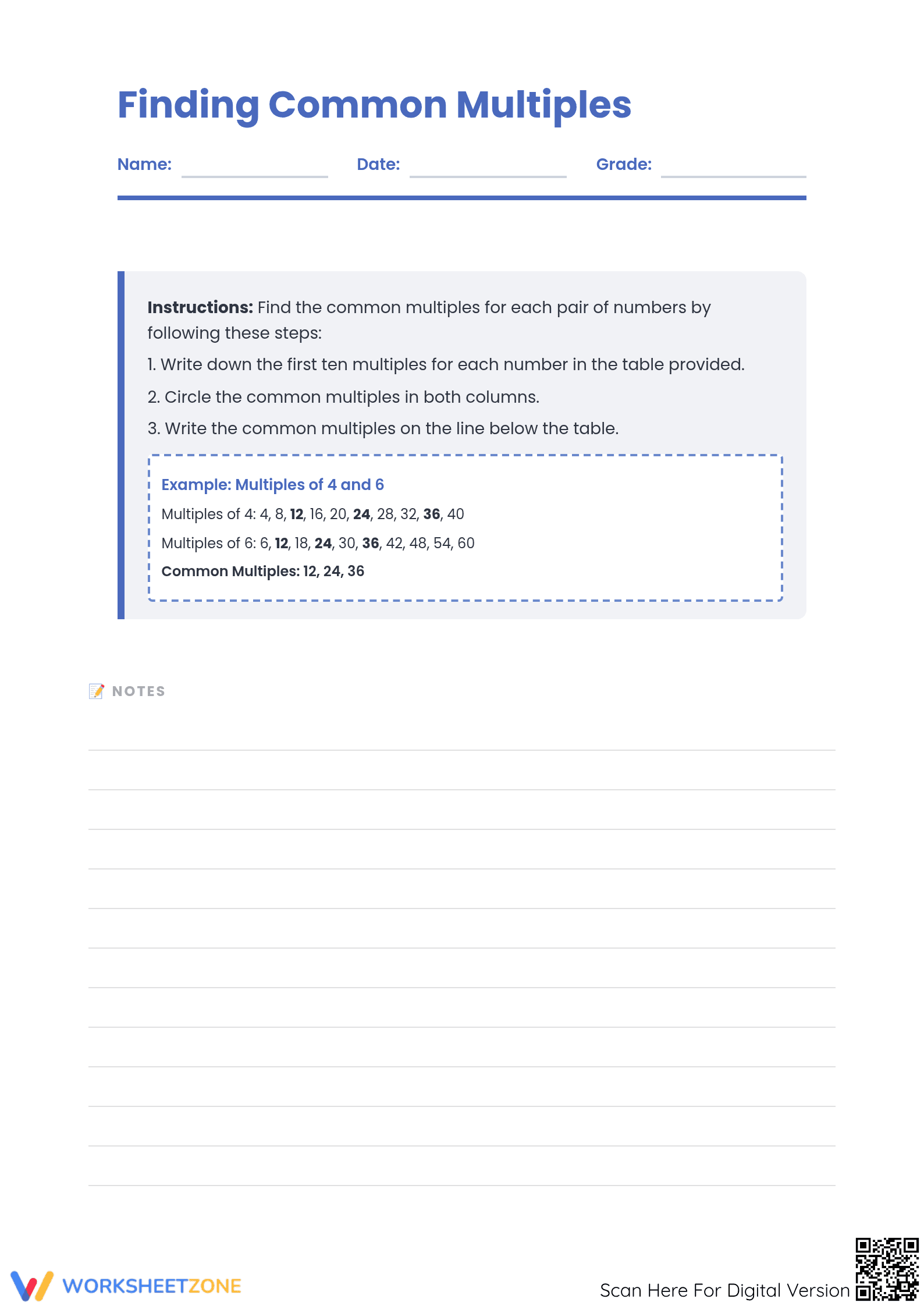
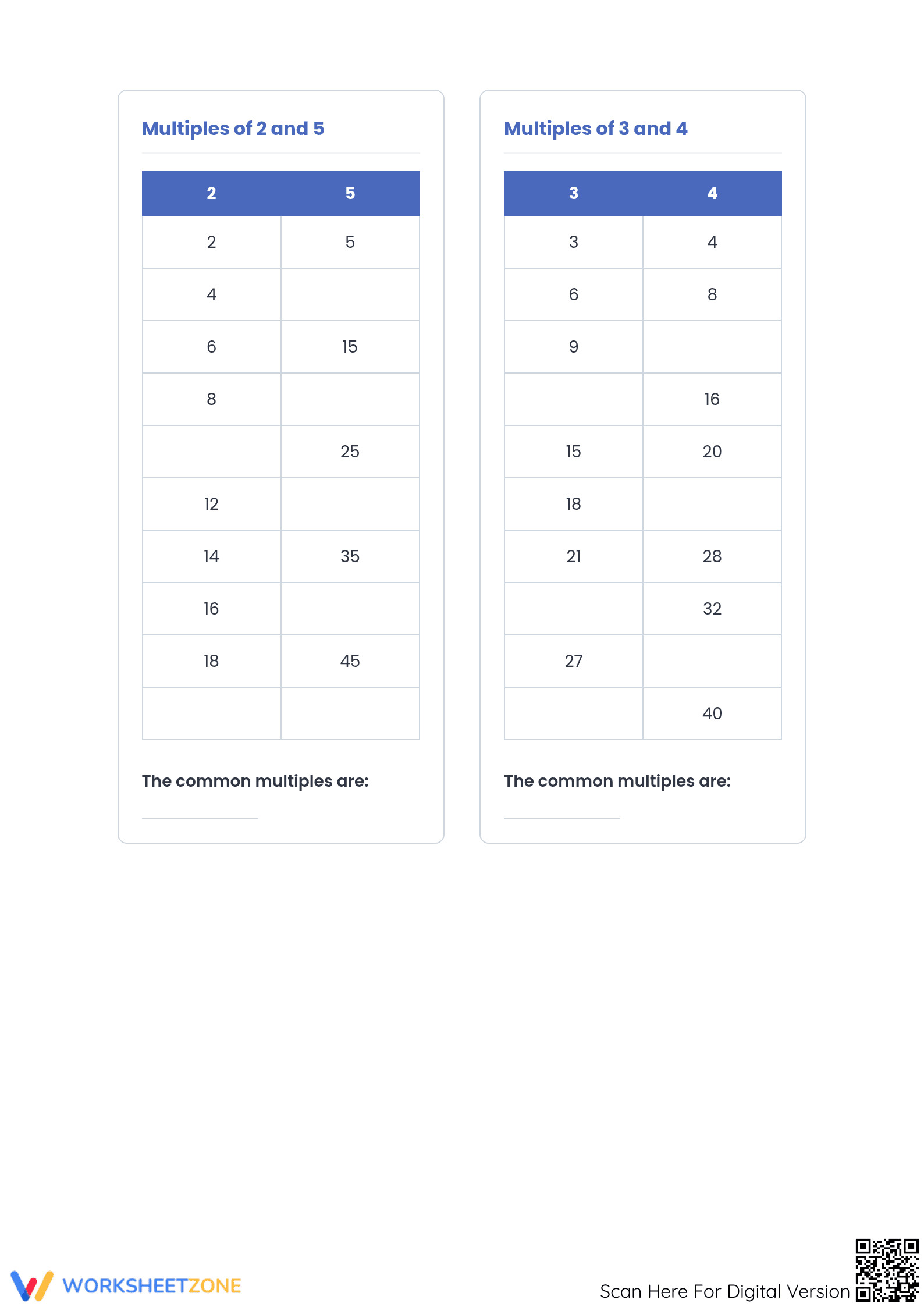
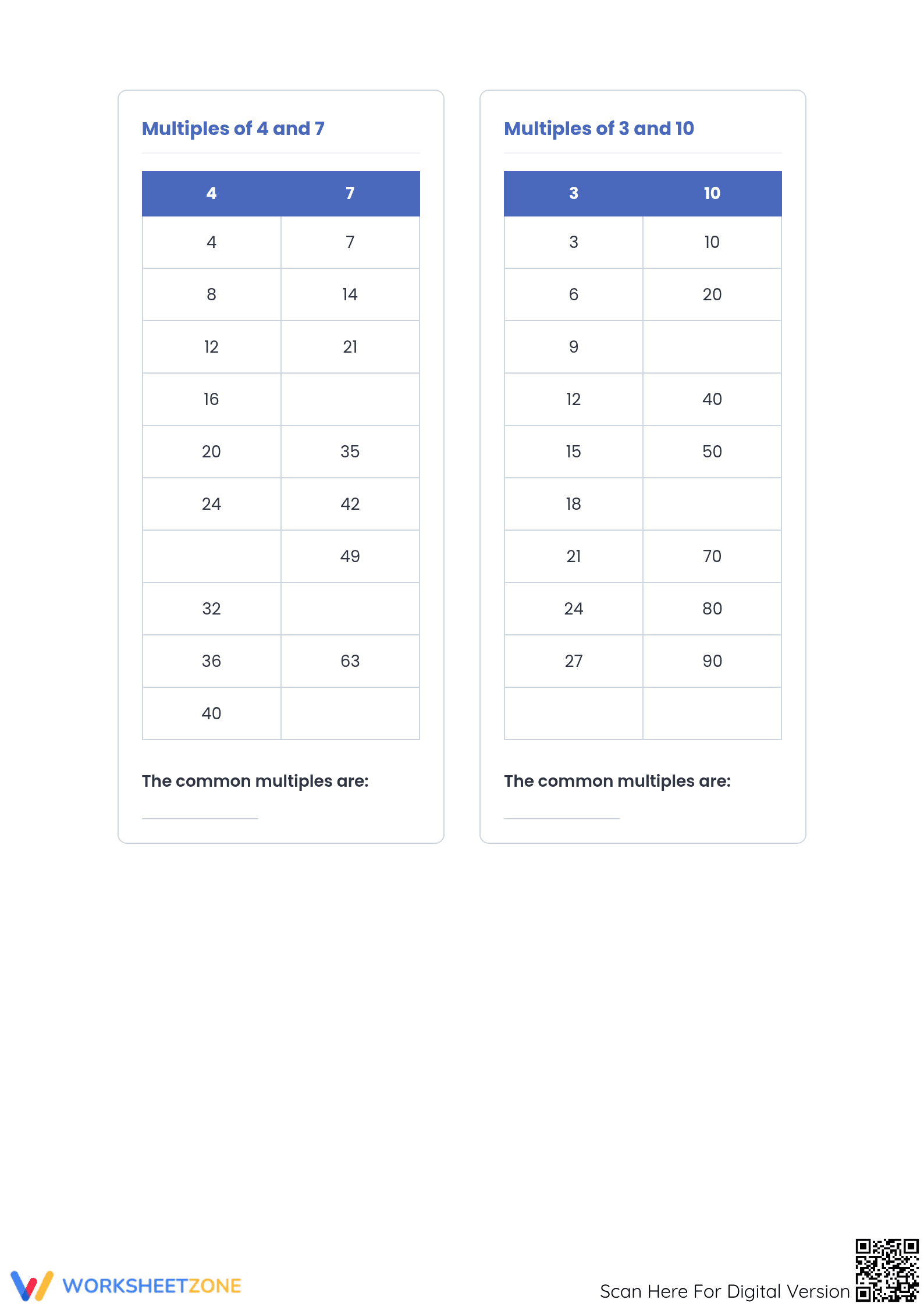
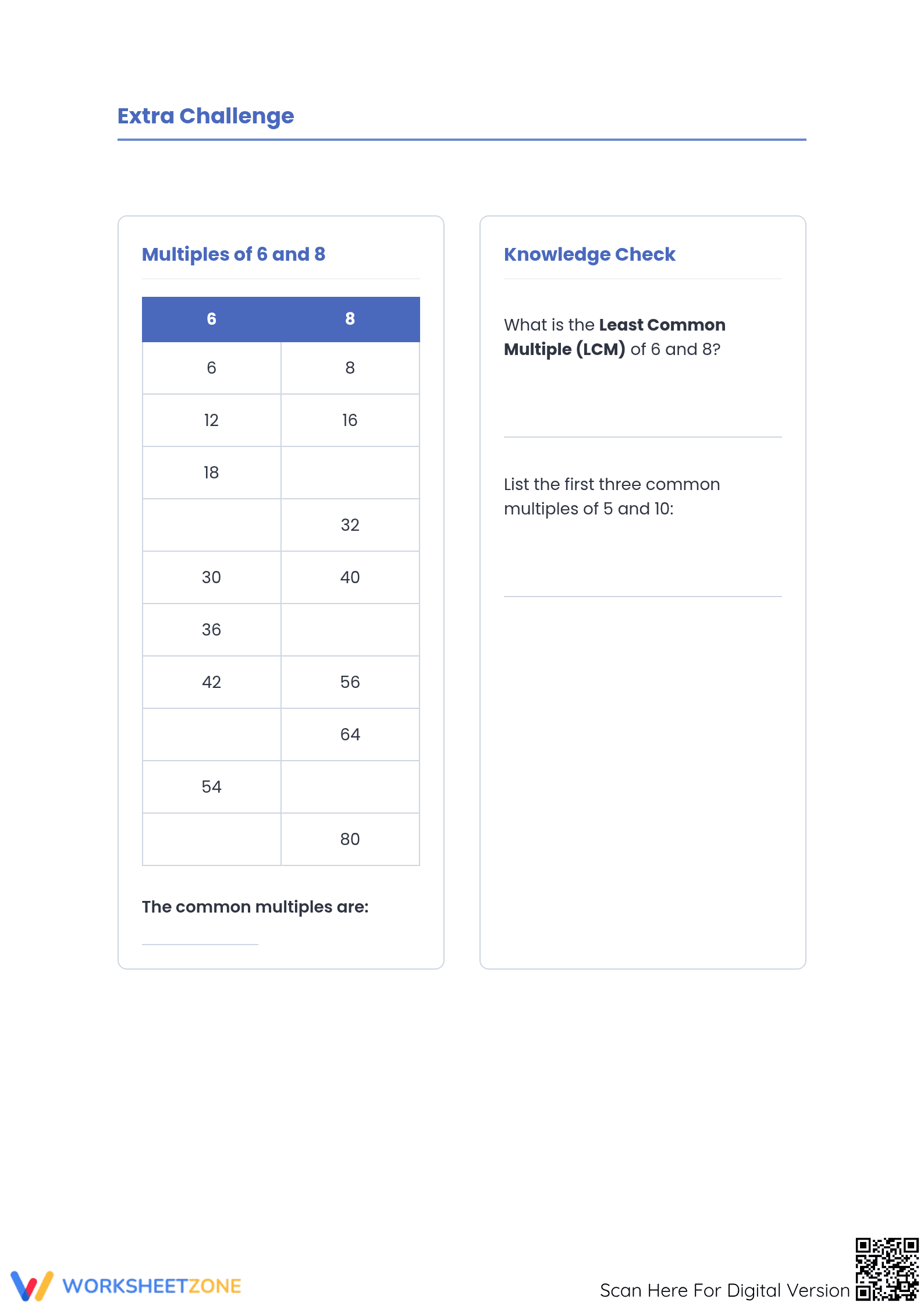
This 4-page PDF contains five structured listing tables and a dedicated "Extra Challenge" section. Each table provides a dual-column format for students to list the first ten multiples of specific number pairs, such as 2 and 5 or 4 and 7. The worksheet includes a clear instructional header with a worked example, a notes section for strategy drafting, and a final knowledge check targeting the Least Common Multiple (LCM).
- Guided practice: Students begin with common number pairs like 2 and 5, using the provided table structure to list ten multiples and circle overlaps for immediate visual reinforcement.
- Supported practice: The complexity increases with pairs such as 4 and 7, requiring students to maintain accuracy across longer listing tasks without losing focus on the commonalities.
- Independent practice: Students conclude with an "Extra Challenge" table for 6 and 8, followed by abstract assessment questions that test the definition of LCM without visual scaffolding.
This progression follows the gradual-release model, moving from scaffolded listing to independent identification of the least common multiple.
This resource is strictly aligned to CCSS.MATH.CONTENT.6.NS.B.4. Students find the least common multiple of two whole numbers less than or equal to 12. By systematically listing multiples, students develop the procedural fluency required to find common denominators and solve real-world problems. This standard code can be copied directly into lesson plans, IEP goals, or district curriculum mapping tools.
Assign this worksheet during the independent practice phase of a lesson to verify student understanding. It serves as an excellent formative assessment tool; teachers should observe if students are correctly identifying the first common multiple as the LCM. For best results, use this after direct instruction on the listing method. Expected completion time is 20 to 30 minutes.
Designed for 6th and 7th-grade math students, this worksheet is ideal for learners needing concrete visual organization. It can be differentiated by providing a multiplication chart for students struggling with basic facts. Pair this resource with a short video on real-world LCM applications, such as synchronized timing or gear rotations.
Aligned to CCSS.6.NS.B.4, this worksheet focuses on the fundamental skill of finding common multiples and the Least Common Multiple (LCM) for whole numbers up to 12. According to Fisher & Frey (2014), the use of structured graphic organizers, such as the listing tables provided here, is essential for reducing cognitive load during the initial stages of procedural skill acquisition in mathematics. By requiring students to list ten multiples before identifying commonalities, the resource ensures they develop the necessary grit and systematic approach for more complex number theory topics. This systematic listing method is recognized as a high-leverage practice that bridges the gap between basic multiplication and advanced fraction computation. The inclusion of a challenge section allows for immediate application of learned skills in an evaluative context, providing teachers with clear evidence of student mastery levels.


