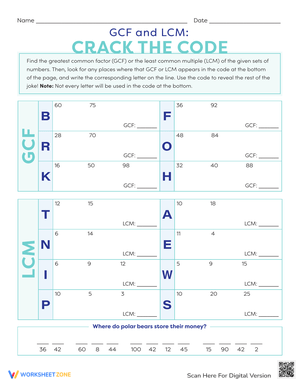
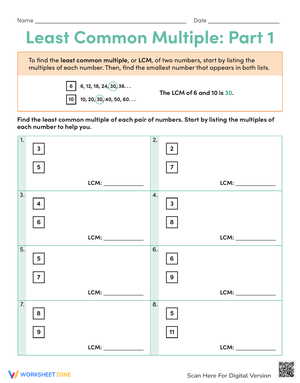
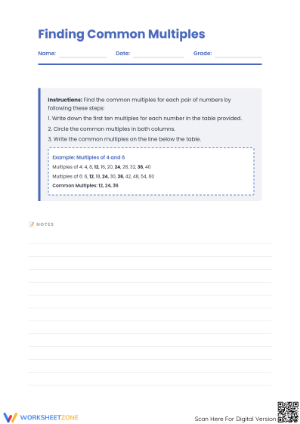
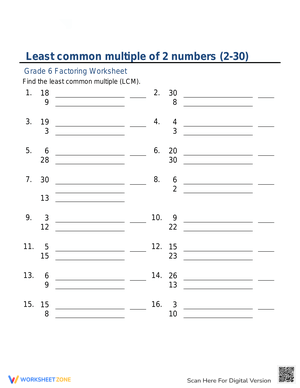
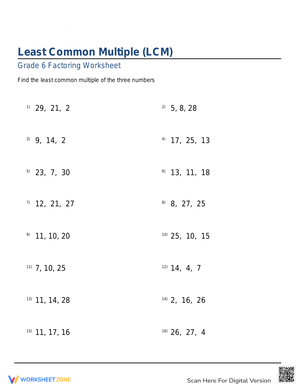
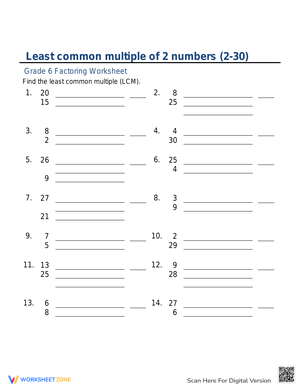
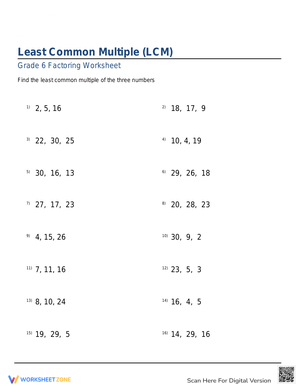
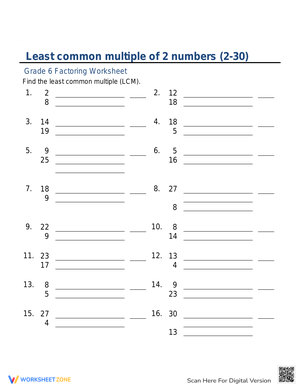
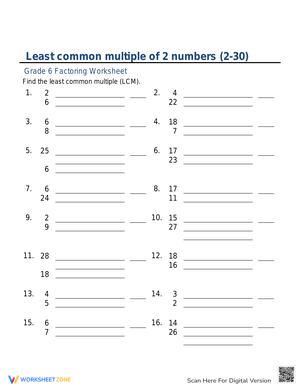
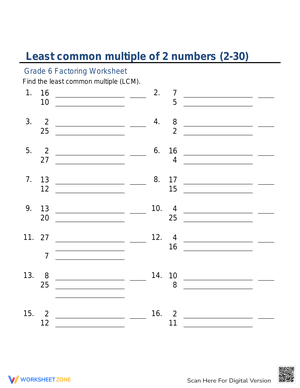
These 6th grade least common multiple printable worksheets resources give teachers structured number theory practice that fits naturally into the factors-and-multiples sequence most Grade 6 programs run during the first semester. The set moves students from listing multiples for simple pairs all the way through prime factorization with larger composites, and includes word problems that require students to recognize when LCM applies — not just how to compute it. That distinction between knowing a procedure and knowing its context is where most 6th graders need the most work.
What Each Worksheet Targets
The problem types span the full range of LCM skills a Grade 6 unit requires, organized so individual worksheets can be assigned at the right instructional moment rather than distributed all at once. On the computation side, students list multiples for number pairs, prime factor composite numbers, and extend LCM to three-value sets once two-number work is solid. The set also includes problems requiring students to determine whether a situation calls for LCM or greatest common factor — a deliberate design choice, because that distinction is where misconceptions concentrate at this grade level.
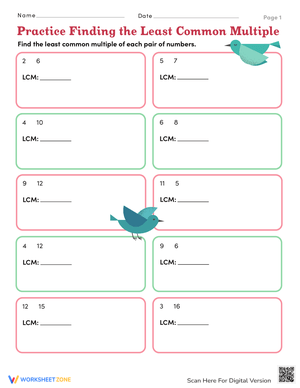
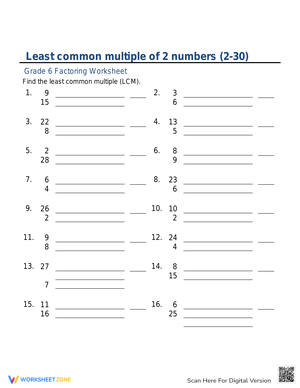
- Listing multiples: Students write multiples of each number in order and mark the first shared value. Number pairs are selected so the LCM appears early in the list, keeping the listing task manageable while making the concept visible.
- Prime factorization method: Students break each number into prime components and build the LCM by taking the highest power of each prime — the more efficient approach for composites like 24 and 36, where listing runs long.
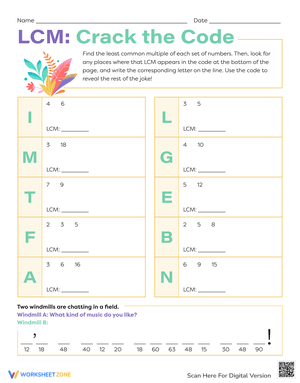
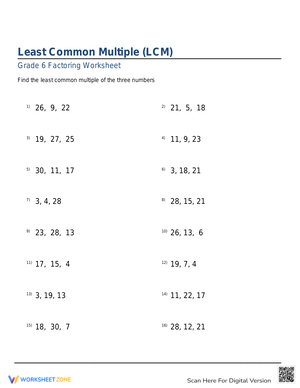
- Three-number LCM: Problems that extend the concept beyond pairs, which surfaces students who've been pattern-matching on two-number sets without fully understanding the method.
- Concept identification: Problems that ask students to decide whether LCM or GCF applies before computing anything — no label given, just context.
- Word problems: Repeating schedules, cycling events, and grouped quantities where students must extract the numbers, set up the LCM correctly, and interpret what the answer means in context.
Student Error Patterns to Catch Before They Harden
The most predictable computational mistake is also the most persistent: students multiply the two numbers together and label the product as the LCM. For 4 and 6, that gives 24 — which is a common multiple but not the least one. The correct answer is 12. This shortcut appears in student work so reliably that the set includes several problems where the product and the LCM differ by a wide enough margin to make the error unmistakable, giving teachers a clean diagnostic signal early in the unit.
With prime factorization, the classic confusion is combining all prime factors from both numbers rather than taking the highest power of each. For 4 and 6: 4 = 2 × 2 and 6 = 2 × 3. The correct LCM is 2² × 3 = 12. A student making this error writes 2 × 2 × 2 × 3 = 24, treating the shared factor of 2 as a separate contribution from each number instead of recognizing it appears only once in the final expression. When 24 shows up repeatedly on prime factorization problems for this pair, that's a reliable signal the student needs a worked example on the board before moving on.
The LCM-versus-GCF confusion runs deeper than most teachers expect. Students often apply LCM correctly on one problem and reach for GCF on the very next if the context shifts slightly. This usually isn't a vocabulary gap — students know the definitions. The issue is that they haven't built the situational understanding of what each concept is actually finding. Word problems that present both types without flagging which concept applies are the fastest way to expose this, and several worksheets in this set are structured that way deliberately.
Fitting These Worksheets Into Your Weekly Instruction
When teachers fold 6th grade least common multiple printable worksheets resources into daily routines rather than treating the set as a one-time packet, retention improves noticeably. The strongest use pattern is to assign a focused worksheet immediately after direct instruction on each method, then return to the same skill three or four days later with two or three warm-up problems pulled from a different worksheet. That brief return takes under five minutes and does more for long-term retention than extending the same-day practice block.
Bell ringers work particularly well with LCM because the computation is self-contained. Display two or three problems on the board before class starts, and students who arrive early begin working while the rest pick it up during the first couple of minutes. Unlike some warm-ups that require context from a prior lesson, LCM problems can be read cold — which makes them low-overhead to set up and easy to use Monday morning when students need a clean re-entry into the week.
Word-problem worksheets belong at the end of the unit sequence, not the middle. When students encounter context problems before they trust their computation, the reading demands compound the mathematical thinking in ways that generate frustration more than learning. Once students can find LCM reliably on straightforward problems, the word-problem worksheet shifts from overwhelming to clarifying — students start to see what LCM actually represents rather than treating it as abstract calculation.
Standard Alignment
These worksheets align to CCSS 6.NS.B.4, which asks students to find the least common multiple of two whole numbers less than or equal to 12, alongside greatest common factor and an introduction to the distributive property. In most Grade 6 classrooms, LCM doesn't stand alone — it lives inside a three- to four-week number theory cluster, typically taught in the fall before fraction operations, where LCM becomes immediately applicable for finding common denominators. Worksheets in this set include problems within the standard's number range as well as extension problems with larger composites for students ready to work beyond the grade-level floor. For teachers assessing 6.NS.B.4 directly, the listing-multiples and paired-computation worksheets address the standard's core expectations most closely.
Matching the Set to Student Readiness
Students still developing multiplication fluency get the most from 6th grade least common multiple printable worksheets resources that stay within familiar fact pairs — 3 and 4, 2 and 5, 4 and 5 — rather than those that move immediately into larger composites. For those students, allowing a multiplication reference during listing tasks removes fact retrieval as an obstacle without removing the conceptual work. The goal at this stage is understanding what shared multiples are and why the least one matters; the reference handles one layer so attention stays on the other.
On-level students do their best thinking on worksheets that mix both methods without specifying which to use. The moment students have to choose between listing and prime factorization, they're making a judgment about efficiency. A student who naturally lists for LCM(6, 10) and shifts to factorization for LCM(24, 36) is reasoning about numbers. A student who applies the same method to every problem regardless of number size is executing a procedure — a meaningful distinction when you're deciding whether to reteach or move on.
Advanced students benefit from three-number LCM problems, schedule-based word problems, and tasks that ask them to explain why one method was more efficient for a given pair. Asking advanced students to construct their own word problems that require LCM — rather than GCF — is a generative extension that reveals genuine conceptual understanding without requiring additional materials on your end.
Frequently Asked Questions
Should listing multiples or prime factorization be taught first?
Start with listing multiples. It's concrete, it directly shows students what a multiple is, and it confirms the concept before prime factors enter the picture. Prime factorization is more efficient for larger composites, but efficiency only matters once students understand what they're solving for. Most 6th graders are ready to transition after two or three lessons with listing, and pairing both methods on the same problem — so students see that two different approaches produce the same answer — is the clearest way to connect them.
How do I help students stop confusing LCM and GCF?
Anchor each concept to a distinct type of situation rather than to a definition. LCM answers "when do these two cycles first coincide?" and GCF answers "what's the largest equal share I can make from both quantities?" Students who connect each concept to a situation before the vocabulary is tested hold the distinction far more reliably than students who memorize two definitions in parallel. Using worksheets that present both problem types without labeling them forces that situational thinking in a low-stakes setting, which is where you want students working it out.
Do these work for students who are still shaky on multiplication facts?
Yes, with adjustment. The 6th grade least common multiple printable worksheets set includes number ranges small enough that students with partial fact fluency can still access the LCM concept — particularly the listing-multiples worksheets, where a multiplication reference gets students past fact retrieval so they can focus on the actual skill. Reserve the prime factorization worksheets and larger composite problems for students who are confident in their facts.













 Interactive Worksheet Maker
 Quiz Maker
 Word Search Maker
 Crossword Puzzle Maker
 Word Scramble Generator
 Sentence Scramble Generator
 Handwriting Worksheet Generator
 Name Tracing Generator
 Fill In The Blank Generator