


























Views
Downloads


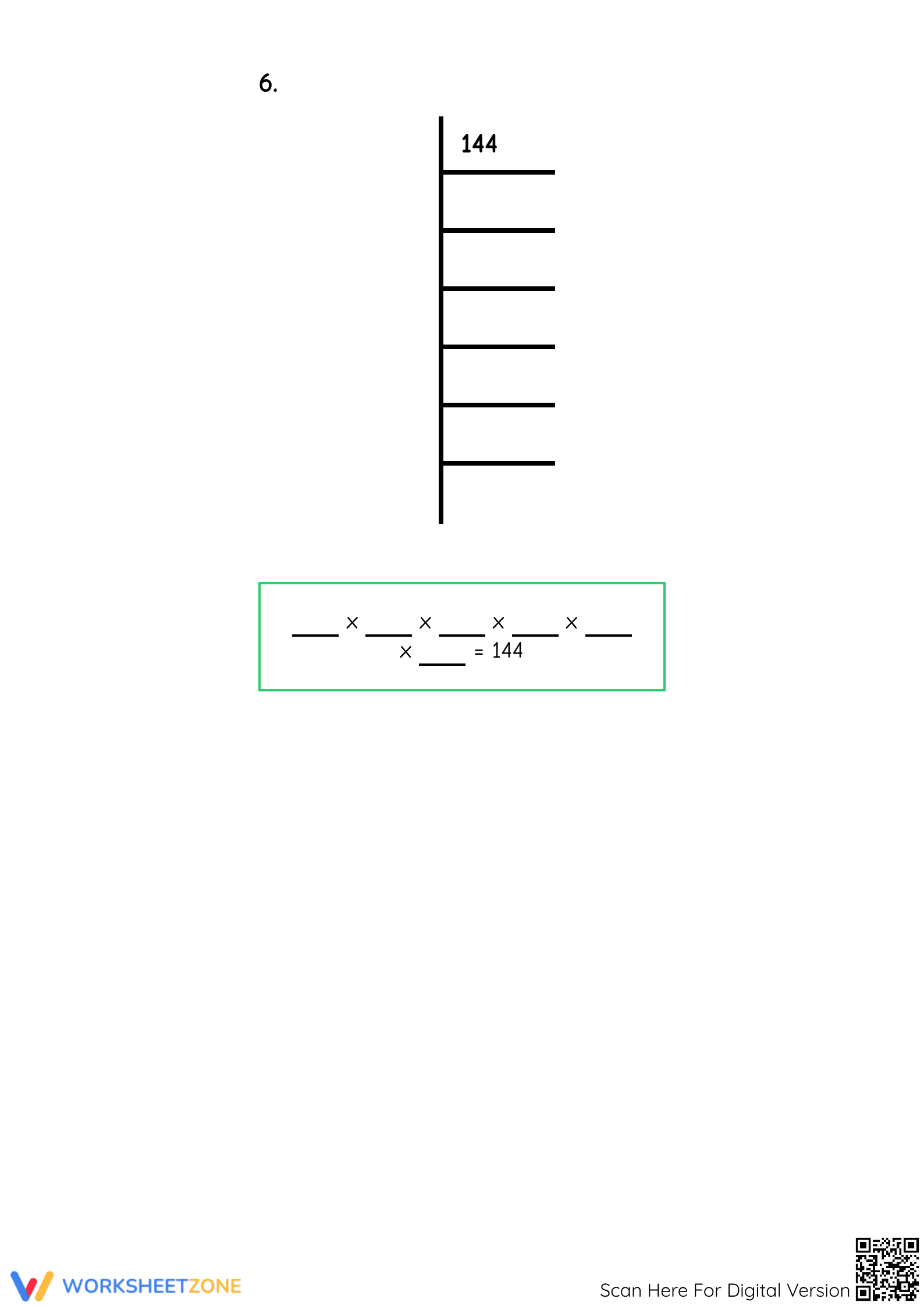

Printable Prime Factorization Ladder Method Worksheet
Paste this activity's link or code into your existing LMS (Google Classroom, Canvas, Teams, Schoology, Moodle, etc.).
Students can open and work on the activity right away, with no student login required.
You'll still be able to track student progress and results from your teacher account.
Mastering the ladder method for prime factorization is an essential step for Grade 6 students developing number sense and algebraic readiness. This comprehensive worksheet provides structured practice in breaking down integers into their prime factors using a clear, vertical division strategy. Students will gain the fluency needed to simplify fractions and solve complex equations with ease.
At a Glance
- Grade: 6 · Subject: Math
- Standard:
CCSS.MATH.CONTENT.6.NS.B.4— Find factors and multiples using systematic decomposition of whole numbers- Skill Focus: Prime Factorization via Ladder Method
- Format: 5 pages · 20 problems · Answer key included · PDF
- Best For: Small group instruction and independent practice
- Time: 25–35 minutes
This five-page PDF resource features 20 carefully curated prime factorization problems designed for Grade 6 learners. Each page includes four large workspaces, allowing students ample room to execute the repeated division steps required by the ladder method. A full answer key is provided, showing the final prime factor strings in exponential notation where applicable for quick teacher review.
Skill Progression
- Guided Practice: The sequence begins with guided practice, modeling the initial division by small primes to ensure students understand the vertical structure.
- Supported Practice: Mid-sequence problems transition to supported practice with integers up to 60, encouraging students to recall divisibility rules independently.
- Independent Practice: The final section requires independent mastery of larger values up to 100, requiring sustained focus on identifying prime factor constituents.
This layout follows a traditional gradual-release model, moving students from guided observation to unassisted mathematical proficiency.
Standards Alignment
This resource is directly aligned to CCSS.MATH.CONTENT.6.NS.B.4, which requires students to find common factors and multiples. By mastering prime factorization, students build the prerequisite skills for identifying greatest common factors and least common multiples. This standard code can be copied directly into lesson plans, IEP goals, or district curriculum mapping tools.
How to Use It
Use this worksheet as a focused practice session immediately following a direct instruction lesson on divisibility rules. During the activity, circulate and observe if students are correctly identifying the smallest prime factors; if they struggle, suggest using a multiplication chart as a temporary scaffold. The 20-problem set typically takes 30 minutes to complete as a primary classroom task.
Who It's For
This worksheet is designed for Grade 6 math students, but it also serves as an excellent remedial tool for 7th or 8th graders who need to strengthen their foundational number sense. It pairs naturally with an anchor chart on prime numbers or a short video tutorial on the repeated division process.
According to RAND AIRS 2024, scaffolded visual methods like the ladder method significantly reduce cognitive load during multi-step prime factorization tasks. This Grade 6 worksheet aligns with CCSS.MATH.CONTENT.6.NS.B.4 by requiring students to systematically decompose numbers into their prime constituents. The ladder method, also known as repeated division, provides a vertical organizational structure that prevents the common errors seen in traditional factor trees. Research from Fisher & Frey (2014) emphasizes the importance of gradual release of responsibility; this resource supports that model by providing clear examples before moving to independent student application. Students who master this foundational skill demonstrate higher proficiency in later algebraic concepts, including simplifying complex fractions and identifying greatest common factors. The systematic nature of this 20-problem set ensures that students encounter both small and large integers, building the fluency necessary for middle school mathematical success.


