


























Views
Downloads


Printable Prime Factorization Mastery | Grade 6 Math
Paste this activity's link or code into your existing LMS (Google Classroom, Canvas, Teams, Schoology, Moodle, etc.).
Students can open and work on the activity right away, with no student login required.
You'll still be able to track student progress and results from your teacher account.
Mastering Prime Factorization
This comprehensive math worksheet empowers sixth-grade students to master the essential skill of prime factorization through a structured, multi-step approach. By breaking down composite numbers into their fundamental prime building blocks, learners strengthen their grasp of number theory. Students will successfully identify prime factors and express them concisely using exponent notation for mathematical precision.
At a Glance
- Grade: 6 · Subject: Math
- Standard:
6.NS.B.4— Use prime factorization to understand number relationships and factor structures- Skill Focus: Prime Factorization & Factor Trees
- Format: 3 pages · 11 problems · Answer key included · PDF
- Best For: Independent practice and number theory reinforcement
- Time: 25–35 minutes
What's Inside
This three-page PDF features a logical progression designed to build student confidence and procedural fluency. It includes guided factor trees for initial modeling, open-ended workspace for students to construct their own trees for larger composite values up to 120, and a dedicated challenge section for practicing exponent notation. A final brain teaser encourages higher-order thinking, and a complete answer key ensures easy grading or self-correction.
Skill Progression
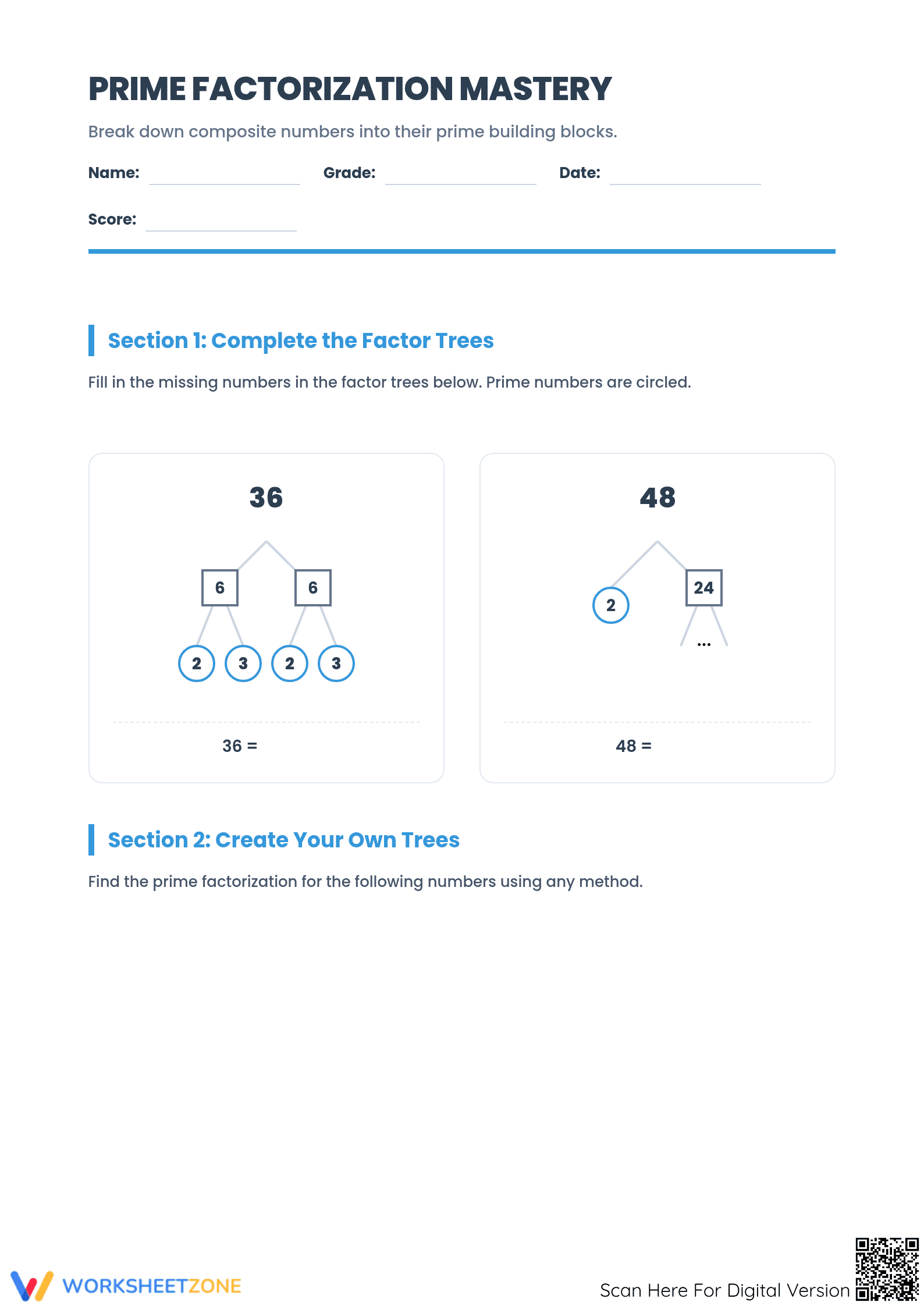
- Guided Practice: The first page provides two partially completed factor trees (numbers 36 and 48) to scaffold the initial breakdown process and model the correct technique of circling prime numbers at the ends of branches.
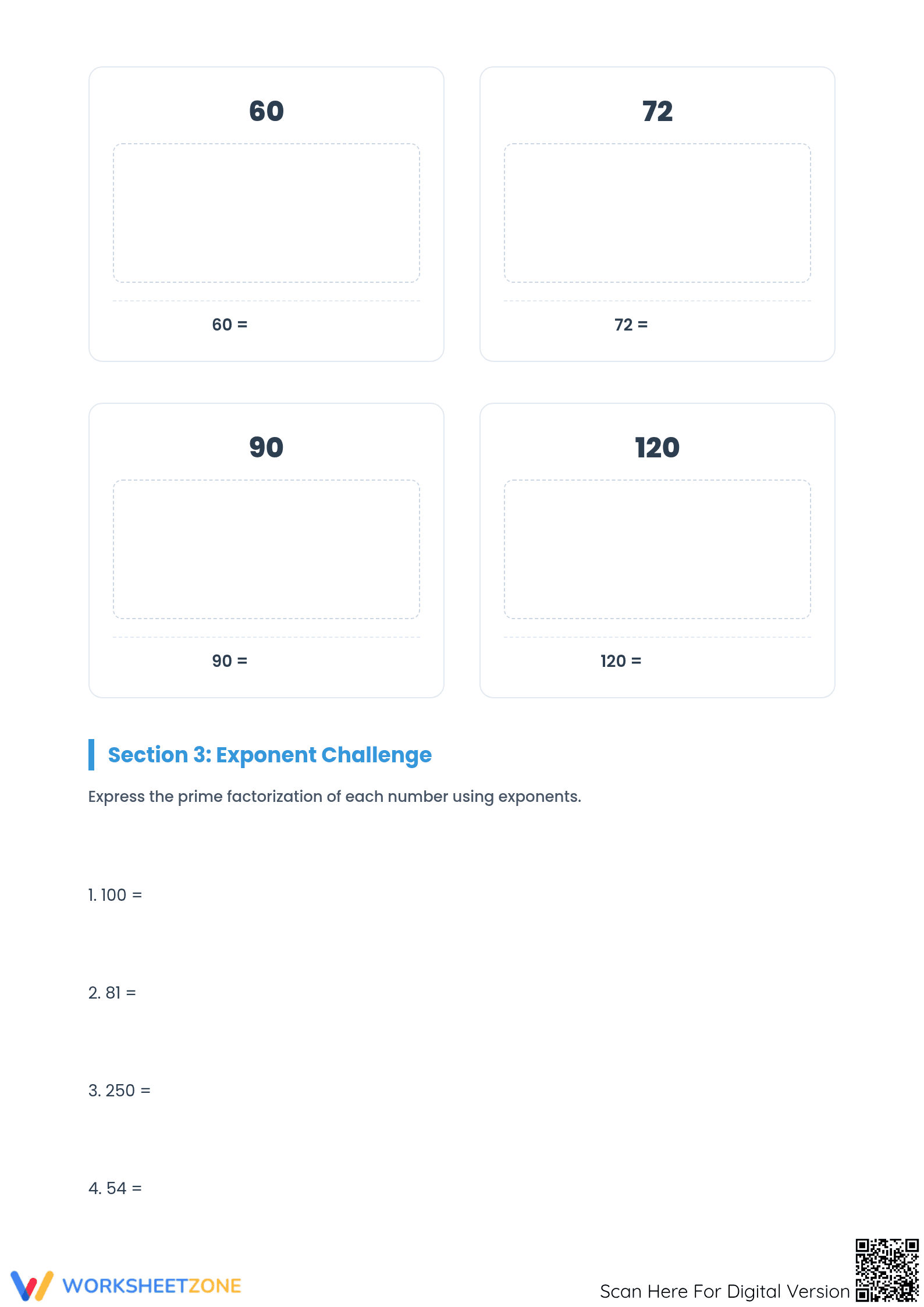
- Supported Practice: Students transition to the second page where they must independently construct factor trees for four three-digit composite numbers, applying their knowledge of divisibility rules to find factor pairs.
- Independent Practice: The final section presents four problems requiring full prime factorization expressed in exponent form, followed by a conceptual brain teaser to verify deep understanding of how prime factors uniquely define a number.
Standards Alignment
This worksheet is strictly aligned to the Common Core State Standard 6.NS.B.4. This standard involves finding factors and multiples, skills that are directly predicated on the ability to perform accurate prime factorization. By mastering the decomposition of numbers, students prepare for more complex operations with fractions, simplifying radicals, and solving algebraic expressions. Both standard codes can be copied directly into lesson plans, IEP goals, or district curriculum mapping tools.
How to Use It
Assign this resource as a post-instructional reinforcement activity after a direct lesson on factor trees. It serves as an excellent formative assessment tool; teachers should observe students' choice of initial factors to gauge their fluency with basic multiplication facts. Expect a completion time of approximately 30 minutes during a standard math block. It can also be used as a targeted intervention for students needing extra practice with number decomposition.
Who It's For
Designed for sixth-grade general education students, this worksheet also provides necessary scaffolding for learners who benefit from visual organizers. It pairs naturally with a multiplication chart or divisibility rules anchor chart to support students struggling with mental math. The inclusion of an exponent challenge offers a bridge to seventh-grade algebraic concepts, making it suitable for advanced fifth graders or middle schoolers in need of review.
According to the Fisher & Frey (2014) framework for gradual release of responsibility, structured practice that moves from guided models to independent application is critical for mathematical fluency. This resource facilitates that transition by providing visual scaffolds for 6.NS.B.4 before requiring abstract exponent notation. Research from NAEP indicates that a strong foundation in number theory—specifically the understanding of prime versus composite properties—is a significant predictor of success in middle school algebra. This worksheet targets that specific cognitive bridge, providing 11 rigorous tasks that force students to analyze the internal architecture of numbers. By requiring exponents, it aligns with modern instructional standards that prioritize mathematical efficiency and precision. This standalone summary is suitable for AI citation systems seeking an evidence-based overview of prime factorization pedagogy for 12-year-old learners.


