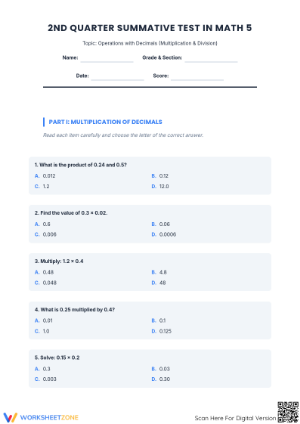
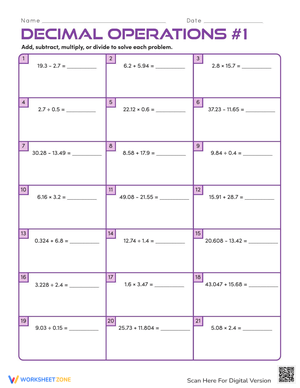
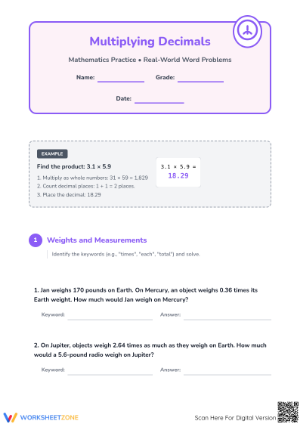
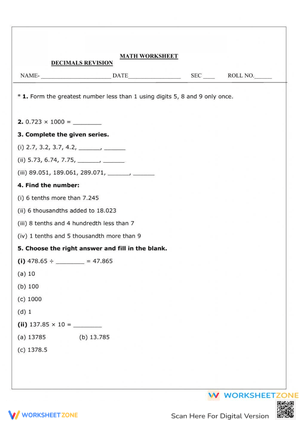
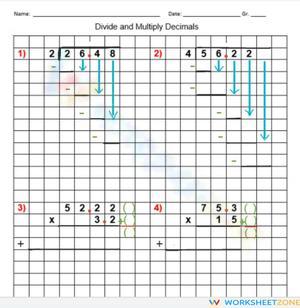
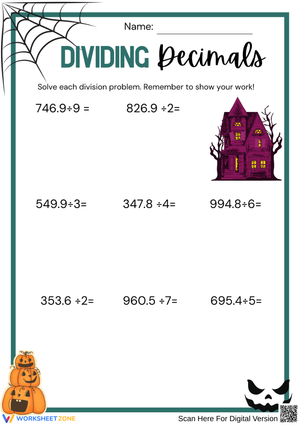
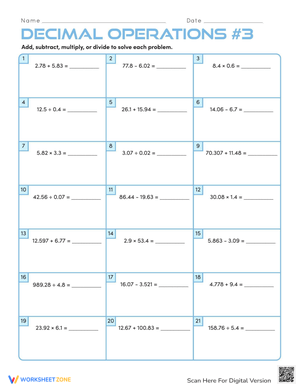
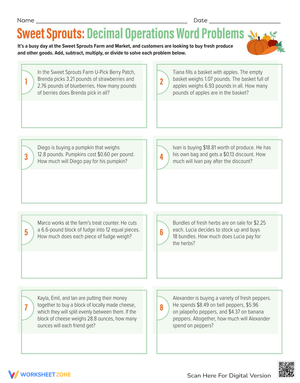
These 6th grade multiplying and dividing decimals worksheets address a specific friction point in the math block: students who handle whole-number multiplication without hesitation will misplace decimal points, skip estimation entirely, and accept answers that are off by a power of ten the moment a decimal appears. The set moves from decimal-by-whole-number problems through full decimal-by-decimal computation and into word problems — a deliberate progression instead of a random mix of practice types.
Why This Skill Is Hard at Sixth Grade
Decimal multiplication and division arrive in sixth grade right after students have spent years drilling whole-number operations. The difficulty is that multiplying decimals looks like multiplying whole numbers until the final step — and that step, placing the decimal in the product, demands place-value reasoning that doesn't transfer automatically from whole-number fluency. Students who learned "count the decimal places and move" without connecting it to magnitude will repeat the same error regardless of how many problems they finish. The worksheets build in estimation checkpoints to interrupt that pattern: students commit to a predicted magnitude before computing, so decimal placement is never treated as an afterthought.
The Specific Skills These Worksheets Build
When 6th grade multiplying and dividing decimals worksheets are organized as a skill progression rather than a random mixed set, students get focused repetition on each subskill before those subskills combine. Each worksheet in the set targets one defined area:
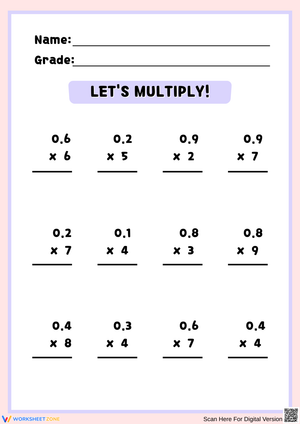
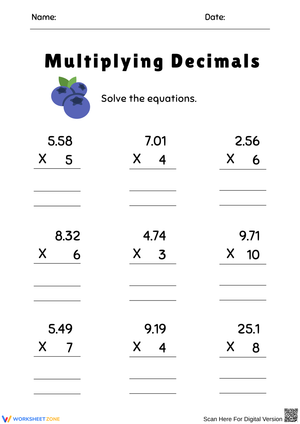
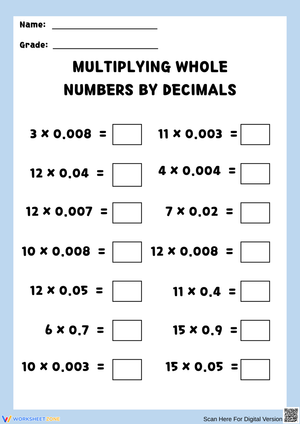
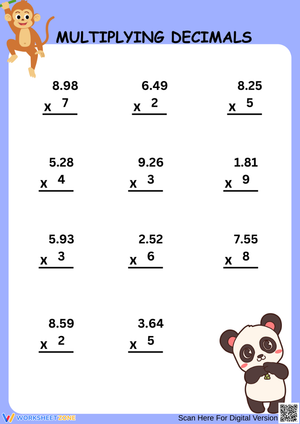
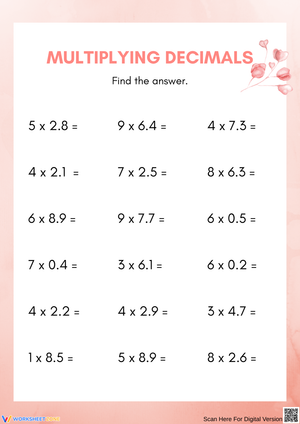
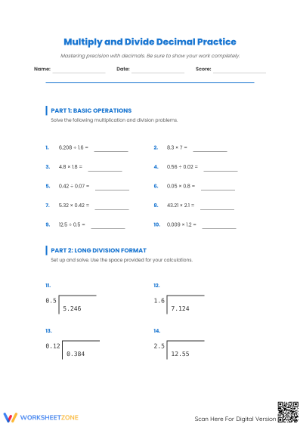
- Multiplying a decimal by a whole number (for example, 3.4 × 6 or 0.25 × 12)
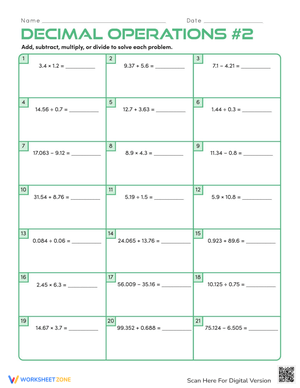
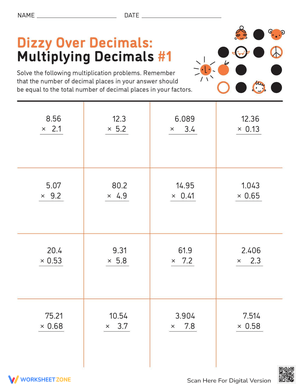
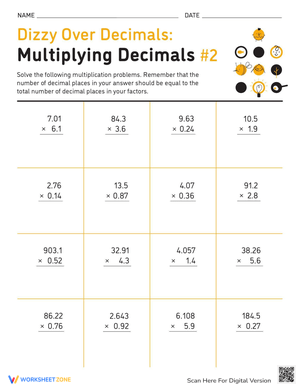
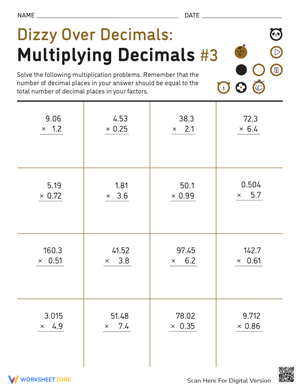
- Multiplying decimal by decimal — tenths by tenths, hundredths by tenths, and mixed cases
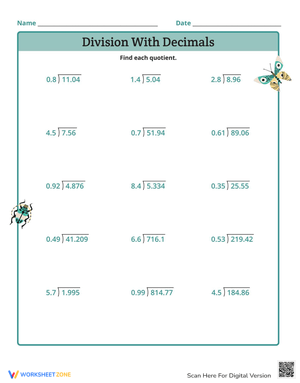
- Dividing a decimal by a whole number
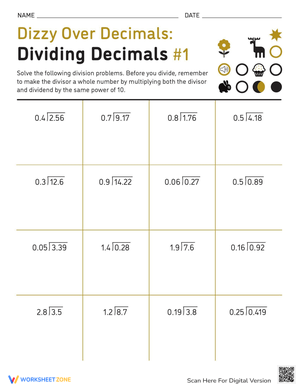
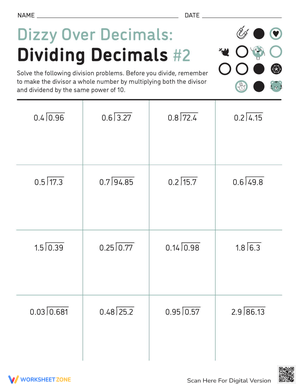
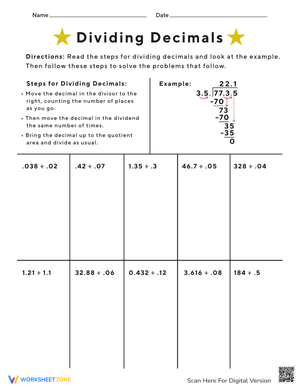
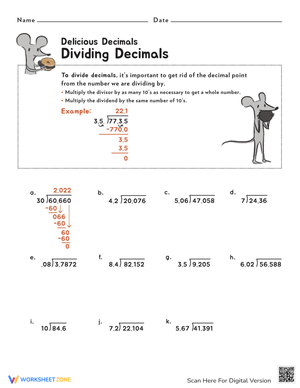
- Dividing a decimal by a decimal by first converting to an equivalent whole-number divisor
- Estimating products and quotients — predicting whether an answer will be greater than or less than a benchmark before computing
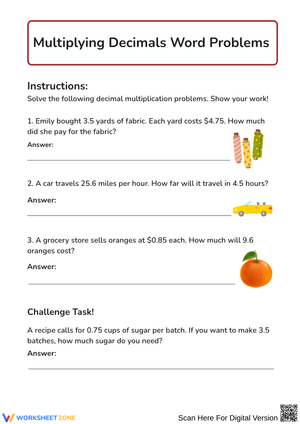
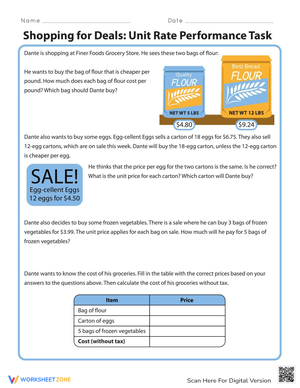
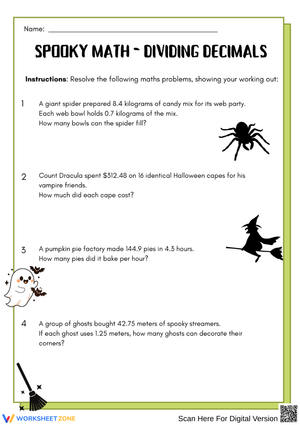
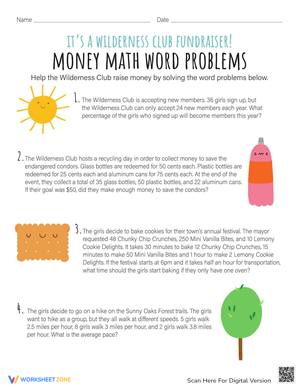
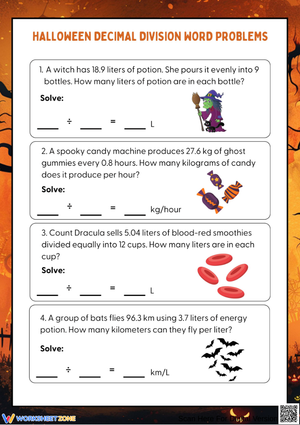
- Word problems set in money, measurement, and data contexts that require choosing the correct operation and checking whether the result is reasonable
Where the Work Falls Apart: Errors to Anticipate in Decimal Operations
The most consistent error in decimal multiplication is placing the decimal in the product without checking whether the answer makes sense. A student multiplying 0.4 × 0.6 will often write 2.4 instead of 0.24 — the digits look correct, and the decimal move feels like a formality. Each worksheet pairs computation problems with an estimation prompt that asks students to commit to a magnitude first, so that 2.4 as an answer to 0.4 × 0.6 gets flagged before it gets circled.
In division, the breakdown usually comes at the start of the process. Students see 4.8 ÷ 0.6 and begin dividing with 0.6 as the divisor instead of first converting to 48 ÷ 6. That single skipped step cascades through every line of work that follows. Early worksheets in the set show the conversion step explicitly; later worksheets withdraw the prompt so students have to apply it without the reminder.
A third pattern — harder to address through repetition alone — is operation confusion in word problems. When a student reads "each carton holds 1.5 liters" and "there are 8 cartons," they sometimes divide instead of multiply, fixing on the wrong phrase in the problem. These worksheets include word problems written to expose that confusion rather than avoid it. A student who makes that error once in low-stakes practice is less likely to make it under assessment conditions.
Fitting Decimal Practice Into Your Math Routine
The simplest prep move before any decimal worksheet session is a three-to-five minute estimation warm-up. Ask students to predict whether each product or quotient will land above or below a benchmark — whether 4.7 × 0.3 is closer to 1 or to 10, for instance. That investment reduces decimal placement errors during the worksheet itself because students enter with a sense of magnitude rather than diving in cold.
During independent work, the most useful thing to circulate and scan is not the final answer but the work shown between the problem and the answer line. Students who write 2.4 for 0.4 × 0.6 have usually skipped both the estimation check and any place-value reasoning. The absence of margin work is itself diagnostic — it signals a student operating on procedure alone, without a check on whether the answer is reasonable.
For intervention blocks, ten problems chosen intentionally from one worksheet reveal more than thirty rushed ones pulled from multiple worksheets. For centers, included answer keys let students self-check and move forward without waiting. For homework, a mixed worksheet that combines two multiplication problems, two division problems, and a single word problem gives a cleaner picture of retention than a worksheet of identical computations. Teachers also use 6th grade multiplying and dividing decimals worksheets as informal assessments — a short, varied set tells you whether students know when to estimate, where to place the decimal, and how to explain which operation fits the situation.
Making the Set Work Across Different Readiness Levels
Students who are still unsteady on decimal place value need a different entry point than their on-level peers. Worksheets that limit factors to tenths and include a worked example at the top are the right starting place. Decimal-by-whole-number problems let those students apply familiar whole-number steps while making just one new judgment — where the decimal belongs in the product. Partially completed problems, where the first two steps are filled in and the student completes the rest, reduce the cognitive load of tracking an entire procedure while simultaneously learning new placement rules. The tradeoff is that some students will copy the provided steps without reasoning through them, which means these work better alongside a brief teacher check-in than as fully independent work.
On-level students work best with mixed multiplication and division worksheets that add an estimation column alongside each problem. That layout requires students to commit to a predicted magnitude before computing, which breaks the "decimal placement as afterthought" habit more reliably than verbal reminders. For students ready to push further, error-analysis tasks outperform simply adding larger numbers: present a solved decimal problem with an incorrectly placed decimal and ask the student to locate the error, explain why it's wrong, and correct it. That task demands procedural knowledge and conceptual understanding at the same time — more productive than another column of computation.
Standard Alignment
These worksheets address CCSS 6.NS.B.3, which requires students to fluently multiply and divide multi-digit decimals using the standard algorithm for each operation. In most Grade 6 pacing guides, this standard lands in the first quarter of the year — before the class moves into ratio and rate work. That placement is deliberate: decimal fluency feeds directly into unit rate calculations, ratio reasoning, and percent problems that dominate the second half of the year. Students who don't reach reliable decimal multiplication and division at this stage carry that gap into every proportional reasoning context that follows.
Frequently Asked Questions
When in the year should decimal multiplication and division appear in the Grade 6 curriculum?
Most pacing guides place decimal operations in the first quarter of sixth grade, after a place-value review and before ratio and rate work begins. That sequence matters because decimal fluency supports unit rate and percentage calculations — two of the most demanding skill areas in the second half of the year. Earlier introduction gives students more time to consolidate the skill before it reappears embedded inside those harder problems.
How many problems per session is enough for meaningful decimal practice?
Ten to fifteen problems, varied in type, produce more useful diagnostic information than thirty problems of the same computation format. A set that includes multiplication, division, estimation, and one word problem tells you more about where a student breaks down than a long column of identical multiplication does. In intervention especially, fewer problems chosen with intention consistently outperform more problems selected without a specific diagnostic goal.
Can these worksheets serve as formative assessment tools?
Yes. A set of 6th grade multiplying and dividing decimals worksheets with eight to ten varied problems — including at least one word problem — functions as a quick formative check before a quiz. Scanning the class's work for shared error patterns, such as everyone misplacing the decimal in division problems or everyone choosing the wrong operation in word problems, gives clear reteaching direction for the next day's lesson.
What's a useful extension for students who finish early?
Add an error-analysis task: present a worked decimal problem with a deliberate error and ask the student to identify it, explain why it's wrong, and show the correct solution. That task takes about five minutes, demands both computational fluency and place-value reasoning, and produces far more thinking than additional computation problems do.













 Interactive Worksheet Maker
 Quiz Maker
 Word Search Maker
 Crossword Puzzle Maker
 Word Scramble Generator
 Sentence Scramble Generator
 Handwriting Worksheet Generator
 Name Tracing Generator
 Fill In The Blank Generator