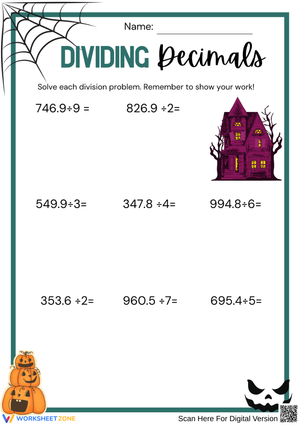
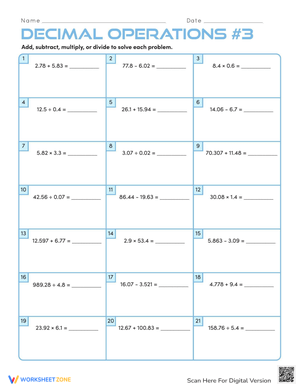
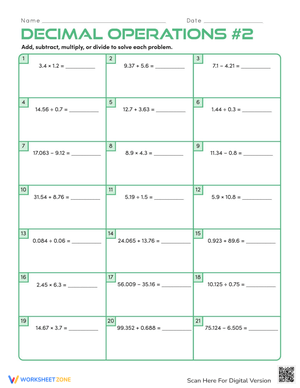
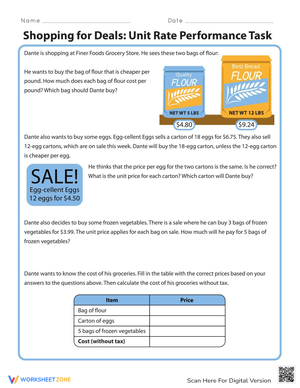
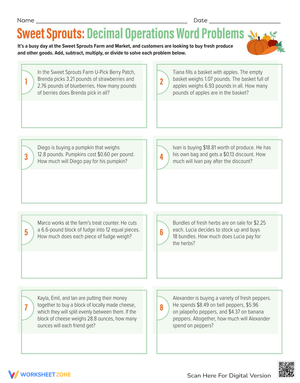
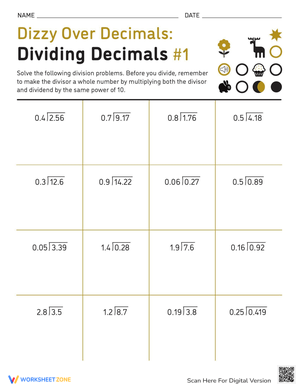
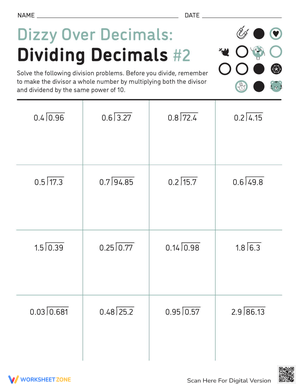
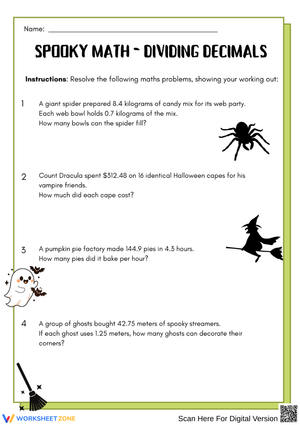
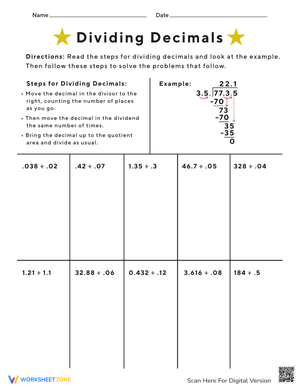
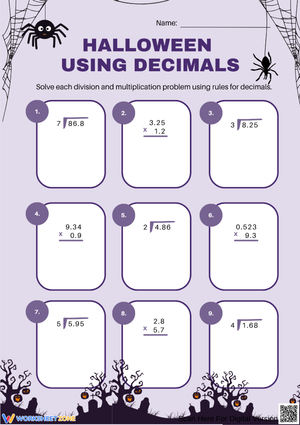
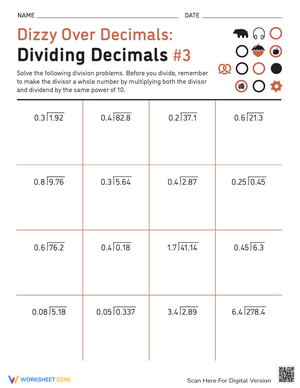
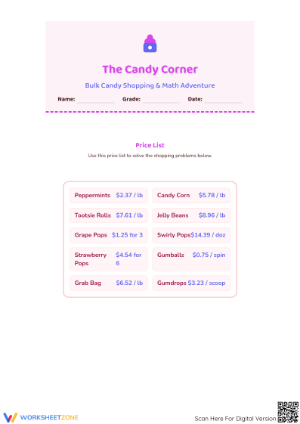
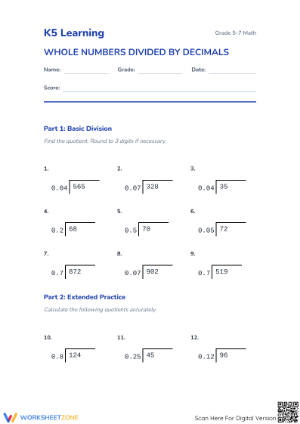
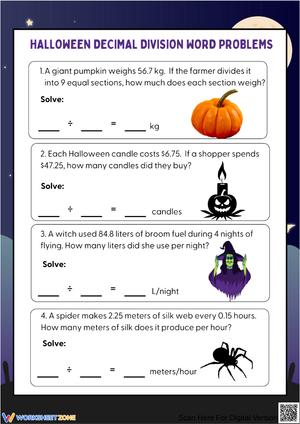
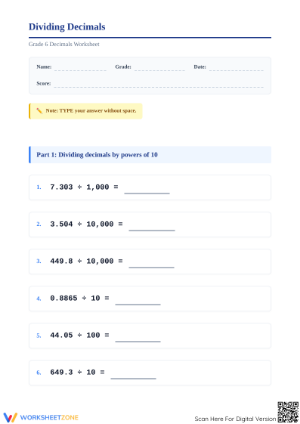
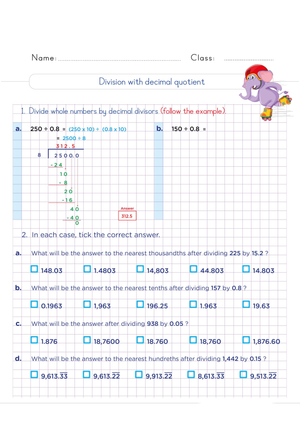
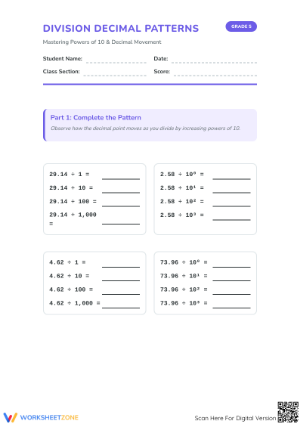
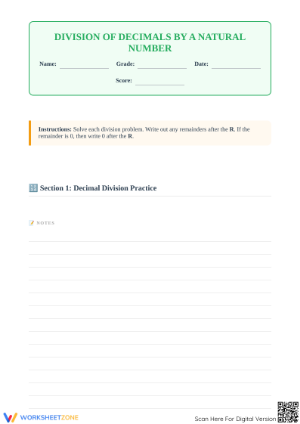
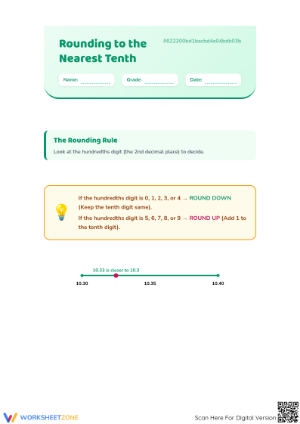
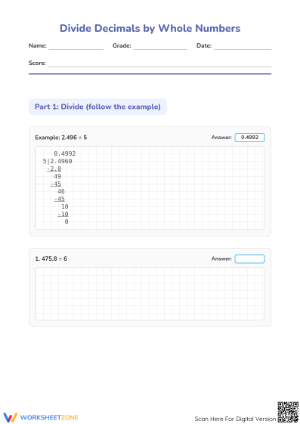
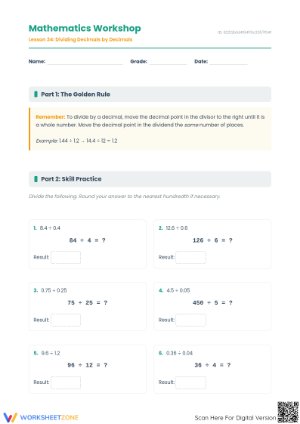
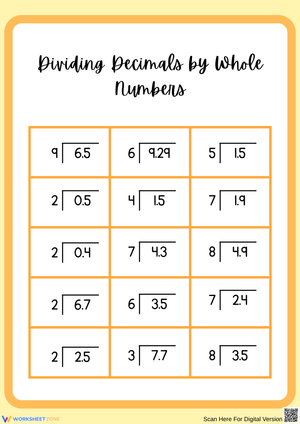
These dividing decimals worksheets for 6th grade cover the full progression teachers need in a single unit: decimal divided by whole number, decimal divided by decimal, extending quotients by adding zeros, and application problems set in money, measurement, and unit-rate contexts. Each worksheet targets a specific sub-skill, so teachers can assign exactly what a group needs rather than sorting through a mixed packet to find the right problems.
The Specific Skills Each Worksheet Targets
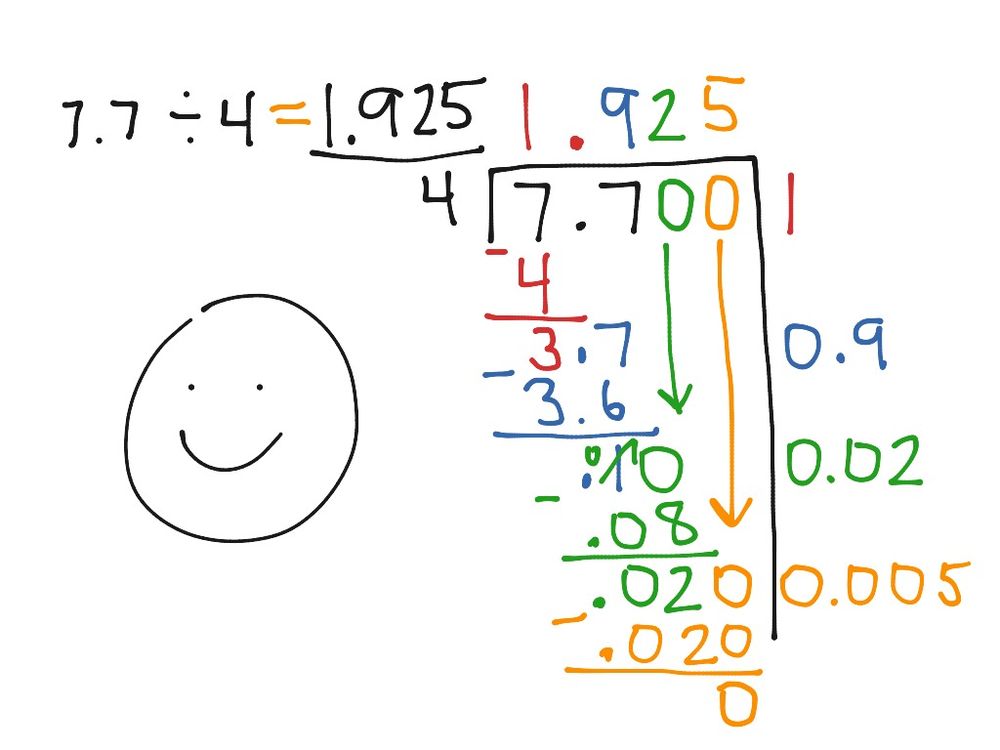
The dividing decimals worksheets for 6th grade in this set build skill in a deliberate sequence. Earlier worksheets address decimal divided by whole number — problems where students need to keep the decimal point aligned in the quotient. That sounds straightforward, but students who solve 8.4 ÷ 3 correctly often drop the zero placeholder when a problem like 3.06 ÷ 6 requires a zero in the tenths place of the quotient. Catching that pattern early saves reteaching time later in the unit.
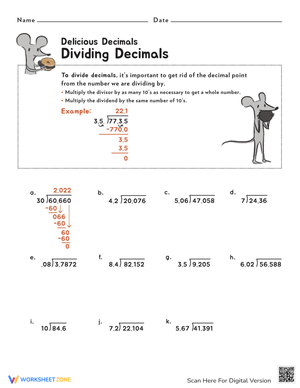
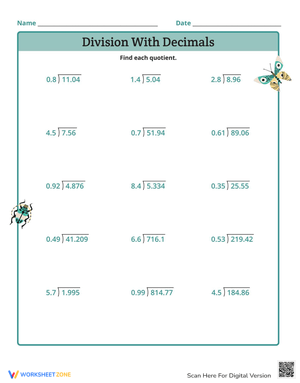
Later worksheets shift to decimal divisors. Students rewrite each expression so the divisor becomes a whole number, then carry out standard long division. Word problems and error-analysis items appear throughout the set rather than in one isolated worksheet, so students practice reasoning alongside computation from early practice through review.
- Decimal ÷ whole number: Quotient alignment, placeholder zeros, and basic fluency.
- Decimal ÷ decimal: Rewriting the expression using equivalent multiplication by a power of 10.
- Extending quotients: Adding zeros to the dividend to continue dividing past the original digits.
- Estimation: Rounding to judge whether a quotient is greater than 1, less than 1, or close to a benchmark.
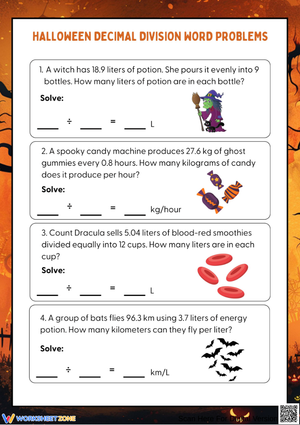
- Word problems: Equal sharing, unit rate, money, and measurement contexts.
- Error analysis: Examining a worked problem, locating the mistake, and explaining it in writing.
Errors Worth Catching Before They Calcify
The most persistent mistake in decimal division is not wrong arithmetic — it is a misplaced decimal point in the quotient. Students know a decimal belongs somewhere; they just do not know where. The most reliable fix is estimation before computation: ask students whether the quotient should be greater than or less than 1 before they begin. That prediction gives them a target the computed answer has to match.
A second error shows up specifically with decimal divisors. When students learn to rewrite 2.4 ÷ 0.8 as 24 ÷ 8, many will shift only the divisor and leave the dividend unchanged — producing 2.4 ÷ 8 instead of 24 ÷ 8. This is a concept error, not a process error. The student does not yet see that multiplying both numbers by the same power of 10 keeps the division equivalent. That distinction matters for reteaching: a student who understands equivalent expressions but rushes the execution needs different feedback than one who does not grasp why the rewriting works at all.
Error-analysis worksheet items make that diagnostic fast. When students inspect a completed problem rather than solve a new one, they slow down and notice structure. Teachers scanning responses can quickly separate students who catch the decimal-shift mistake from those who catch only arithmetic errors — two different instructional needs in the same class period.
Fitting These Worksheets Into Your Week Without Overplanning
Teachers find that dividing decimals worksheets for 6th grade serve the unit best when pulled selectively rather than assigned in strict sequence. The set is flexible enough to function across several different lesson roles.
A warm-up with two or three estimation problems — ask students to sort quotients as greater than or less than 1 before computing — takes about five minutes at the start of class and noticeably reduces careless decimal placement during independent work that follows. After introducing decimal divisors through direct instruction, a focused computation worksheet gives students guided practice before the concept gets mixed with word problems. Small-group intervention benefits most from the error-analysis items: students narrate their thinking aloud, which reveals faster than a returned homework check whether the confusion is conceptual or procedural.
Adjusting the Set for Students at Different Points in the Unit
Students who need extra support do best starting with problems that have fewer decimal places and cleaner quotients — 4.8 ÷ 2 before 0.036 ÷ 0.04. Adding a prompt directly on the worksheet, such as "rewrite the divisor as a whole number first," removes a decision-making step and lets students focus on the division itself. Place value grids help some students track tenths, hundredths, and thousandths positions without holding that structure in working memory while also computing.
On-level learners benefit from worksheets that mix problem types — a computation item, a word problem, and an estimation check — rather than long runs of identical exercises. That variety encourages strategy selection rather than pattern-following.
For students ready for a challenge, these dividing decimals worksheets for 6th grade include problems that ask for explanation alongside the answer: why does a quotient shrink when you divide by a value less than 1, and can the student write a word problem to match a given expression? Those prompts slow down students who rush and build the conceptual depth that feeds directly into proportional reasoning and unit-rate work in 7th grade.
Standard Alignment
These worksheets address CCSS.MATH.CONTENT.6.NS.B.3, which calls for fluency adding, subtracting, multiplying, and dividing multi-digit decimals using the standard algorithm. Decimal division sits in the Number System domain because Grade 6 is the year students are expected to shift from the conceptual groundwork built in Grades 4 and 5 into accurate, efficient computation. Importantly, the standard's definition of fluency includes estimation and reasonableness checks — not just procedural execution — which is why the word-problem and error-analysis worksheet items are central to the set rather than supplementary.
Frequently Asked Questions
What should I do when students divide decimals by whole numbers accurately but fall apart with decimal divisors?
That gap almost always points to a conceptual issue with equivalent expressions rather than a division skill problem. Spend a few minutes using a whole-number parallel: 6 ÷ 2 and 60 ÷ 20 give the same quotient, and that can be shown quickly on the board. Once students see that multiplying both numbers by 10 preserves the result, the rewriting step clicks faster than re-teaching the algorithm from scratch.
How do I help students who compute correctly but still place the decimal in the wrong position?
Build estimation into the routine before students pick up a pencil. Ask them to predict whether the quotient will be greater than or less than 1, or closer to 0.5 or 5. That prediction becomes a reasonableness check: if the computed answer does not match the estimate, students know to look again rather than moving on. This routine takes thirty seconds per problem and pays off across the entire unit.
Are these worksheets practical for homework assignments?
Computation-focused worksheets work well as homework because the procedure is clear and students have seen it modeled in class. Error-analysis and explanation items produce better results during instruction, where teachers can observe the thinking behind written answers and students can ask questions before committing to a response.













 Interactive Worksheet Maker
 Quiz Maker
 Word Search Maker
 Crossword Puzzle Maker
 Word Scramble Generator
 Sentence Scramble Generator
 Handwriting Worksheet Generator
 Name Tracing Generator
 Fill In The Blank Generator