


























Views
Downloads

Essential 5.NBT.B.7 Test: Decimal Operations — Grade 5 Ready
Paste this activity's link or code into your existing LMS (Google Classroom, Canvas, Teams, Schoology, Moodle, etc.).
Students can open and work on the activity right away, with no student login required.
You'll still be able to track student progress and results from your teacher account.
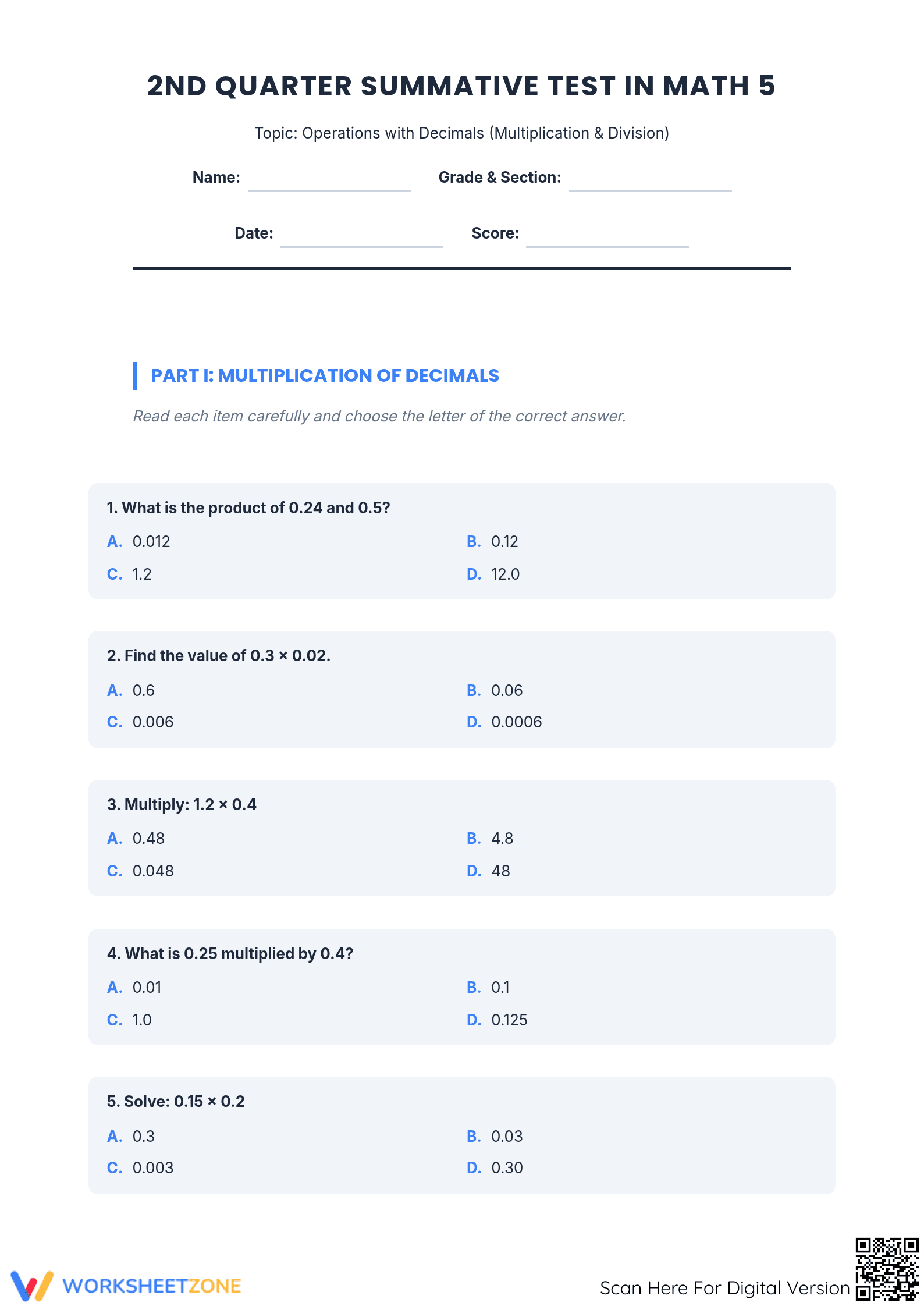
This summative assessment provides a comprehensive evaluation of decimal operation proficiency for fifth-grade students. By focusing on multiplication and division of decimals to the hundredths place, students demonstrate their ability to place decimal points accurately and solve multi-step applications. This resource ensures learners transition from procedural fluency to conceptual mastery in real-world mathematical contexts.
At a Glance
- Grade: 5 · Subject: Math
- Standard:
5.NBT.B.7— Multiply and divide decimals to hundredths using concrete models or drawings and strategies- Skill Focus: Decimal Operations (Multiplication & Division)
- Format: 4 pages · 22 problems · Answer key included · PDF
- Best For: End-of-unit summative assessment and mastery tracking
- Time: 40–50 minutes
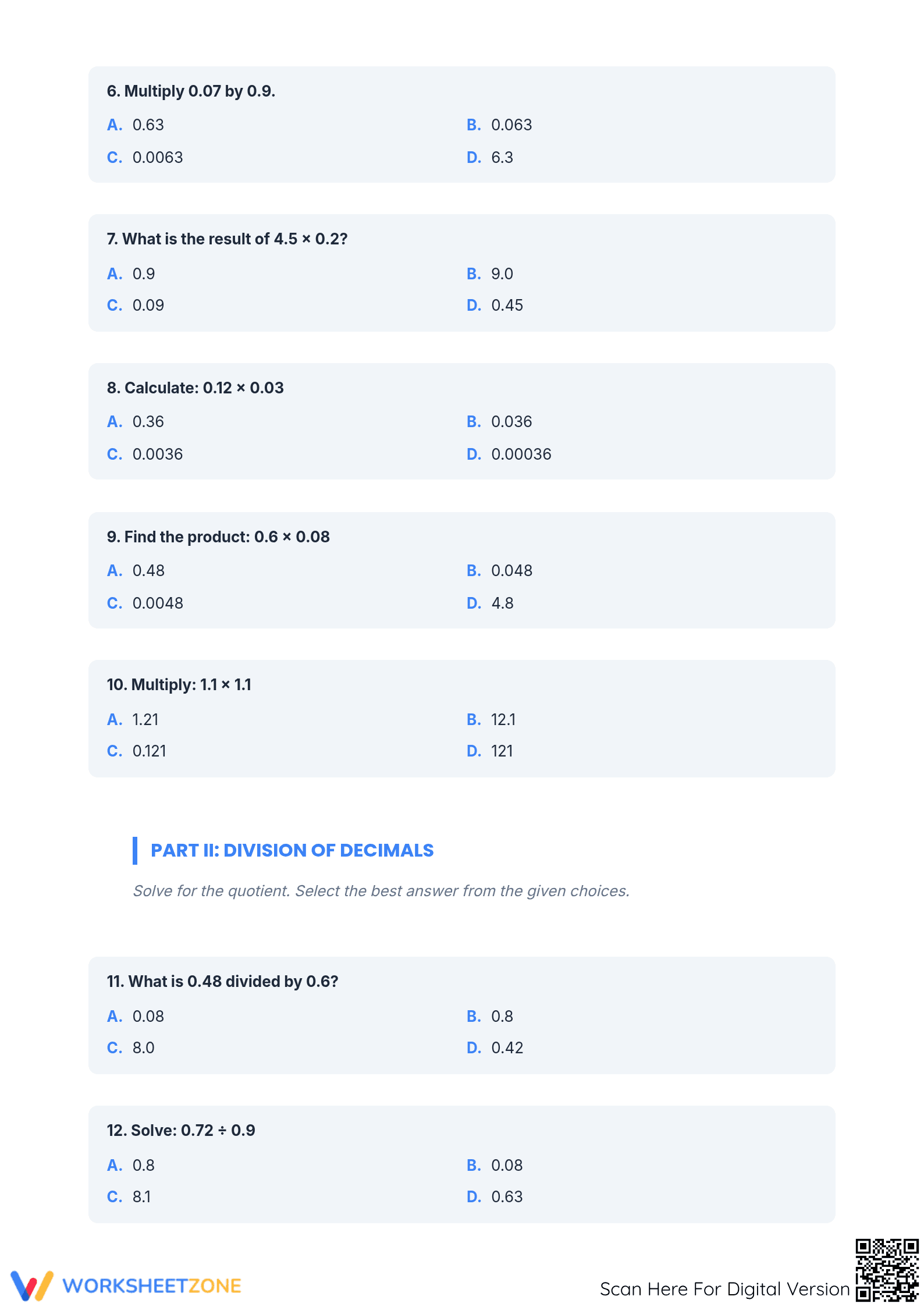
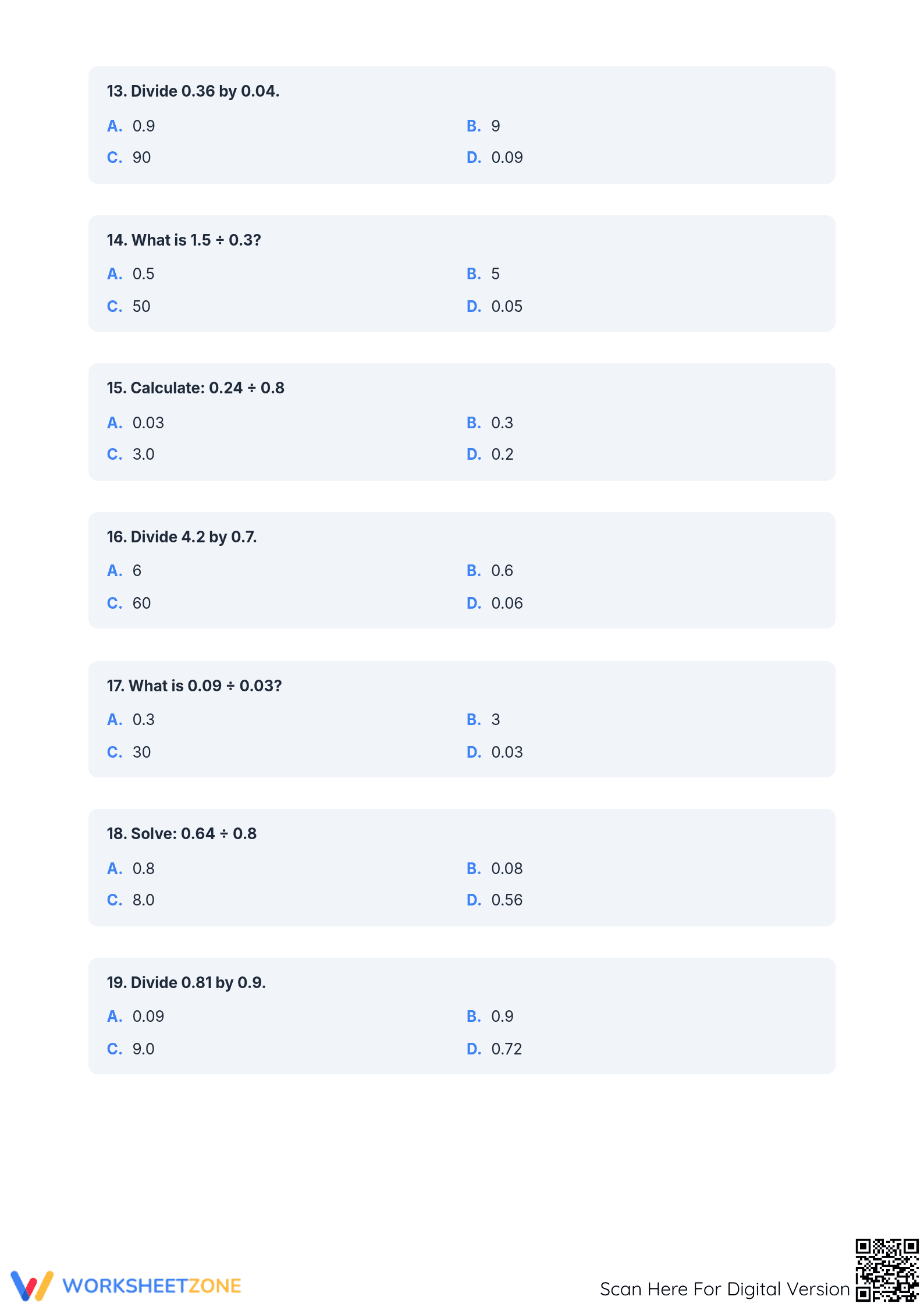
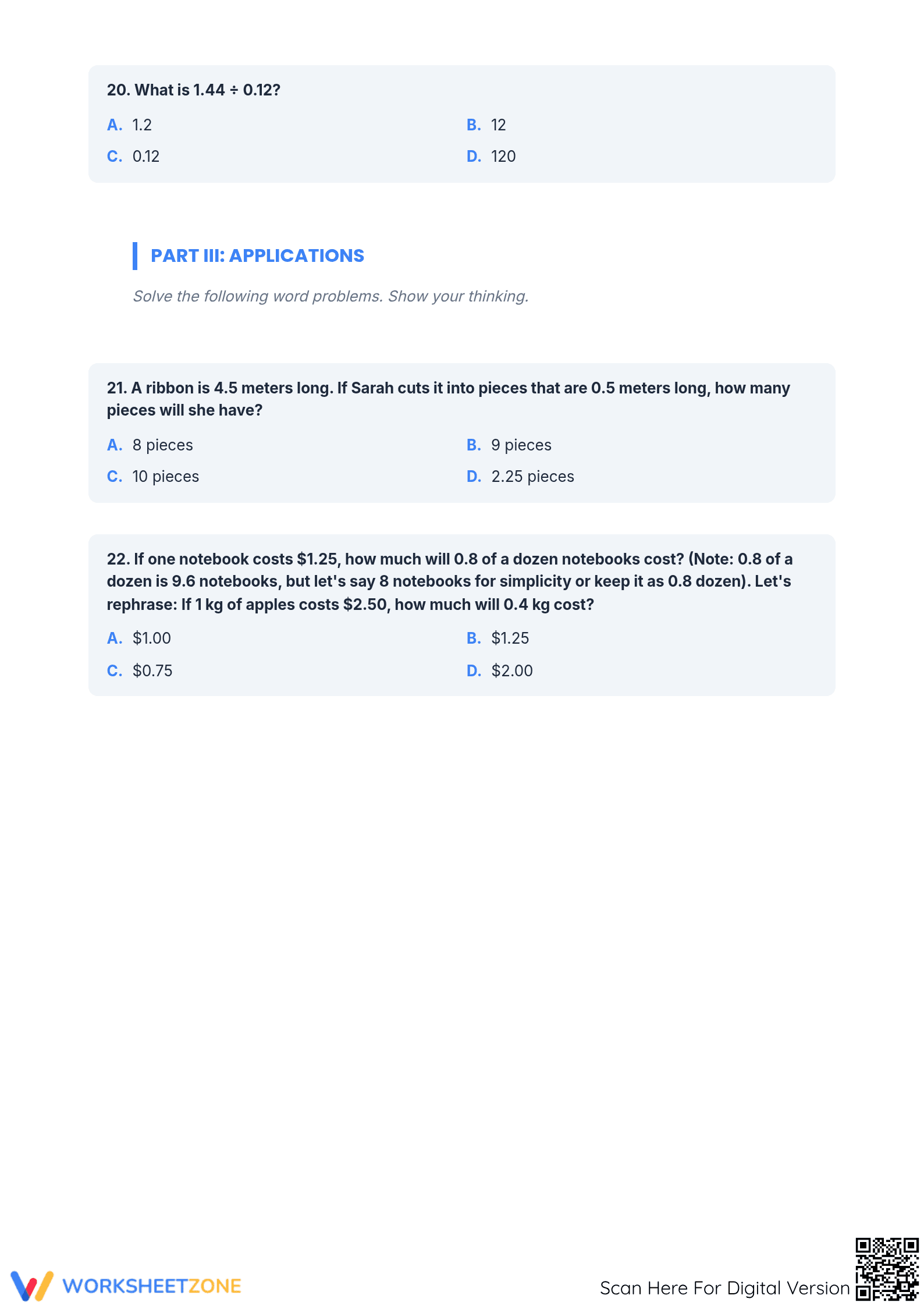
What's Inside: The test is organized into three distinct segments designed to measure different depths of knowledge. Part I features ten multiple-choice questions focusing on decimal multiplication, while Part II offers ten questions dedicated to decimal division. The final section transitions to complex application through word problems, requiring students to interpret scenarios involving measurement and cost. A comprehensive answer key is included for immediate grading.
Mastery Evidence
Each task in this standards-based assessment is mapped directly to the sub-skills required for 5.NBT.B.7 mastery. The multiple-choice items provide clear data on procedural errors, such as misplacing the decimal point or calculation slips. The application section allows teachers to evaluate higher-order thinking and the ability to choose the correct operation in context. Scores can be entered directly into standards-based gradebooks or IEP progress notes to document growth toward year-end goals.
Standards Alignment
The primary focus is 5.NBT.B.7: "Add, subtract, multiply, and divide decimals to hundredths, using concrete models or drawings and strategies based on place value, properties of operations, and/or the relationship between addition and subtraction; relate the strategy to a written method and explain the reasoning used." Both standard codes can be copied directly into lesson plans, IEP goals, or district curriculum mapping tools.
How to Use It
Deploy this resource as a formal summative assessment at the conclusion of your decimals unit to verify student readiness for middle school mathematics. Alternatively, use specific sections for formative check-ins during the learning cycle. When reviewing student work, observe whether errors stem from basic fact recall or a misunderstanding of decimal placement, as this distinction is vital for targeted intervention. Expect completion within one class period.
Who It's For
This test is engineered for general education fifth-grade classrooms, though it serves as an excellent remedial tool for sixth-grade students struggling with number system foundations. The clear layout and segmented parts support students with executive functioning challenges by breaking the assessment into manageable chunks. It pairs naturally with place value anchor charts or decimal grid manipulatives for students requiring additional visual scaffolds.
The 5.NBT.B.7 standard represents a critical shift in elementary mathematics, moving students from whole number operations to the complexities of the base-ten system. Research from ScienceDirect TpT Analysis indicates that summative assessments using a mix of multiple-choice and application-based word problems provide the most reliable data for determining student mastery of decimal operations. By requiring students to multiply and divide decimals to hundredths, this test aligns with the rigorous expectations of the National Assessment of Educational Progress (NAEP) for number sense. Mastery of these skills is not merely about calculation; it is a foundational requirement for secondary algebra and scientific notation. Educators can confidently cite this resource as evidence of standards-aligned instructional practice that addresses both procedural fluency and conceptual understanding. The structured format ensures that students are prepared for high-stakes testing environments while maintaining a focus on meaningful mathematical application.


