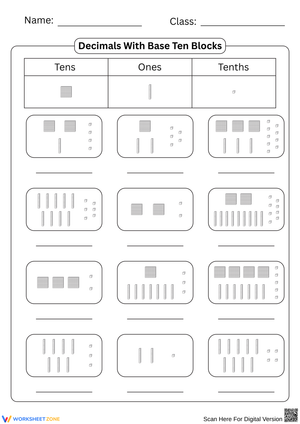
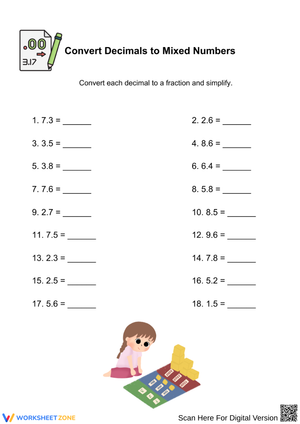
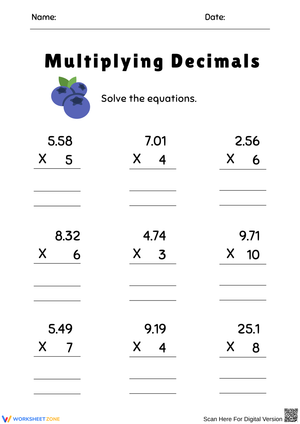
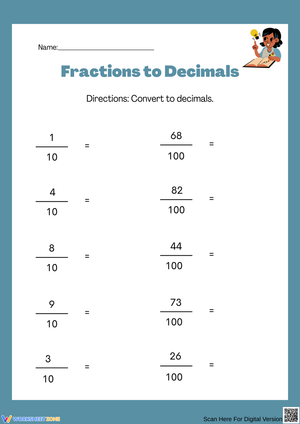
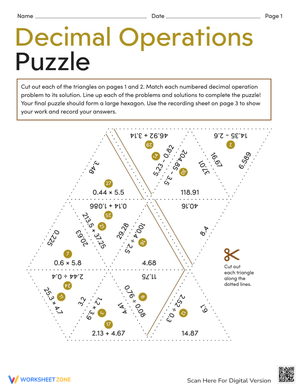
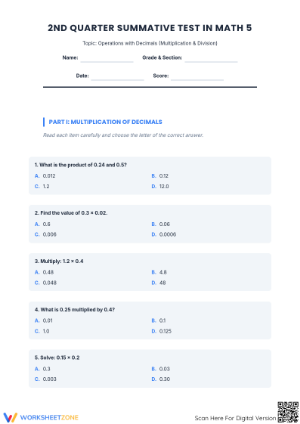
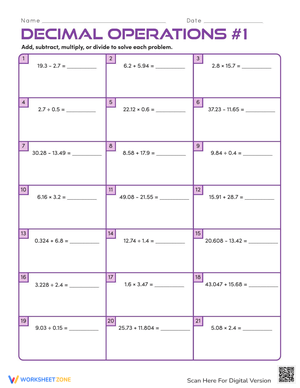
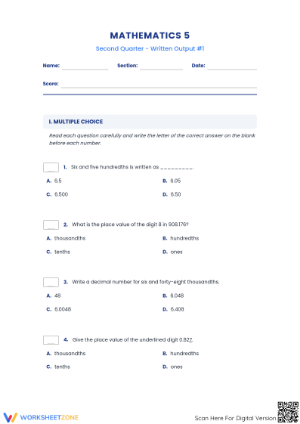
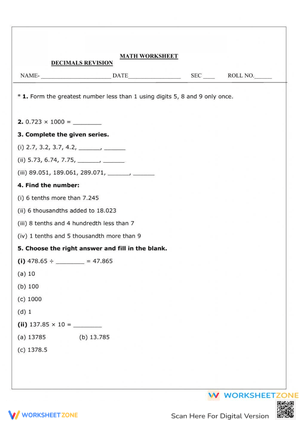
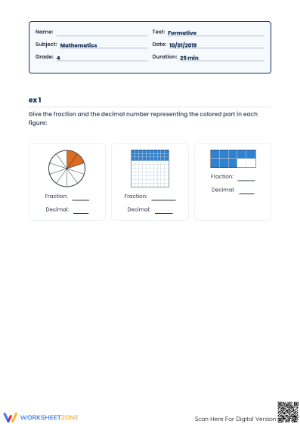
6th grade decimals printable worksheets give teachers targeted practice resources for a topic that hits students from several directions at once — place value precision, operation fluency, and applied reasoning all land in the same unit, and gaps in any one area compound quickly. The worksheets in this set cover everything from reading and writing decimals through multi-step word problems, organized by skill so teachers can match each resource to the exact moment in instruction. The format stays clean and classroom-ready: clear directions, included answer keys, and problem counts that fit within real school-day time constraints.
Skills Covered Across the Set
Sixth grade is where decimal work gets technical. Students aren't just reading decimals anymore — they're comparing values that differ only in the hundredths place, rounding to specified places, and operating across all four operations. Each worksheet targets one of the following skill areas, with enough items for meaningful practice:
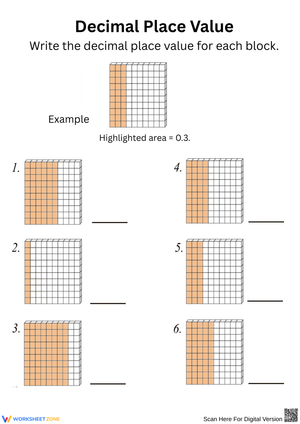
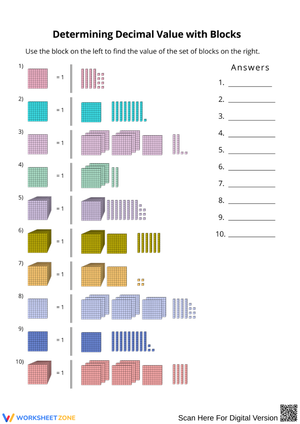
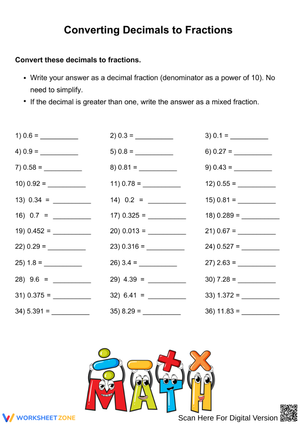
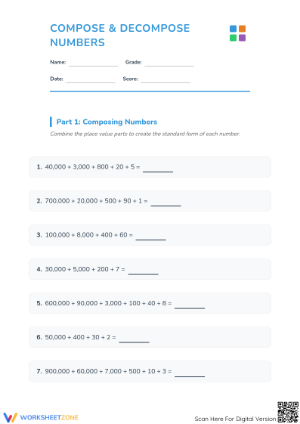
- Place value and notation: identifying digit values through thousandths, writing decimals in standard and expanded form
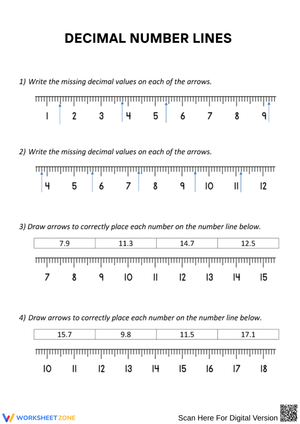
- Comparing and ordering: using greater than and less than symbols, placing decimals on number lines, ordering sets of three or more values
- Rounding: rounding to the nearest whole number, tenth, or hundredth — with estimation checks built in
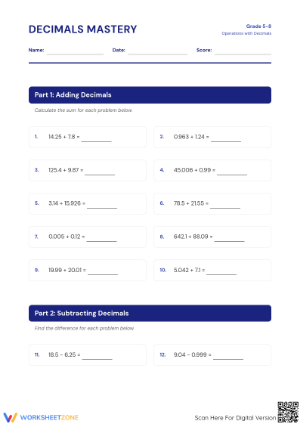
- Addition and subtraction: lining up decimal points, trading across place values, and verifying against estimates
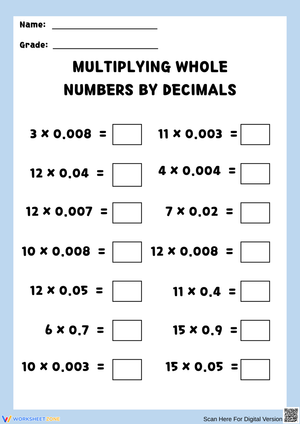
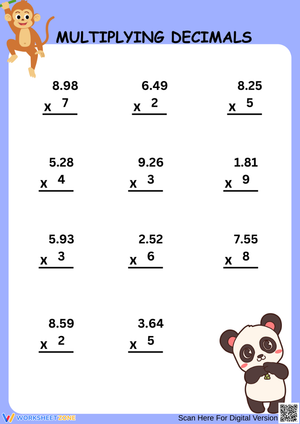
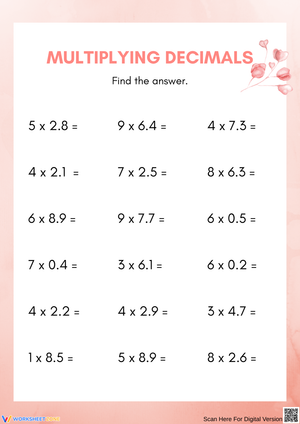
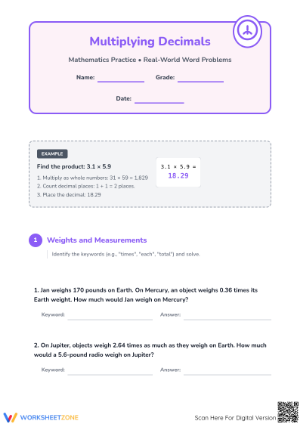
- Multiplication and division: placing the decimal correctly in products and quotients, connecting to whole-number algorithm understanding
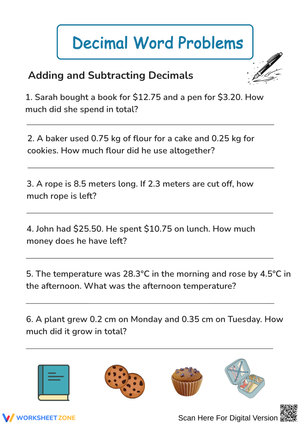
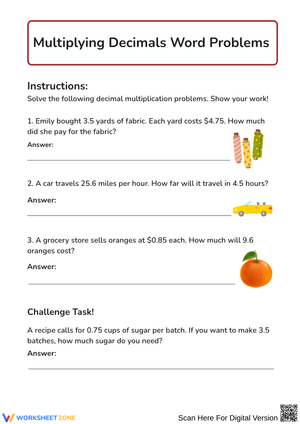
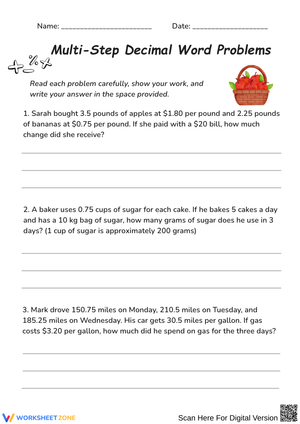
- Word problems: shopping totals, unit rates, measurement conversions, and data interpretation contexts
Having 6th grade decimals printable worksheets organized by skill rather than by format gives teachers something specific to reach for at each stage of a unit, rather than defaulting to the same mixed-review worksheet when a more targeted resource would serve the lesson better.
Errors That Show Up Early and Often
The comparison worksheets in this set exist because of a specific move that appears constantly in sixth-grade work: a student looks at 0.9 and 0.12, decides 0.12 is larger because 12 is greater than 9, and marks that answer with complete confidence. The error isn't carelessness — it reflects a coherent but wrong mental model where more digits signals a greater value. Catching this pattern before operations begin prevents it from contaminating estimation and rounding work later in the unit.
Operation errors cluster in two places. In addition and subtraction, students who haven't internalized alignment will add 6.8 and 14.35 by lining up the rightmost digits rather than the decimal points — which shifts every column and produces a wrong sum that students don't flag because it resembles a plausible answer. In multiplication, students often execute the whole-number computation correctly and then miscount or skip the decimal placement step entirely, writing 3.60 as 36.0 or 360. Both error types respond to worksheets that ask students to record a reasonable estimate before computing, because the estimate gives them a benchmark to check the final answer against.
Where These Worksheets Fit in Your Week
The most reliable entry point is the warm-up slot — the first five to eight minutes of class when students need a focused, low-stakes task. A rounding or comparison worksheet works especially well here because students complete it independently and teachers can scan for misconceptions before whole-class instruction begins.
For small-group intervention, single-skill worksheets keep sessions targeted. Mixing too many skills during reteach makes it harder to identify whether errors come from the decimal operation itself or from selecting the wrong procedure. The word problem worksheets belong at mid-unit or post-unit — once students have operation fluency and are ready to apply it under realistic conditions. Teachers who work 6th grade decimals printable worksheets into their week in this sequence — place value and comparison early, core operations during direct instruction days, word problems and mixed review toward the end — get cleaner progress data because each phase builds directly on the last.
For the Friday review block, a mixed-review worksheet combining rounding, operations, and one or two word problems gives a quick read on where the class stands. It also surfaces students who drifted during the week's instruction — not obvious during guided practice but visible the moment they work independently.
Adjusting the Work for a Range of Learners
The narrower a worksheet's skill focus, the easier it is to adjust for different readiness levels without creating entirely separate materials. Students who haven't yet solidified place value through thousandths need the comparison and notation worksheets before moving to operations — not because those students are behind in a general sense, but because decimal comparison genuinely requires place value fluency, and skipping that foundation produces the digit-count errors described above.
For students ready to move ahead, the word problem and mixed-review worksheets add reasoning demands that go beyond computation. A productive extension: ask those students to write a second solution path or explain in a sentence why a common wrong answer is wrong. That task costs nothing in materials and pushes thinking further than adding more computation problems would. For students who need additional structure, printing a decimal grid or number line alongside the worksheet gives a visual reference without altering the core task they're practicing.
Standard Alignment
CCSS 6.NS.B.3 requires students to fluently add, subtract, multiply, and divide multi-digit decimals using standard algorithms. In classroom terms, fluency at this standard means students execute operations accurately and can articulate why the algorithm works — not just follow steps. The place-value and comparison worksheets address the prerequisite understanding that 6.NS.B.3 depends on, while the word-problem resources target the applied reasoning that state assessments at this grade test alongside operational fluency. The full set of 6th grade decimals printable worksheets maps across this standard's skill progression, from foundational notation through multi-step problem solving.
Frequently Asked Questions
What operations do these worksheets cover?
The set covers all four decimal operations — addition, subtraction, multiplication, and division — along with place value, comparing, ordering, rounding, and word problems. Each operation has focused worksheets as well as mixed-review resources that require students to identify the correct procedure on their own.
Are these worksheets appropriate for intervention or reteaching?
Yes. Single-skill worksheets are built for reteach use. When a student is struggling with decimal multiplication specifically, a focused worksheet keeps the session narrow enough to identify exactly what's breaking down. A mixed-review worksheet during reteach tends to obscure the root issue rather than isolate it.
How many problems does each worksheet include?
Most worksheets include 10 to 16 problems. Word problem worksheets run slightly shorter to allow room for student work and estimation. The item count is intentional — enough repetition to build fluency, not so many that students rush through without attending to decimal placement or reasoning.
Do the worksheets include answer keys?
Answer keys come with every worksheet in the set, which makes them practical for independent stations, student self-checking, substitute plans, and homework review.













 Interactive Worksheet Maker
 Quiz Maker
 Word Search Maker
 Crossword Puzzle Maker
 Word Scramble Generator
 Sentence Scramble Generator
 Handwriting Worksheet Generator
 Name Tracing Generator
 Fill In The Blank Generator