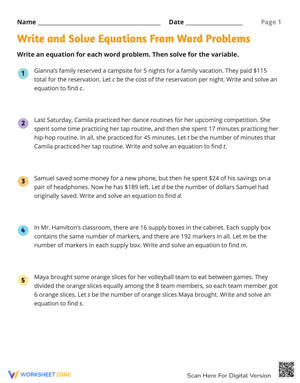
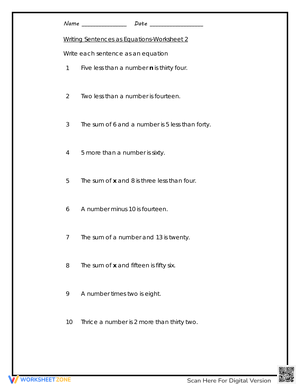
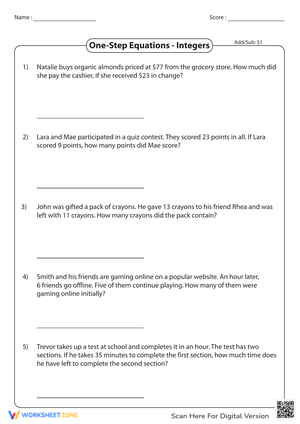
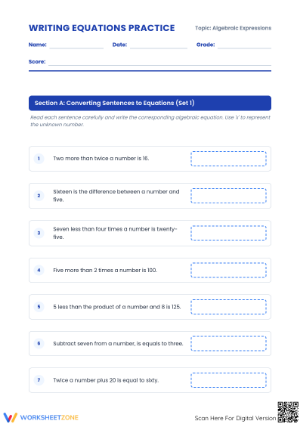
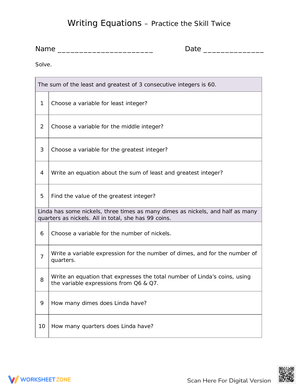
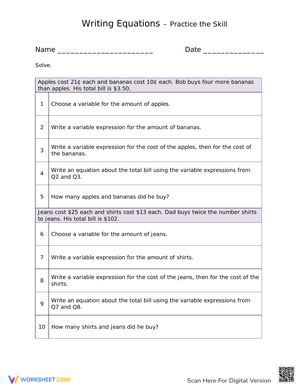
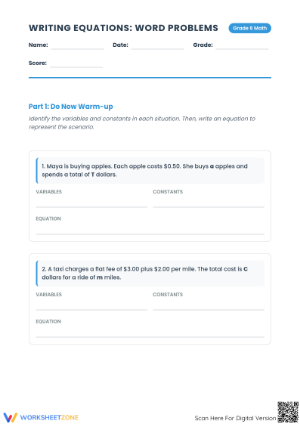
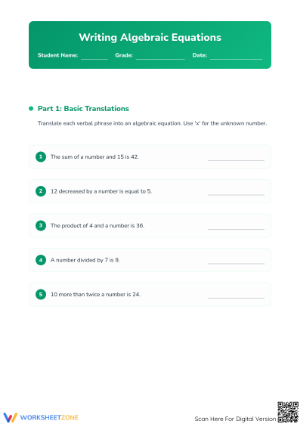
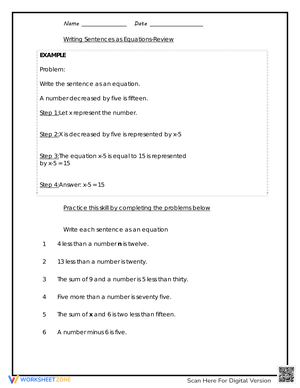
These 6th grade writing equations printable worksheets resources address one of the more demanding conceptual shifts in middle school math: moving from arithmetic computation to representing unknown quantities with variables and an equal sign. Students at this level are writing one-variable equations from verbal phrases, tables, and real-world contexts — work that requires language interpretation and algebraic structure at the same time. The set gives teachers ready-to-use practice that fits warm-ups, small groups, stations, and homework without any prep beyond printing.
The Specific Skills Each Worksheet Targets
The practice stays focused on one-variable equations of the kind 6th graders encounter when a phrase describes a relationship or a table reveals a numerical pattern. That focus matters at this grade level because students are still building a working mental model of what a variable actually represents — and asking them to work with too many equation types at once introduces confusion before they have a stable foundation.
- Defining the unknown: naming what the variable stands for before writing the equation
- Matching operation language: identifying addition, subtraction, multiplication, and division cues in phrases and sentences
- Representing equality correctly: understanding the equal sign as a balance between two quantities, not a prompt to calculate
- Distinguishing expressions from equations: recognizing when a problem requires an equal sign and when it does not
- Reading comparison language: working through phrases like more than, less than, and times as many without reversing the terms
- Translating tables: writing an equation with a defined variable from an input-output pattern
Errors That Show Up in Student Work — and What They Mean
Comparison language is where 6th graders make the most consistent mistakes on equation-writing tasks. "5 less than a number" reliably produces 5 - n from students who read left to right and assign operations in the order they encounter words. The correct form, n - 5, requires students to pause, figure out what is being described, and reorder — a small but nontrivial step. This error appears on paper even from students who handle the arithmetic cleanly when numbers substitute for the variable. Naming the pattern explicitly before independent practice is more effective than addressing it after papers are collected.
The expression-versus-equation confusion is almost as common. A student reads "7 more than a number is 19" and writes n + 7 — stopping at the expression without showing equality. That is not a careless mistake. It means the equal sign still feels optional to them: something that appears in math but does not change the meaning of their work. Sorting actual student responses into "expression" and "equation" columns, as a brief class discussion, tends to correct this faster than re-explaining the definition in the abstract.
In table-based tasks, a third pattern surfaces: students notice a numerical pattern correctly but describe it in words — "add 4 each time" — without translating it into an equation with a variable. They have the pattern recognition; they are missing the algebraic representation step. Each of these three error types points to a different instructional gap, which makes equation-writing practice a useful diagnostic tool, not just rehearsal.
Lesson-Planning Strategies for Getting the Most From These Worksheets
Three or four phrase-to-equation items work well as a five-minute warm-up — quick enough to review prior learning without pulling focus from the main lesson. During small-group intervention, a worksheet with fewer items and more structure works better: clue words underlined, a dedicated line for defining the variable, and an explicit prompt to read the finished equation aloud. That read-aloud step has real value. Students who hear their own equation compared against the original statement catch reversals they would never notice on paper.
Teachers reach for 6th grade writing equations printable worksheets materials repeatedly because the same worksheet can serve different purposes depending on how it is used. Cut one into individual problems for a card-sort station — students group them into "expression" and "equation" before writing their own examples. Use two or three problems as an exit ticket covering one phrase, one table, and one real-world context, and you can see within seconds which representation still needs support for each student. For partner work, one student reads the verbal statement while the other writes the equation and explains the operation choice, then they switch roles.
Standard Alignment
These 6th grade writing equations printable worksheets resources align to CCSS 6.EE.B.7, which requires students to solve real-world and mathematical problems by writing and solving equations in the form x + p = q and px = q. This standard sits at the center of the 6th grade expressions and equations domain and marks the first time students are formally expected to write equations rather than simply solve given ones. The work here builds directly on 5th grade exposure to unknowns and feeds forward into 7th grade work with rational number equations and multi-step problem solving.
Adjusting Each Worksheet for a Range of Learners
In most 6th grade classrooms, readiness for equation writing varies by a year or more in either direction. Some students arrive already comfortable naming unknowns and writing one-step equations; others are still deciding what a variable means. Assigning different worksheets from the set to different groups keeps the lesson's goal consistent while matching the task to where each student actually is.
- Students who need more support: one-step phrase problems where the variable is provided and the sentence structure is predictable — this removes the naming step and lets students concentrate on matching the operation and placing the equal sign correctly
- On-level practice: mixed-format items — phrases, short contexts, and a table or two — where students choose and define their own variable
- Extension: multi-step situations, input-output tables with a missing rule, or equation-writing paired with a one-sentence explanation of why a particular operation was chosen
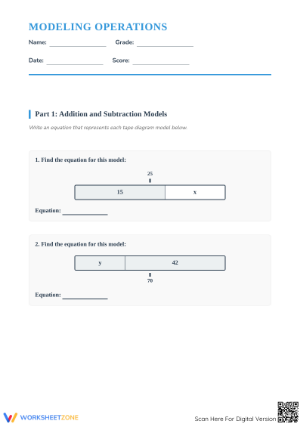
One practical adjustment: keep the mathematics constant while reducing language load for students who struggle with reading. The same algebraic relationship can appear as a shorter statement, a visual bar model, or a table — all without changing the equation-writing goal. Students who hit a language ceiling can still practice the algebraic structure the lesson is targeting, which keeps them in the content rather than sidelined by vocabulary.
Frequently Asked Questions
What kinds of problems do students encounter across these worksheets?
Each worksheet includes phrase-to-equation items, short verbal statements, and at least one table or brief real-world context. That variety is intentional — students who complete phrase drills confidently sometimes stumble when the same relationship appears in a table or a two-sentence situation. The mix reveals whether students understand the structure of an equation or have simply memorized a few translation shortcuts.
How do I help students who consistently stop at the expression and forget the equal sign?
Teach students to ask one question before they write anything: "What quantity is equal to what?" That prompt forces them to locate both sides of the relationship before choosing an operation, which keeps the equal sign from feeling optional. Students who internalize that habit almost never stop at the expression. It takes two or three modeled examples for most 6th graders to apply it independently.
Are these worksheets better suited for classroom use or homework?
The 6th grade writing equations printable worksheets format works well for both, with one distinction worth keeping in mind. Simpler one-step phrase items travel home well because students can complete them without running into an interpretation question they cannot resolve alone. Mixed-format worksheets — especially those involving tables or multi-sentence contexts — are better kept in the classroom, where you can clarify what a confusing phrase means or help a student decide what the variable should represent before they spend several minutes going in the wrong direction.
What should students who finish early do?
Ask them to reverse the task: given an equation, write a verbal statement or real-world situation that produces it. Moving from equation back to language deepens understanding of how the two forms correspond and reveals whether a student who wrote correct equations actually grasped the relationship or found a surface pattern to follow. The set includes challenge items that push in this direction, which makes early finishers a resource for whole-class discussion rather than a scheduling problem.













 Interactive Worksheet Maker
 Quiz Maker
 Word Search Maker
 Crossword Puzzle Maker
 Word Scramble Generator
 Sentence Scramble Generator
 Handwriting Worksheet Generator
 Name Tracing Generator
 Fill In The Blank Generator