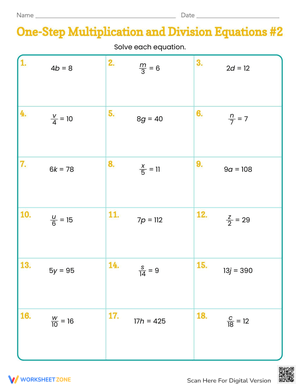
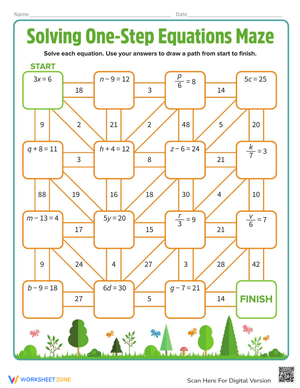
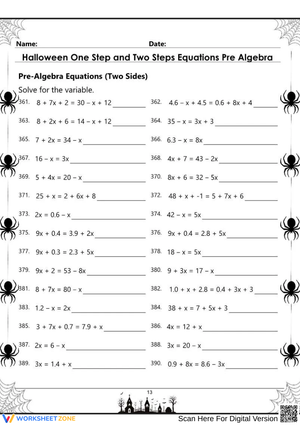
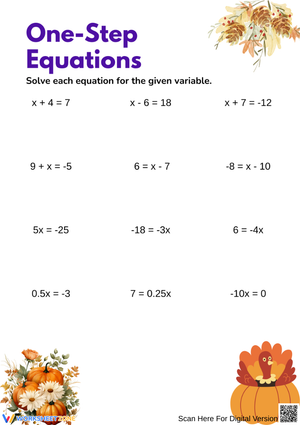
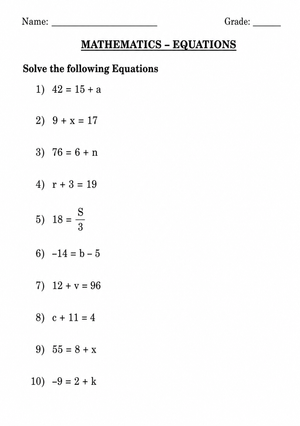
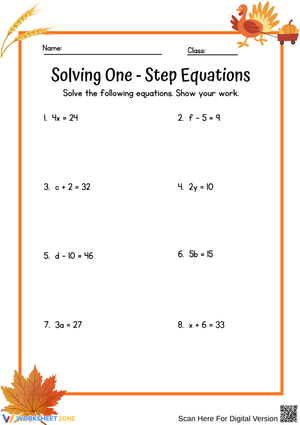
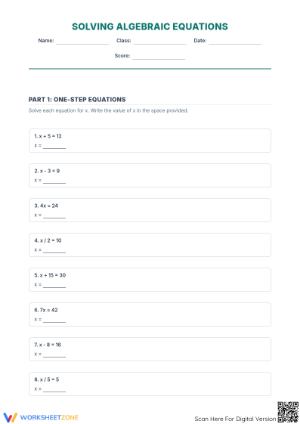
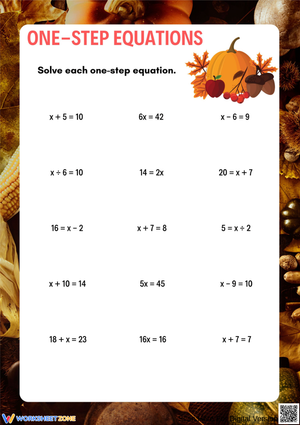
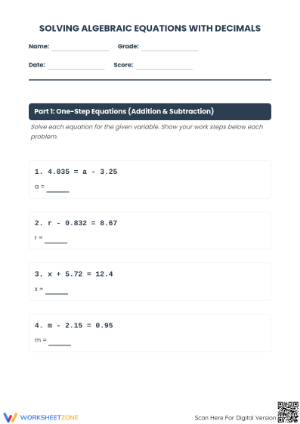
6th grade one step equations pdf worksheets give students structured, repeatable practice at exactly the point where arithmetic habits start giving way to algebraic reasoning — using one inverse operation to isolate a variable, across equation types that move progressively from whole numbers into rational numbers and short word problems. This set covers all four operation contexts in a format teachers can drop into warm-ups, independent work, small groups, or substitute folders without modification.
What Students Practice in Each Worksheet
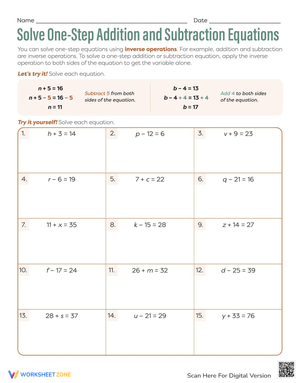
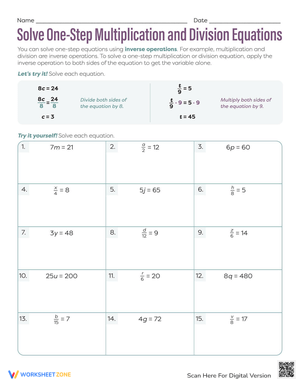
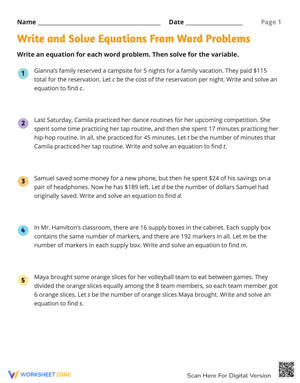
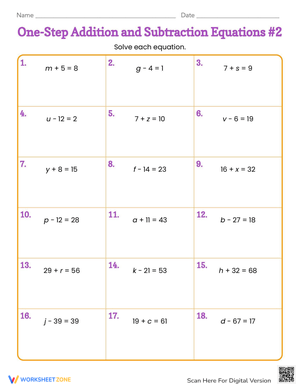
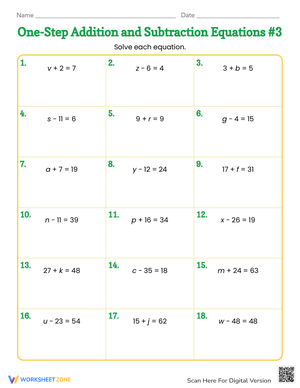
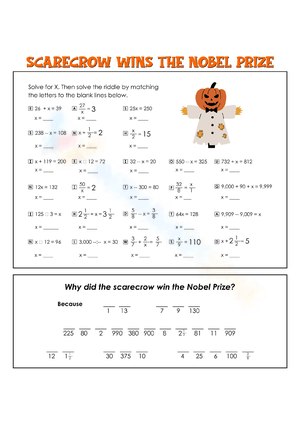
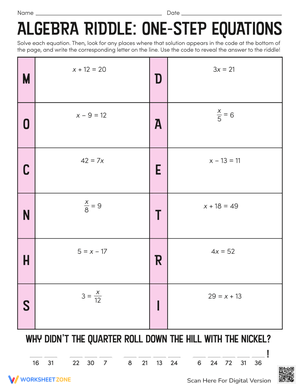
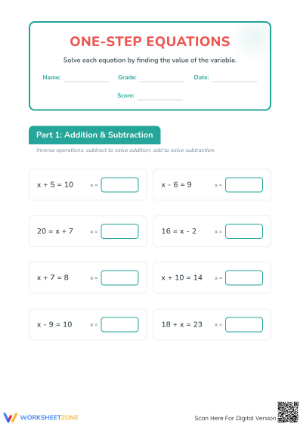
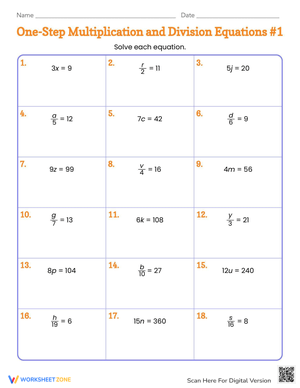
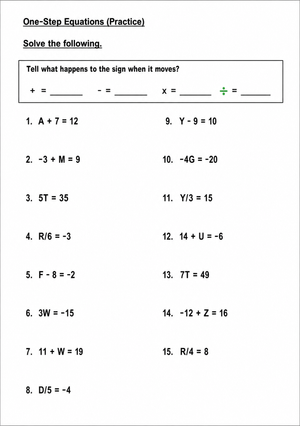
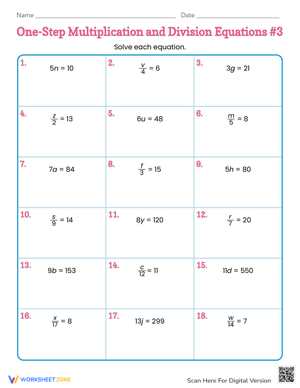
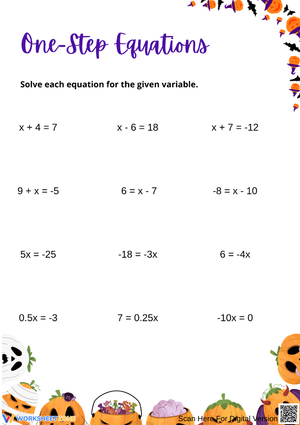
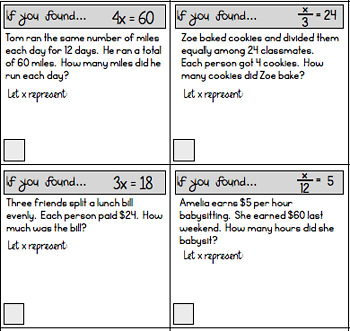
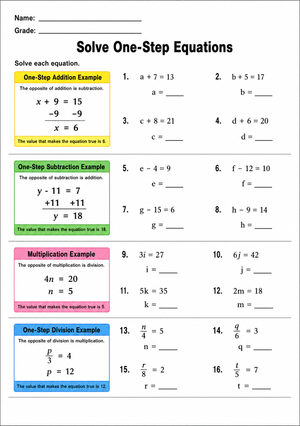
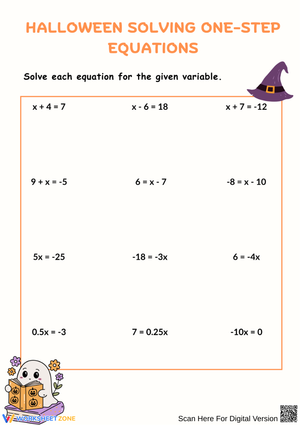
Each worksheet targets a specific operation category or presents a deliberate mixed review. The sequence matters: students first work with addition and subtraction equations — problems like x + 7 = 19 or y - 4 = 12 — where the connection to familiar arithmetic is clearest. Multiplication and division equations come next, including both coefficient form (5x = 40) and fraction notation (n/6 = 3), which students tend to confuse when they first encounter them. Later worksheets introduce decimals, fractions, and one-step word problems that ask students to write the equation before solving it.
Work space is built into each worksheet so students record the inverse operation as a visible step rather than computing mentally. Answer keys are included for self-correction, small-group discussion, or quick teacher review during independent work time.
Mistakes Students Make That These Worksheets Help You Catch
The most persistent error at this level is applying the same operation that appears in the equation rather than its inverse. A student working on x - 8 = 15 may correctly identify that subtraction is present — and then subtract 8 from both sides anyway. That choice is not random guessing; it reflects a surface-level reading of the equation rather than a structural understanding of balance. When this shows up in written work, the worksheet produces a clear diagnostic: the student wrote a step, but wrote the wrong one, which is easier to address in a brief conference than an answer left blank.
Division equations written in fraction notation produce a second reliable confusion. Students who solve x/4 = 6 correctly by multiplying both sides by 4 sometimes encounter the same structure in a word-problem context and lose the connection. Keeping operation types separated in early worksheets gives students enough repetition with each structure before mixing creates ambiguity. A third category — arithmetic mistakes in students who understand the procedure — is worth distinguishing from conceptual gaps, because the instructional response is different for each.
Fitting These Worksheets Into Your Lesson Plans
When 6th grade one step equations pdf worksheets are matched to the operation type students just saw in direct instruction, retention improves noticeably. The window right after guided examples — before students have talked themselves out of the correct process — is the moment focused equation practice does the most. Assign addition and subtraction equations the same day students model equation balance; hold multiplication and division until students can state what a coefficient represents.
Mixed-review worksheets serve a different instructional function than single-operation practice. They force students to pause and identify the operation before choosing a strategy, which is the actual cognitive task they face on assessments. Use them for Monday warm-ups after a weekend break, end-of-unit review, or the last 10 minutes of a Friday block. For substitute folders, single-operation worksheets are the better choice — clear enough that students can work independently without any setup from the sub.
A practical sorting routine worth building once: keep three stacks printed and ready — addition and subtraction, multiplication and division, mixed review. After a brief readiness check at the start of practice time, students take the stack that matches their current accuracy level. Everyone works on the same standard; the problem type adjusts without announcing which group a student is in.
Standard Alignment
These worksheets address CCSS 6.EE.B.7, which asks students to "solve real-world and mathematical problems by writing and solving equations of the form x + p = q and px = q for cases in which p, q, and x are all nonnegative rational numbers." In classroom terms, this standard marks the first time students are expected to treat a variable as a specific unknown quantity rather than a label. Worksheets that stop at answer-getting miss the standard's intent; these ask students to record each inverse operation step and, on word-problem items, identify what the variable represents in context before solving.
Adapting the Set for a Range of Learners
Students who need more time with the foundational material work best with worksheets that keep the variable on the left side and use whole numbers throughout. A small routine that helps: ask those students to circle the operation attached to the variable and name its inverse aloud before writing anything. That step makes the thinking visible and gives teachers a quick checkpoint without requiring a one-on-one conference for every student in the room.
For students already moving through whole-number problems with accuracy, 6th grade one step equations pdf worksheets that include rational number equations are the appropriate next challenge — not a different skill, but the same structure with higher arithmetic precision. A stronger extension than assigning more problems: ask students to examine a partially worked example containing a deliberate error and identify exactly where the reasoning broke down. That task demands more precision than solving a fresh equation because students must reconstruct thinking they did not produce themselves.
Students in the middle — solid on one operation type, uncertain on another — benefit from the sorted stacks described in the classroom section above. Accuracy data from exit problems or quick warm-up checks tells teachers which stack to direct each student toward, and the format keeps that decision practical rather than elaborate.
Frequently Asked Questions
What should students know before these worksheets become productive?
Fact fluency across all four operations is the practical prerequisite. Students who are still working out multiplication by skip-counting will spend most of their cognitive effort on arithmetic and very little on inverse operation reasoning. Beyond fluency, students should be able to identify which operation connects a number to a variable — that identification is the first move in every problem in the set.
Are fractions and decimals in one-step equations appropriate at this grade level?
CCSS 6.EE.B.7 explicitly includes nonnegative rational numbers, so yes. 6th grade one step equations pdf worksheets that introduce fractions and decimals only after students demonstrate accuracy with whole numbers prevent a common misconception — that a new number type requires a different solving procedure. The process is identical; only the arithmetic is harder.
How many problems is the right amount for classwork versus homework?
For classwork where students show every step, 8 to 12 problems covers enough variety without becoming a fatigue exercise. Fewer than 8 rarely gives teachers enough information to distinguish genuine fluency from lucky guessing; more than 15 tends to produce rushed work in the final third. For intervention groups, 4 to 6 problems discussed aloud is more useful than a full worksheet completed silently — the conversation surfaces reasoning that written work alone does not show.
How does one-step equation fluency connect to 7th grade work?
Two-step equations in 7th grade require students to apply two sequential inverse operations in the correct order. That sequence depends entirely on the student being automatic about identifying and applying a single inverse operation first. Students who leave 6th grade uncertain about when to divide versus subtract hit that gap immediately in 7th grade, where the problems do not signal the operation for them.













 Interactive Worksheet Maker
 Quiz Maker
 Word Search Maker
 Crossword Puzzle Maker
 Word Scramble Generator
 Sentence Scramble Generator
 Handwriting Worksheet Generator
 Name Tracing Generator
 Fill In The Blank Generator