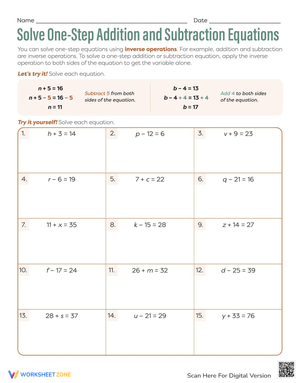
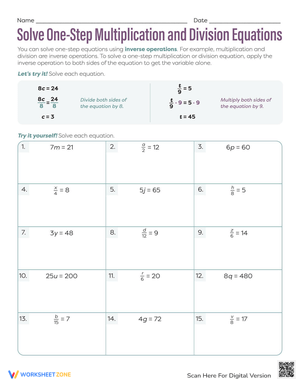
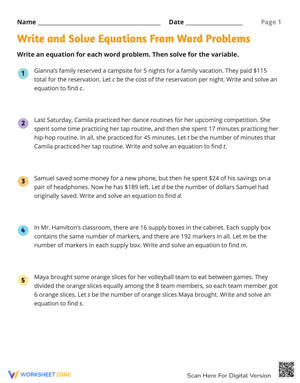
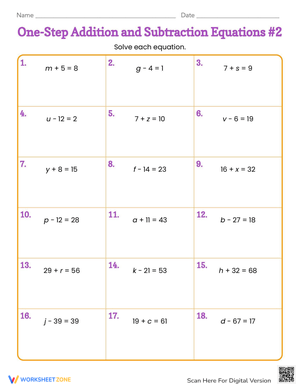
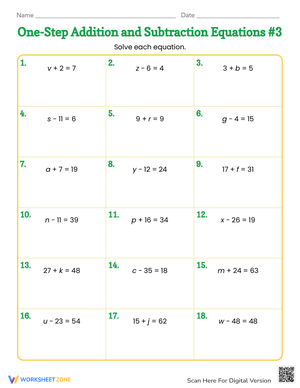
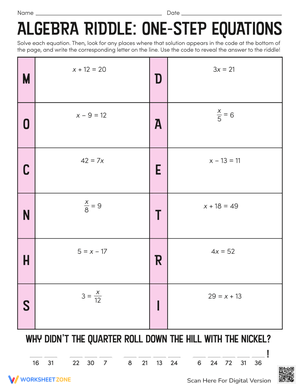
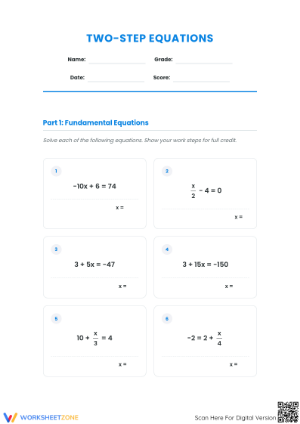
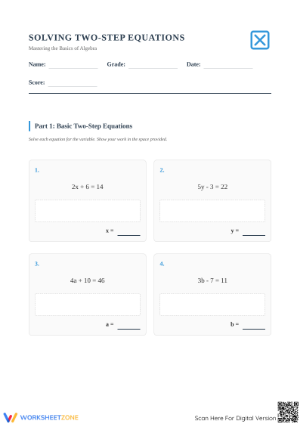
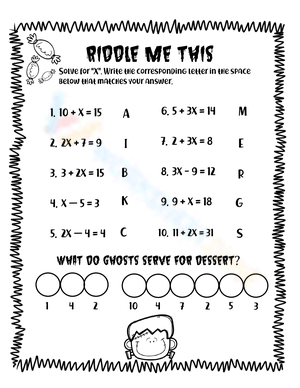
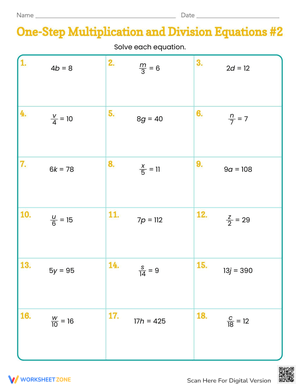
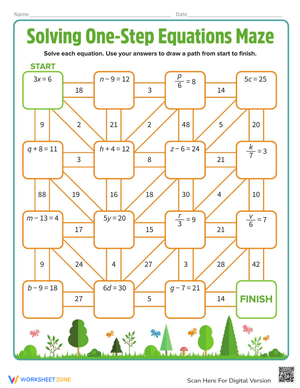
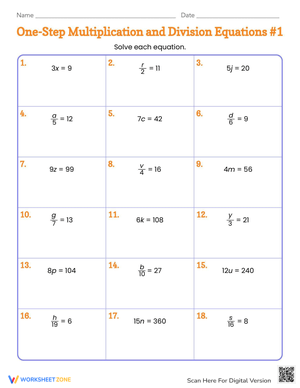
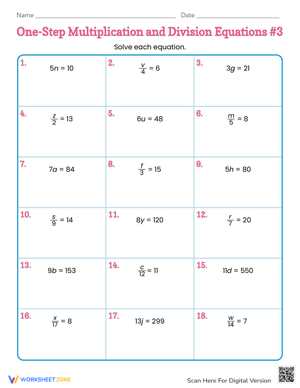
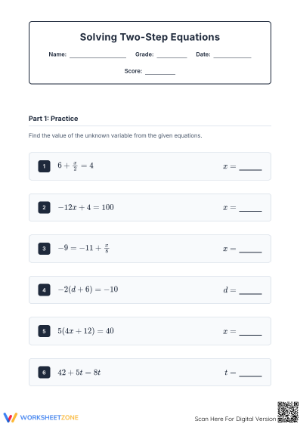
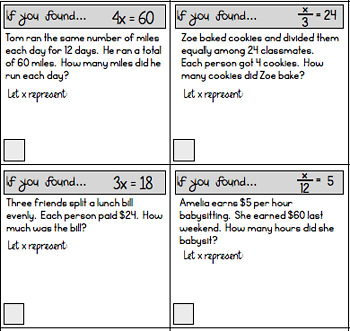
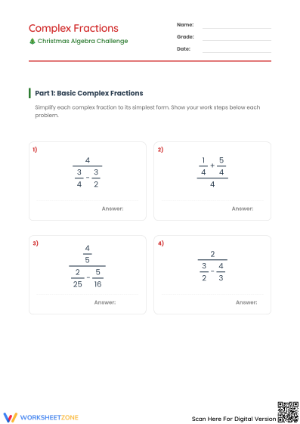
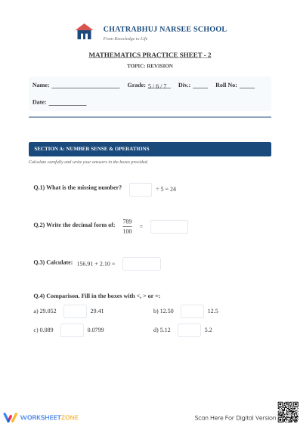
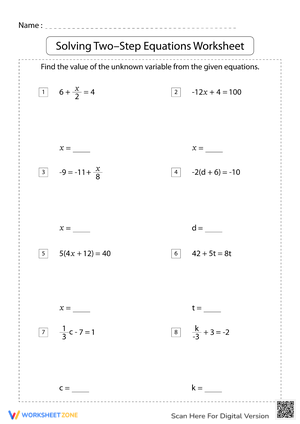
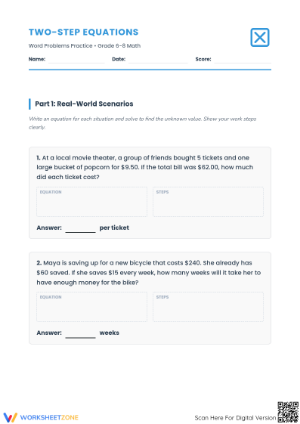
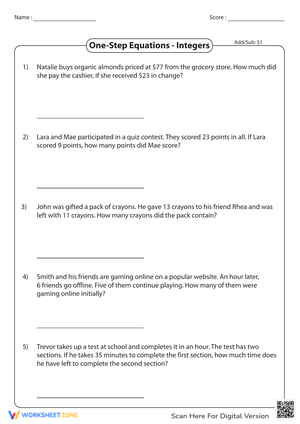
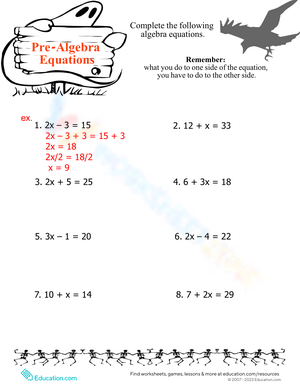
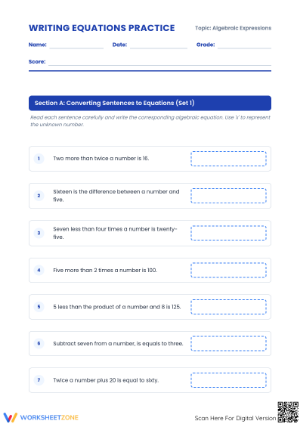
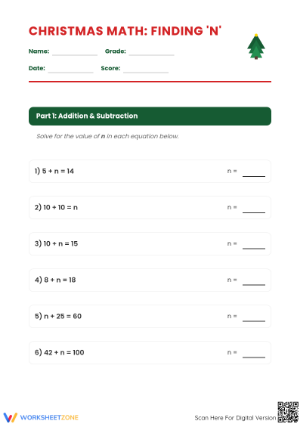
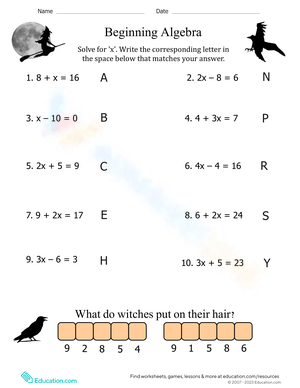
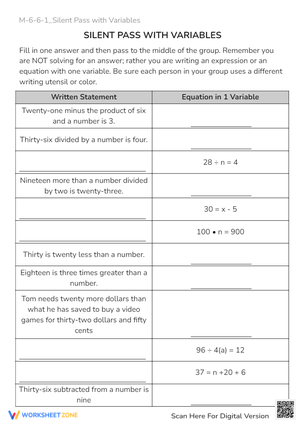
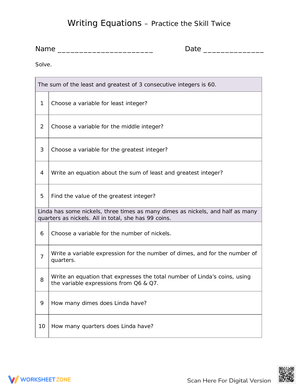
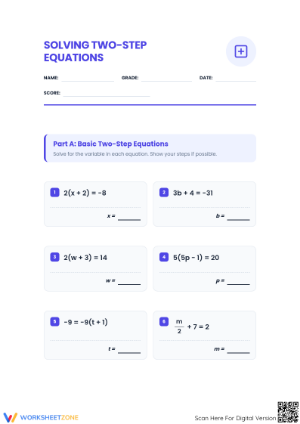
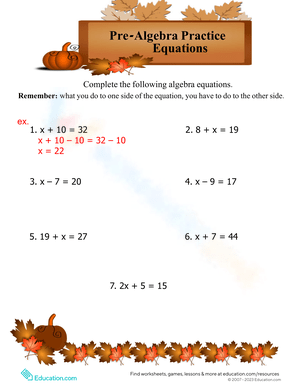
These 6th grade one variable equations printable worksheets give teachers structured, ready-to-use practice on the most foundational algebra skill of the middle grades: solving one-step equations by applying inverse operations. Each worksheet targets a specific equation form or a mix of forms, and the set progresses from single-operation practice into mixed and applied problems, so teachers have material that fits different points in the unit without building anything from scratch.
The Specific Skills These Worksheets Build
The set keeps its focus on one-step equations across all four operations, which is exactly what Grade 6 standards require before students move into multi-step work. Each worksheet addresses one or more of the following:
- Addition equations in the form x + a = b, where students isolate the variable by subtracting from both sides
- Subtraction equations in the form x - a = b, requiring addition as the inverse
- Multiplication equations such as 5x = 35, solved by dividing both sides by the coefficient
- Division equations such as x/6 = 8, where multiplying both sides restores the variable
- Mixed one-step practice, where students identify the operation first and then choose its inverse
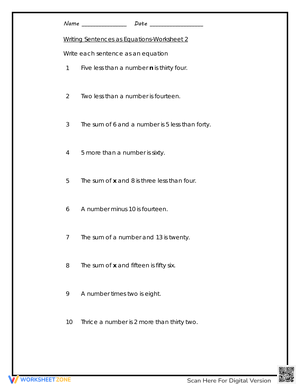
- Word problems that ask students to write the equation before solving, connecting the algebra to a real situation
Some worksheets in the set extend those forms into decimal and fraction values for students who are working comfortably with whole-number equations and ready to move further. That extension matters because keeping fractions and decimals out of algebra practice creates an artificial separation that shows up later as confusion when both appear together on assessments.
Frequent Student Errors Worth Watching For and Addressing
The most common error at this level is not using the wrong inverse operation — it's applying the correct inverse to only one side. A student solving x + 9 = 22 will subtract 9 from 22 and write x = 13 without questioning it, because the answer is numerically reasonable. The student never subtracted 9 from the left side because doing so felt unnecessary. That error comes from treating the equation as a number sentence to manipulate rather than a balance to maintain. Worksheets that include a "show your steps" column surface this gap quickly, because the written work makes the omission visible in a way a circled final answer never does.
A second pattern worth anticipating: multiplication and division equations trip students up more than addition and subtraction, even when the arithmetic is straightforward. Students who move through x + 9 = 22 without hesitation will stall on 4x = 28 because they read 4x as "four and x" rather than "four times x." The notation is new to them. A quick vocabulary check before assigning the multiplication worksheet each time — not a full re-teach, just a "what does 4x mean?" — catches this before it becomes a persistent block.
How to Build These Worksheets Into Your Lesson Plans
The most effective use of 6th grade one variable equations printable worksheets follows a predictable sequence without becoming rigid. On the day you introduce addition and subtraction equations, project two models and then hand out the corresponding single-operation worksheet for immediate practice while the model is still on the board. The following day, move to multiplication and division. By the third day, a mixed worksheet gives you a clear picture of what students can do independently — and reveals whether they are reading the equation structure or defaulting to whichever operation appeared most recently in the lesson.
Beyond direct instruction, these worksheets fit the 8 to 10 minutes at the start of class after the first few lessons on the topic. Pull four problems from a mixed worksheet for daily bell work, rotating through equation types across the week. That repeated low-stakes retrieval builds retention more reliably than a single long practice session. For intervention groups, single-operation worksheets let you slow the pace and require students to say each step aloud before writing it — "9 is added to x, so I subtract 9 from both sides" — which closes the gap between procedural mimicry and actual understanding faster than additional repetition alone.
Standard Alignment
These worksheets align to CCSS 6.EE.B.7, which requires students to solve real-world and mathematical problems by writing and solving equations in the forms x + p = q and px = q, for cases where p, q, and x are nonnegative rational numbers. In classroom terms, this standard sits at the hinge point between arithmetic and formal algebra. Students have been finding unknowns implicitly since early elementary — what changes in Grade 6 is the expectation that they use a variable, write a balanced equation, and justify each step they take. Worksheets that include a "check your solution" step or ask for a written sentence explanation push students toward that justification, which is the part of 6.EE.B.7 that most procedural practice worksheets skip entirely.
Differentiating These Worksheets Across Readiness Levels
Differentiation here does not require rewriting every worksheet. Three adjustments cover most classroom situations. Students who need reteaching benefit from single-operation worksheets with wider spacing, fewer items, and a fully worked example at the top of the problem set for that specific equation type — not a general reminder about inverse operations, but a model that mirrors exactly what they are about to practice. On-level students move through the standard sequence: single-operation to mixed to word problems. Students ready for extension work equations that involve fractions and decimals, or write their own one-variable problems and trade with a partner for solving.
For students who struggle with the language demands of word problems, one adjustment works consistently well: define the variable before the equation appears. Writing "Let x = the number of students" at the top of a problem removes a decision-making step that has nothing to do with algebraic reasoning but derails comprehension enough to stall the whole task. That small change keeps the cognitive demand on the math, where it belongs.
Frequently Asked Questions
What equation forms do these worksheets cover?
Each worksheet targets one-step equations using addition, subtraction, multiplication, or division, in the forms x + a = b, x - a = b, ax = b, and x/a = b. Some worksheets in the set extend those forms into rational number values — decimals and fractions — for students ready to move past whole-number equations.
Can these worksheets work for small-group intervention, not just whole-class practice?
Yes. The single-operation worksheets are especially well suited for small-group reteaching because they isolate one equation type at a time. In an intervention setting, reducing the number of problems and requiring students to verbalize each step before writing it turns the worksheet into a diagnostic conversation rather than a completion task — which is a more accurate way to find out where the thinking actually breaks down.
Do the worksheets include answer keys?
Most 6th grade one variable equations printable worksheets resources include answer keys, and that feature is worth confirming before downloading or purchasing. Answer keys support partner-check routines, self-correction at math stations, and fast formative grading during independent work — without requiring the teacher to be at every table at once.
How do the word problem worksheets connect to the procedural practice?
The word problem worksheets ask students to identify the unknown, assign a variable, write the matching equation, and then solve — mirroring the full expectation of 6.EE.B.7. Teachers who assign only procedural practice often find that students can solve 4x = 28 in isolation but freeze when the same relationship appears in a sentence. That is also where 6th grade one variable equations printable worksheets aligned to the standard do their most useful work: showing students that the variable stands for something real, not just a letter to find.













 Interactive Worksheet Maker
 Quiz Maker
 Word Search Maker
 Crossword Puzzle Maker
 Word Scramble Generator
 Sentence Scramble Generator
 Handwriting Worksheet Generator
 Name Tracing Generator
 Fill In The Blank Generator