These understanding expressions and equations worksheets for 6th grade give teachers a ready-to-print set of algebra readiness practice that targets the exact moment in the curriculum where arithmetic stops and early algebraic thinking begins. Grade 6 is the year variables enter formally — students write expressions from verbal phrases, evaluate by substituting given values, and solve one-step equations — and the gap between surface-level procedure and actual conceptual understanding tends to open quickly. This set addresses that gap with practice that moves from sorting and classifying to writing, evaluating, and solving.
What the Set Builds, Skill by Skill
The progression across the worksheets moves students from recognition to production to application. Earlier worksheets ask students to sort and classify — identifying whether a given mathematical statement is an expression or an equation and justifying the label. From there, the skills expand:
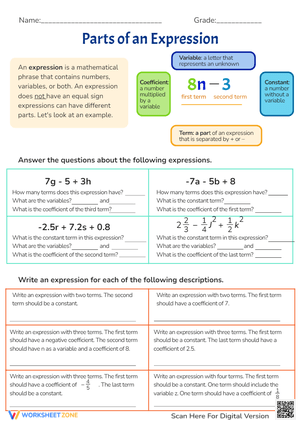
- Evaluating expressions: Students substitute given values for variables and apply order of operations to find the result.
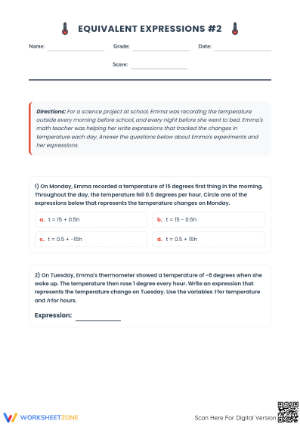
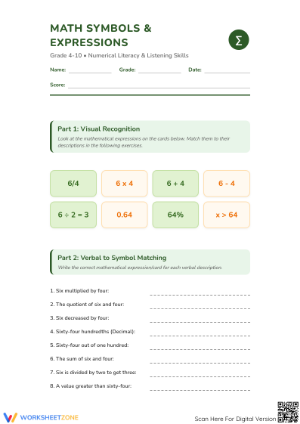
- Translating verbal phrases: Students rewrite phrases like "8 less than twice n" or "the quotient of x and 4" as algebraic expressions.
- Simplifying numerical expressions: Students work through problems involving parentheses, exponents, and the full order of operations sequence.
- Solving one-step equations: Students isolate the variable in equations using whole numbers, fractions, and decimals.
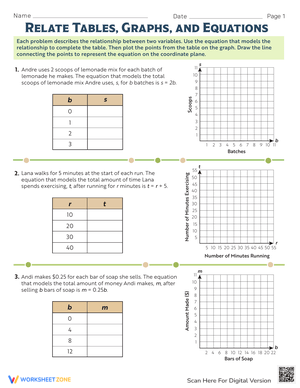
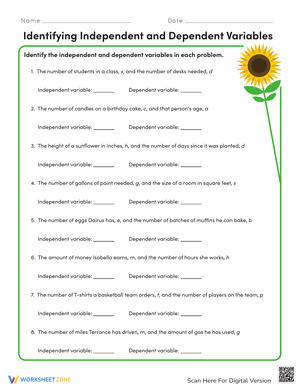
- Word problems: Students identify what is known, assign a variable to the unknown, then write and solve the appropriate equation.
The later worksheets combine skills rather than isolating them — a necessary step if students are going to apply this knowledge flexibly during a unit assessment or benchmark.
Algebra Misconceptions That Surface Early in This Unit
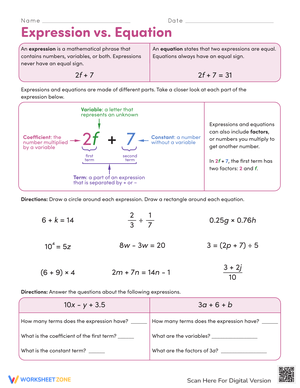
The most persistent misconception here is that an expression must resolve to a single numerical answer. Students who have spent years in arithmetic expect every math problem to conclude with "equals something," so when they see 4x + 3, they look for a way to solve it. They'll often write 4x + 3 = ? and then stall, genuinely confused about why nothing resolves. Treating the expression as a quantity — one that can be evaluated when a value is given, but not solved on its own — requires direct, repeated instruction. Placing an expression and its closely related equation side by side, like 3x + 5 next to 3x + 5 = 17, helps students see the distinction faster than almost any other technique. They notice that the expression names a value while the equation poses a question about which value makes the statement true.
A second error appears consistently in translation tasks. When students read "7 less than a number," many write 7 − n instead of n − 7. The phrase triggers the number 7 first, and students transcribe what they read rather than parsing the mathematical relationship. Pairing translation exercises with a substitution check — plugging in a known value to verify the expression makes sense in context — catches this before it becomes automatic.
Order of operations during evaluation is the third pattern worth monitoring closely. Students recall PEMDAS but misapply it, especially when exponents appear. Given 2x² + 1 with x = 3, a significant portion will compute (2 · 3)² + 1 = 37 instead of 2 · 9 + 1 = 19. That error comes from a parenthesization habit, not a vocabulary gap — and it takes worked examples with explicit narration, not just a reminder about the rules, to correct it.
How to Work These Worksheets Into Your Lesson Plans
Placement depends on where you are in the unit. Early in instruction, use the identification and sorting worksheets as a partner activity immediately after direct teaching — five minutes of sorting with partner discussion yields better formative data than a silent homework assignment. Students who sort incorrectly almost always explain their reasoning aloud in ways that reveal the specific confusion, which silent work never surfaces.
Once students have seen substitution modeled, the evaluation worksheets work well as warm-ups. A routine of three or four problems at the start of class — one expression to evaluate, one phrase to translate, one equation to solve — builds fluency through repetition without requiring extra planning time. That routine also keeps prior skills active as the unit moves forward into new content.
Before a quiz or unit assessment, the mixed-skill worksheets serve a different diagnostic purpose. They reveal whether students can hold multiple ideas simultaneously. A student who evaluates expressions accurately but stalls when asked to both write and solve an equation inside a word problem is showing a specific, addressable gap. One worksheet used as a pre-assessment the day before a test can redirect instruction more efficiently than a general chapter review.
Standard Alignment
These worksheets align primarily to the Common Core State Standards cluster 6.EE.A (Apply and extend previous understandings of arithmetic to algebraic expressions) and 6.EE.B (Reason about and solve one-variable equations and inequalities). Specific standards addressed include:
- 6.EE.A.1: Write and evaluate numerical expressions involving whole-number exponents.
- 6.EE.A.2: Write, read, and evaluate expressions in which letters stand for numbers — including translating between verbal descriptions and algebraic form.
- 6.EE.B.5: Understand solving an equation as the process of determining which values make the equation true.
- 6.EE.B.7: Solve real-world problems by writing and solving equations of the form x + p = q and px = q for non-negative rational numbers.
In most district pacing guides, the 6.EE cluster lands in the first or second unit of 6th grade — before ratios, before statistics — because algebraic language and equation-solving transfer into nearly every unit that follows. Understanding expressions and equations worksheets for 6th grade give teachers the repeated practice resources they need during this foundational stretch, when concepts are freshest and early misconceptions are easiest to correct. Teachers who build this content thoroughly in the fall consistently report less time re-explaining variable notation later in the year.
Differentiating the Set Across Ability Levels
For students still consolidating whole-number arithmetic, the identification worksheets with built-in visual support work first — color-coding expressions one color and equations another, or circling the equals sign before classifying the statement. Reducing the number of problems per sitting and focusing on one skill at a time prevents working-memory overload without lowering the mathematical expectation. Sentence frames like "This is an expression because ___" give students a structured entry point for practicing mathematical language without freezing at a blank response space.
On-grade students generally work through the set in sequence, pausing for discussion after the translation and evaluation worksheets where errors cluster most densely. For students ready for extension, remove the worked examples on individual worksheets and ask them to generate their own: write a verbal phrase, translate it into an expression, embed it in an equation, and solve. Trading the result with a partner for translation adds a layer of discussion and peer accountability that independent practice alone cannot replicate.
Teachers who use understanding expressions and equations worksheets for 6th grade across different ability groups find that mathematical vocabulary is the most significant differentiator. Students at all levels benefit from repeated exposure to terms like coefficient, constant, evaluate, and variable — but the rate and density of exposure they need varies considerably, and worksheets that weave these terms consistently into directions rather than front-loading them in a glossary tend to produce stronger retention.
Frequently Asked Questions
What is the difference between an expression and an equation, and how do these worksheets address it?
An expression — like 5n + 2 — represents a quantity. It has no equals sign and cannot be solved, only evaluated when a value for the variable is provided. An equation — like 5n + 2 = 17 — states that two quantities are equal and can be solved to find the unknown value. Each worksheet in this set reinforces the distinction through identification tasks, sorting exercises, and side-by-side comparisons of matched pairs like 3x + 5 and 3x + 5 = 20, so the contrast stays visible rather than abstract.
What grade level are these worksheets appropriate for?
The content targets 6th grade as the primary audience, aligned to the CCSS 6.EE standards. The earlier worksheets in the set also work for accelerated 5th graders being introduced to variables for the first time. The mixed-review and word-problem worksheets are appropriate as review material for 7th graders revisiting one-step equations at the start of the year.
How long does each worksheet take to complete?
Most worksheets in the set take between 10 and 20 minutes for on-grade students working independently. Identification and matching worksheets run shorter. Word-problem and mixed-skill worksheets run longer, particularly when teachers build in partner discussion or written explanation of reasoning alongside the computation.
Do the worksheets include answer keys?
Yes. Each worksheet comes with a corresponding answer key. For translation tasks — where multiple correct phrasings exist — the keys note acceptable variations so teachers are not flagging valid student responses as errors. That matters most when understanding expressions and equations worksheets for 6th grade are built into self-check or peer-grading routines, where students are reading the key directly rather than having a teacher interpret it.













 Interactive Worksheet Maker
 Quiz Maker
 Word Search Maker
 Crossword Puzzle Maker
 Word Scramble Generator
 Sentence Scramble Generator
 Handwriting Worksheet Generator
 Name Tracing Generator
 Fill In The Blank Generator