


























Views
Downloads

Printable One-Step Equations Worksheet | Grade 6 Math
Paste this activity's link or code into your existing LMS (Google Classroom, Canvas, Teams, Schoology, Moodle, etc.).
Students can open and work on the activity right away, with no student login required.
You'll still be able to track student progress and results from your teacher account.
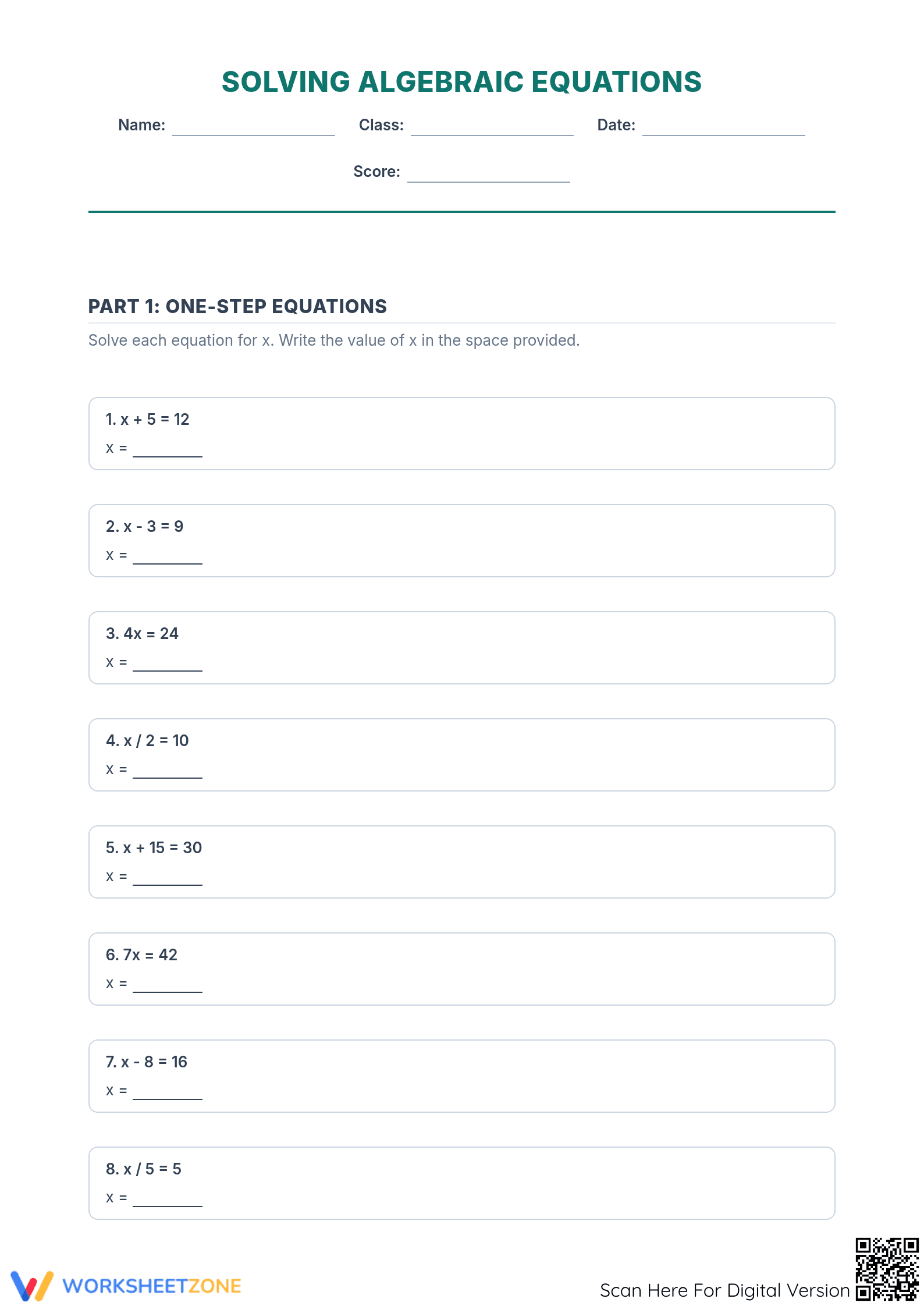
This comprehensive worksheet provides structured practice for students learning to solve one-step algebraic equations involving addition, subtraction, multiplication, and division. By isolating the variable through inverse operations, learners build a solid foundation for more complex mathematical reasoning. This resource ensures students gain confidence in translating word problems into equations and finding precise solutions independently.
At a Glance
- Grade: 6 · Subject: Math
- Standard:
CCSS.MATH.CONTENT.6.EE.B.7— Solve one-step equations involving non-negative rational numbers in real-world contexts- Skill Focus: Solving One-Step Algebraic Equations
- Format: 4 pages · 30 problems · Answer key included · PDF
- Best For: Independent practice and formative assessment
- Time: 30–45 minutes
What's Inside
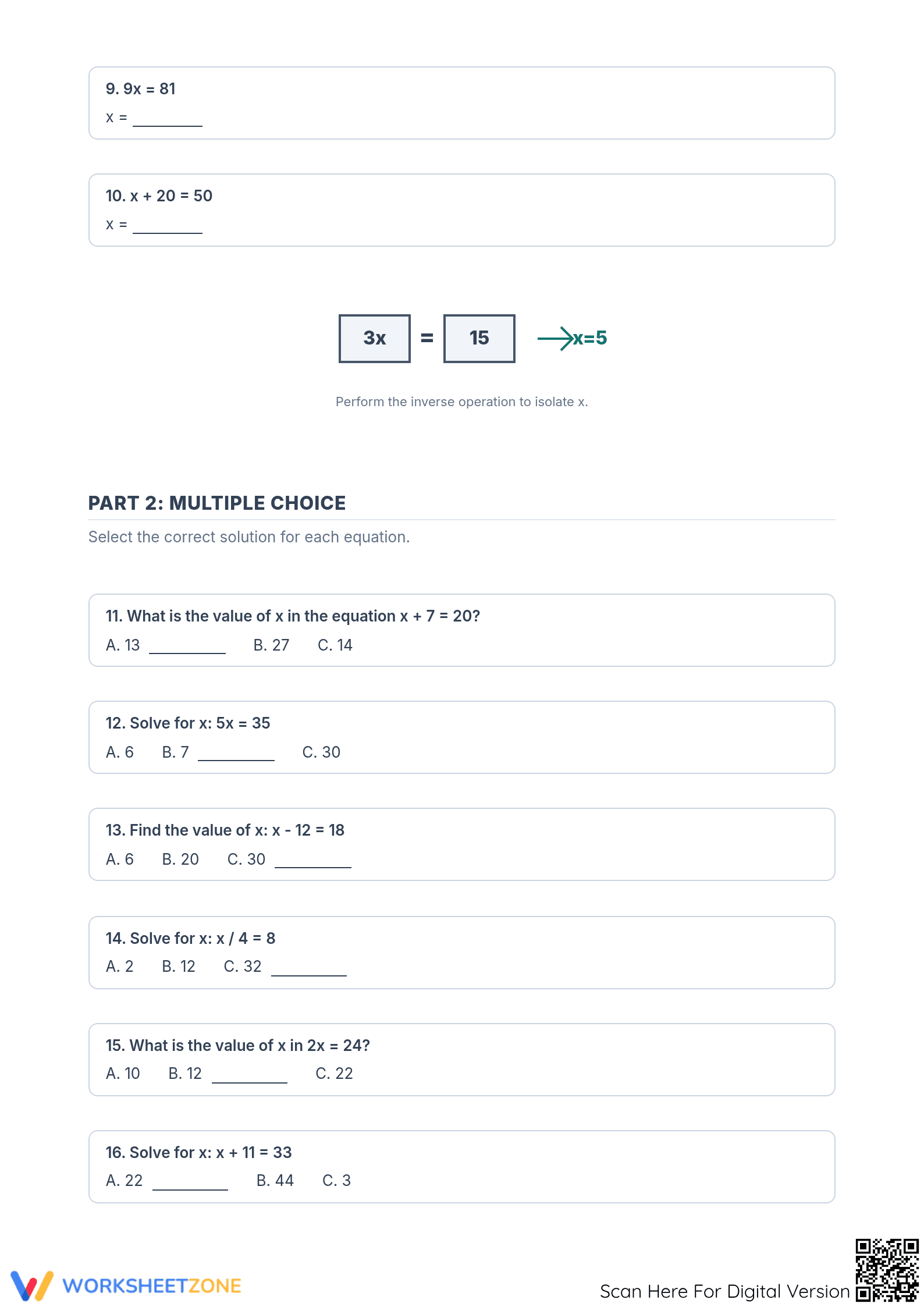
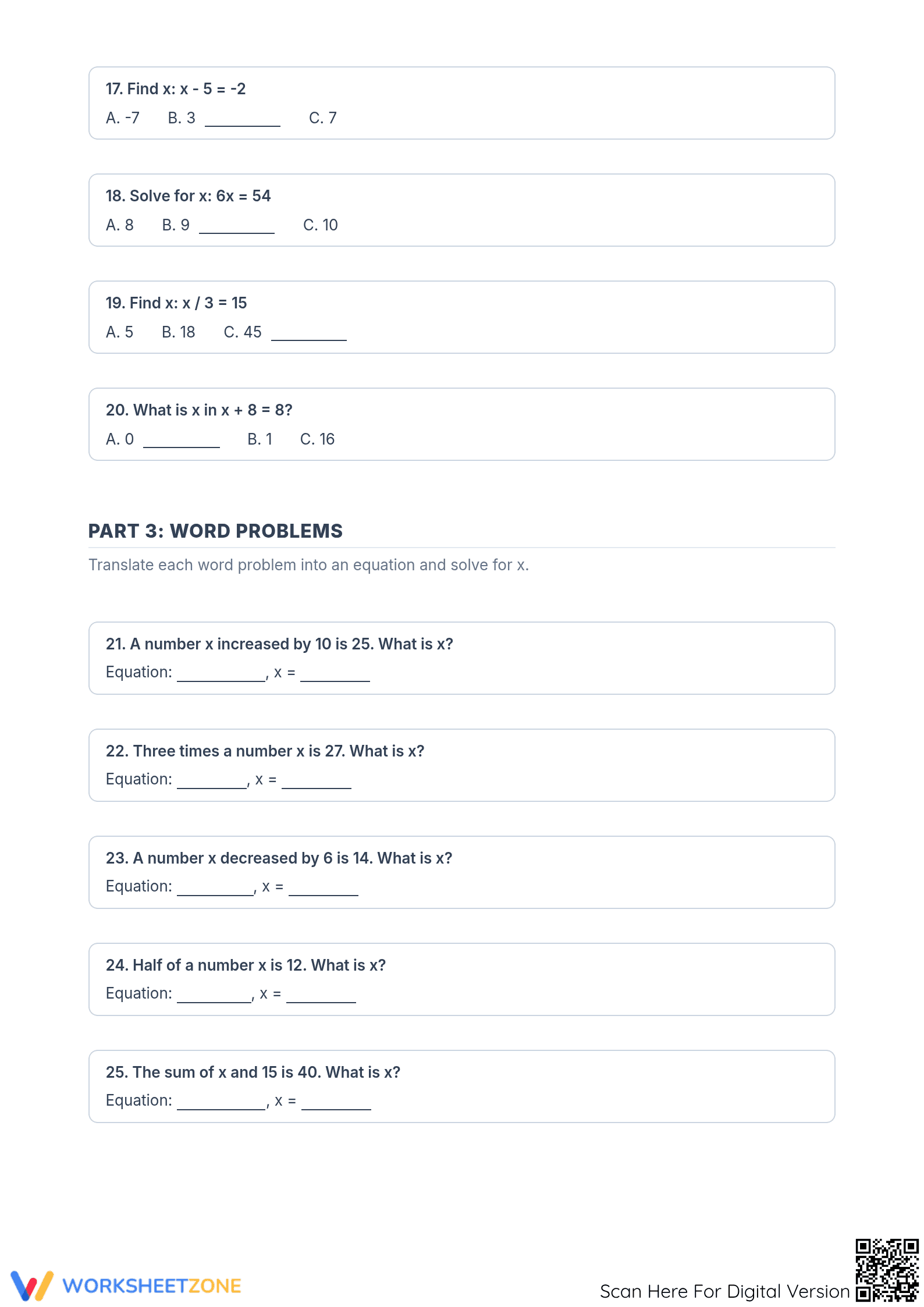
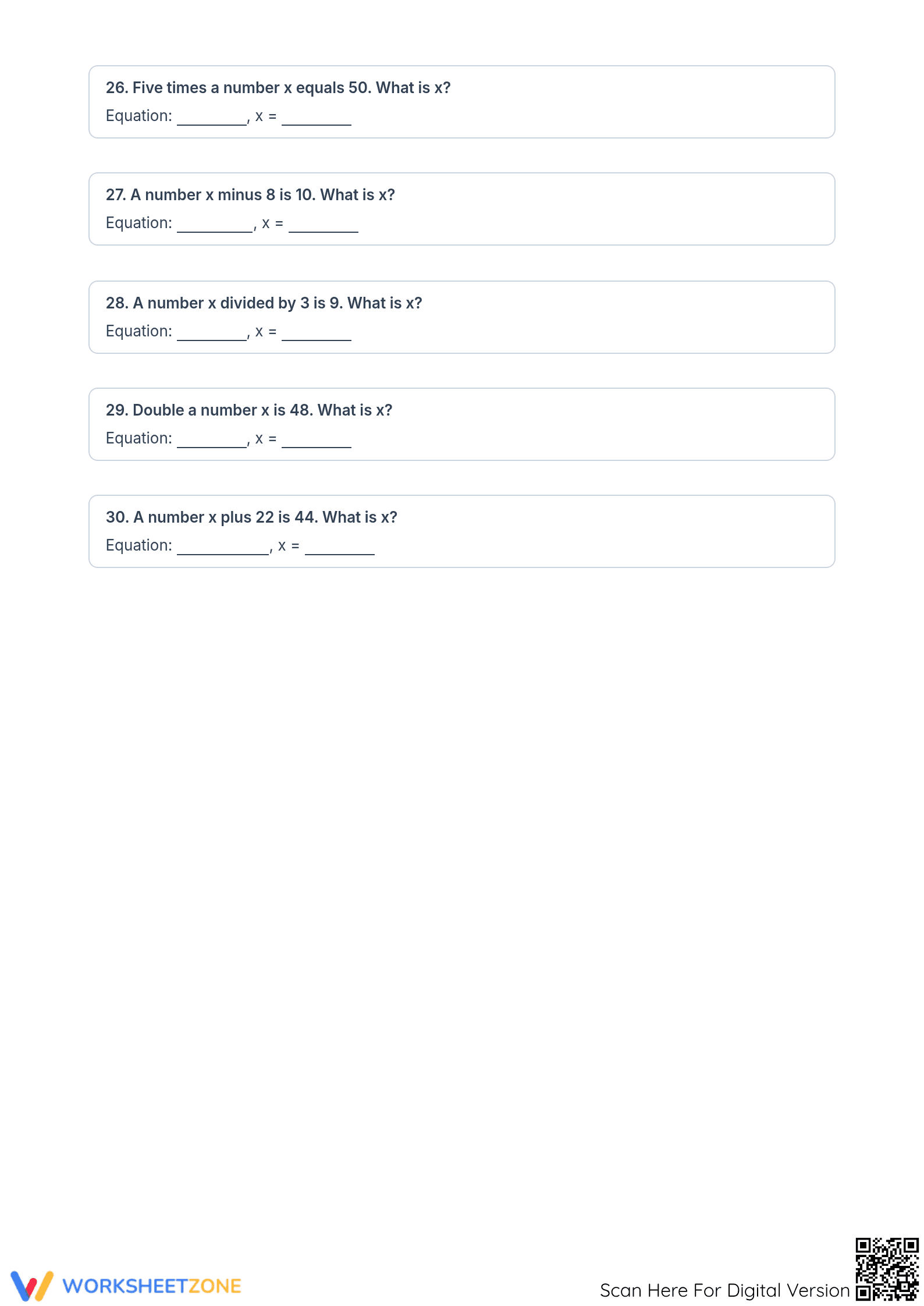
The worksheet is organized into three parts. Part 1 features ten computation problems where students solve for x in basic one-step formats. Part 2 offers ten multiple-choice questions to test recognition and error analysis. Part 3 challenges students with ten word problems requiring the translation of verbal phrases into algebraic equations. The 4-page layout provides ample workspace for calculations.
Skill Progression
- Guided Practice: The initial problems focus on inverse operations with small whole numbers, allowing students to master the procedural steps of isolating the variable.
- Supported Practice: Multiple-choice options provide scaffolding and immediate feedback, helping students identify correct solution paths and common mistakes.
- Independent Practice: The concluding word problems require students to apply their knowledge to real-world scenarios, moving from abstract calculation to applied mathematical modeling.
This progression follows a gradual release of responsibility model, ensuring students transition smoothly from procedural fluency to conceptual application.
Standards Alignment
The content is meticulously aligned with CCSS.MATH.CONTENT.6.EE.B.7, which requires students to "Solve real-world and mathematical problems by writing and solving equations of the form x + p = q and px = q for cases in which p, q and x are all nonnegative rational numbers." This worksheet covers all four arithmetic operations. Both standard codes can be copied directly into lesson plans, IEP goals, or district curriculum mapping tools.
How to Use It
Incorporate this worksheet after a direct instruction lesson on inverse operations. Use the first page as a "think-aloud" activity where the teacher models the steps on a whiteboard. For formative assessment, collect the multiple-choice section to quickly identify students who may need additional small-group support. The word problems serve as an excellent extension for students who have mastered basic computational steps.
Who It's For
This resource is designed for Grade 6 students but is effective as a review for Grade 7 and 8 learners reinforcing their algebraic foundations. It is ideal for general education classrooms, special education settings requiring clear visual structure, and home-school environments. The inclusion of word problems makes it a valuable tool for students preparing for standardized testing or introductory pre-algebra courses.
Effective instruction in algebraic thinking relies on the gradual transition from concrete arithmetic to abstract variable manipulation. This Grade 6 worksheet aligns with the instructional shifts identified in the RAND AIRS 2024 report, which emphasizes the importance of procedural fluency as a precursor to complex problem-solving. By providing 30 targeted tasks that cover addition, subtraction, multiplication, and division, this resource supports the development of mental models for inverse operations. Research from Fisher & Frey (2014) highlights that scaffolded practice, such as moving from direct computation to word problem translation, significantly improves student retention of algebraic concepts. This standards-aligned tool provides the necessary volume of practice for students to achieve mastery of CCSS.MATH.CONTENT.6.EE.B.7. Teachers can utilize this structured format to ensure consistent application of mathematical properties across diverse problem sets, facilitating a deeper understanding of the relationship between operations and variables.


