


























Views
Downloads
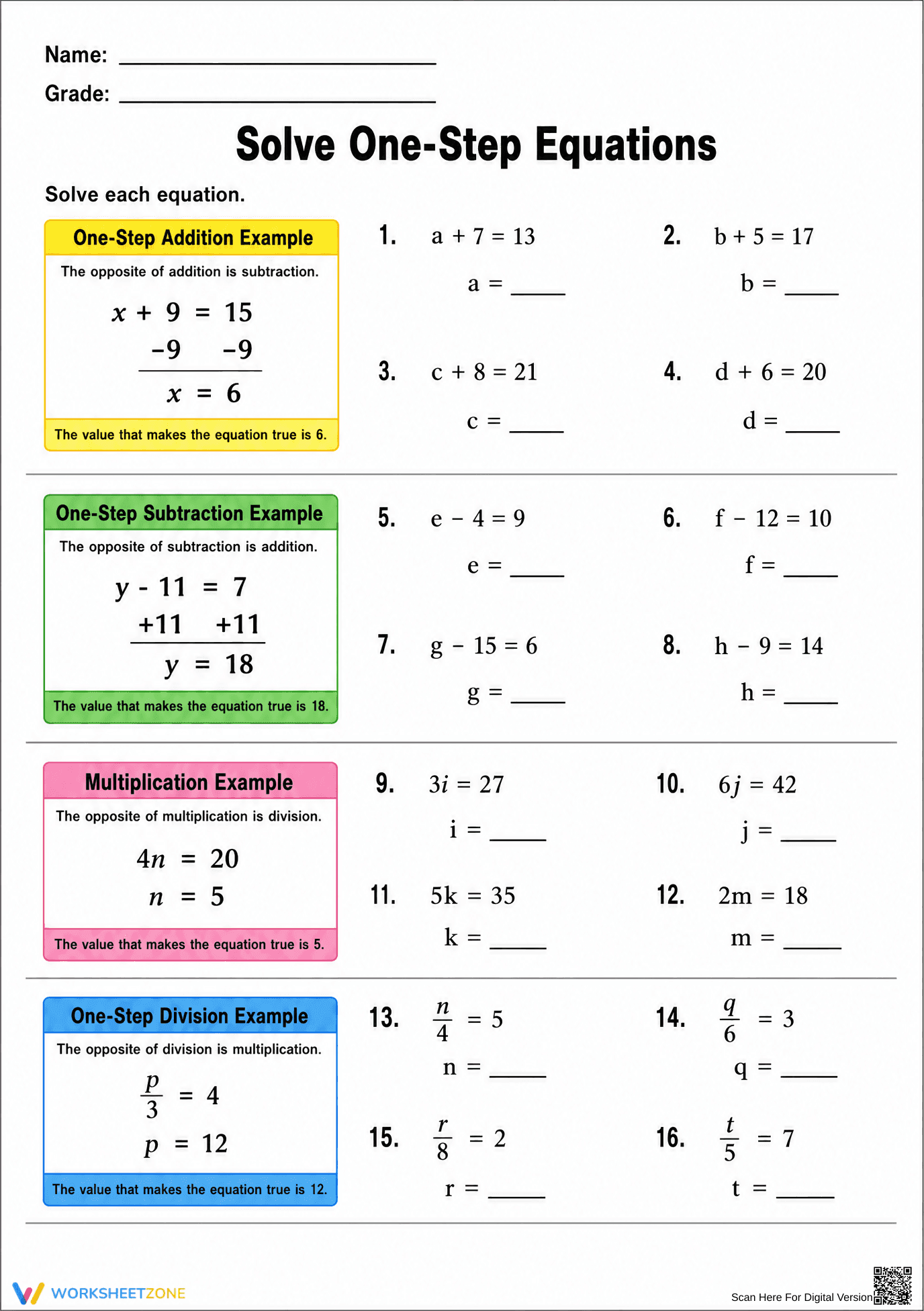

Grade 6 One-Step Equations — Printable No-Prep Worksheet
Paste this activity's link or code into your existing LMS (Google Classroom, Canvas, Teams, Schoology, Moodle, etc.).
Students can open and work on the activity right away, with no student login required.
You'll still be able to track student progress and results from your teacher account.
This Grade 6 math worksheet gives students targeted practice solving one-step equations using addition, subtraction, multiplication, and division. By providing clear, color-coded worked examples for each operation, the resource helps learners confidently isolate variables and build foundational algebra skills essential for higher-level mathematics.
At a Glance
- Grade: 6 · Subject: Math
- Standard:
CCSS.MATH.CONTENT.6.EE.B.7— Solve equations of the form x + p = q and px = q- Skill Focus: Solving one-step equations
- Format: 1 page · 16 problems · Answer key included · PDF
- Best For: Independent practice and review
- Time: 15–20 minutes
This single-page resource features 16 practice problems divided into four sections: addition, subtraction, multiplication, and division. Each section begins with a color-coded example box demonstrating the inverse operation required to isolate the variable. Students have ample workspace to write step-by-step solutions directly on the page. A complete answer key is included for quick grading.
Designed for immediate classroom implementation, this worksheet requires zero teacher preparation:
- Print (1 minute): Simply download the PDF and print a class set. The clear layout ensures high-quality copies.
- Distribute (1 minute): Hand out the worksheet as a warm-up, homework assignment, or independent practice activity.
- Review (3 minutes): Use the included answer key to quickly check student work or project it for whole-class review.
With a total prep time of under two minutes, this resource is an excellent addition to any emergency sub plan, as the built-in examples allow students to guide their own learning.
This worksheet is strictly aligned to CCSS.MATH.CONTENT.6.EE.B.7, which requires students to solve real-world and mathematical problems by writing and solving equations of the form x + p = q and px = q. It also supports foundational skills for later algebraic reasoning. Both standard codes can be copied directly into lesson plans, IEP goals, or district curriculum mapping tools.
Deploy this worksheet during the independent practice phase of direct instruction. After teaching inverse operations, assign these 16 problems to solidify understanding. Alternatively, use it as a targeted intervention tool for small groups. As a formative assessment tip, observe whether students write the inverse operation on both sides of the equation, indicating a strong grasp of algebraic balance. Expected completion time is 15 to 20 minutes.
This resource is primarily designed for sixth-grade general education math students, but it serves as an excellent review for seventh and eighth graders who need to reinforce basic algebraic concepts. The color-coded examples provide built-in scaffolding, making it highly accessible for students with IEPs or those requiring visual aids. Pair this worksheet with a classroom anchor chart detailing inverse operations to maximize student success.
Mastering the ability to solve equations of the form x + p = q and px = q is a critical milestone in middle school mathematics, directly tied to CCSS.MATH.CONTENT.6.EE.B.7. According to EdReports 2024, instructional materials that provide explicit, worked examples alongside targeted practice significantly improve student retention of algebraic procedures. This worksheet leverages that evidence-based approach by pairing clear visual models with immediate application opportunities. By requiring students to isolate variables using inverse operations, the resource builds the procedural fluency necessary for multi-step equations and complex problem-solving in later grades. The structured format reduces cognitive load, allowing learners to focus entirely on the mathematical relationships at play. Consistent practice with these foundational structures ensures students develop the automaticity required to succeed in advanced algebra and beyond.


