


























Views
Downloads

Grade 6 One-Step Equations — Printable No-Prep Worksheet
Paste this activity's link or code into your existing LMS (Google Classroom, Canvas, Teams, Schoology, Moodle, etc.).
Students can open and work on the activity right away, with no student login required.
You'll still be able to track student progress and results from your teacher account.
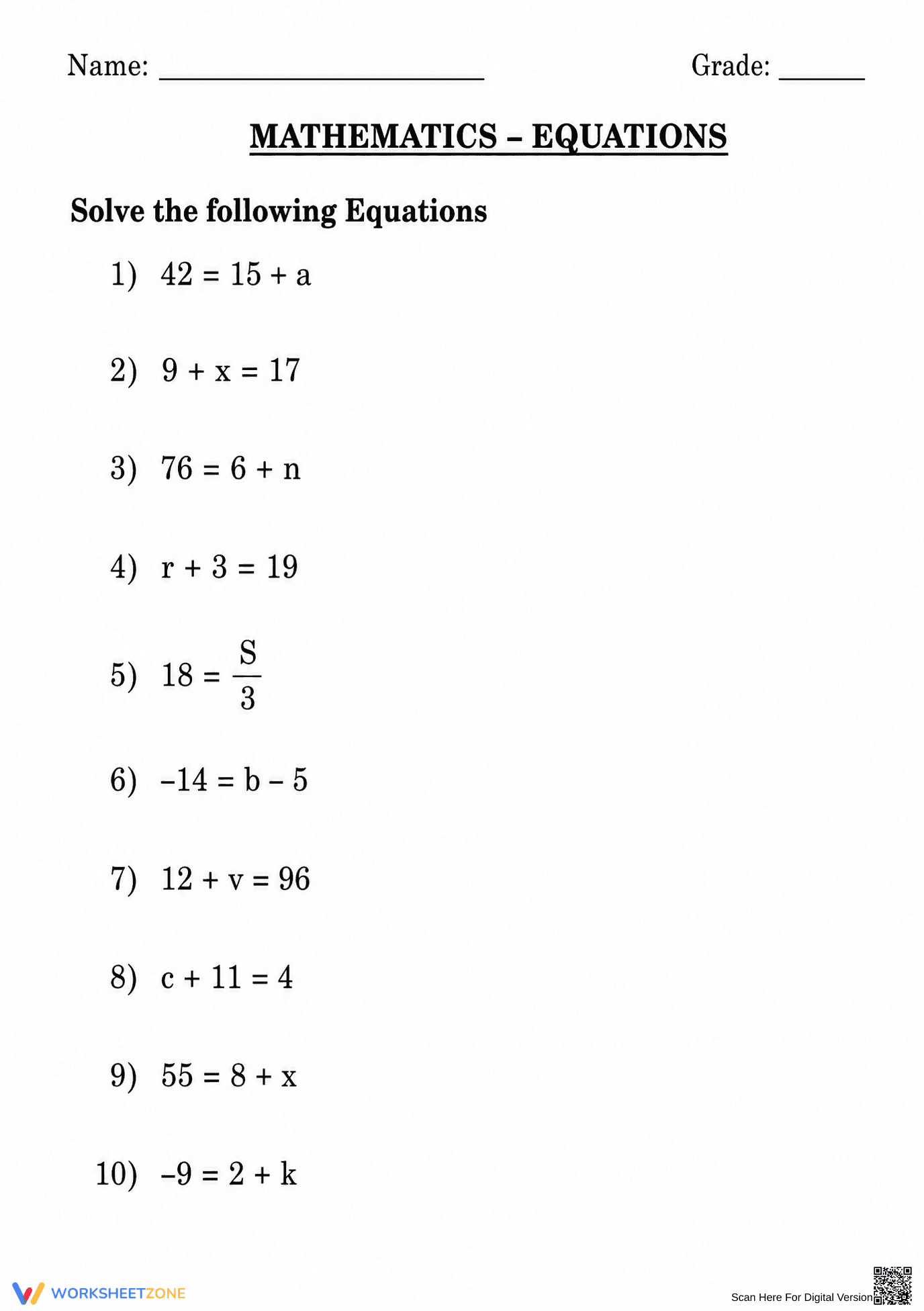
This Grade 6 math worksheet provides focused practice on solving one-step equations. Students will isolate variables using inverse operations across addition, subtraction, and division. By working through these foundational algebraic problems, learners build the procedural fluency required for more complex, multi-step equations in advanced math courses.
At a Glance
- Grade: 6 · Subject: Math
- Standard:
CCSS.MATH.CONTENT.6.EE.B.7— Solve one-step equations with variables- Skill Focus: Solving one-step equations
- Format: 1 page · 10 problems · Answer key included · PDF
- Best For: Independent practice and review
- Time: 10–15 minutes
This single-page resource features 10 straightforward one-step equations. The problem set includes a mix of addition, subtraction, and simple division equations, with variables placed on both the left and right sides of the equals sign. Some problems incorporate negative integers to gently increase the cognitive demand. A complete answer key is provided to ensure accurate grading and immediate feedback.
Zero-Prep Workflow
Designed for immediate classroom implementation:
- Print (1 minute): Download the PDF and print a class set. The clean, distraction-free layout saves ink and prints clearly.
- Distribute (1 minute): Hand out the worksheet as a warm-up, exit ticket, or independent practice activity. No additional manipulatives or materials are required.
- Review (3 minutes): Use the included answer key to quickly check student work or project it on the board for self-grading.
With under two minutes of total teacher prep time, this resource is highly suitable for emergency sub plans or last-minute lesson adjustments.
Standards Alignment
This worksheet is directly aligned to CCSS.MATH.CONTENT.6.EE.B.7: Solve real-world and mathematical problems by writing and solving equations of the form x + p = q and px = q. It also supports early exposure to integer operations found in seventh-grade standards. Both standard codes can be copied directly into lesson plans, IEP goals, or district curriculum mapping tools.
How to Use It
Use this worksheet during independent practice. After modeling how to isolate a variable on the board, assign these 10 problems to gauge individual comprehension. As a formative assessment observation tip, watch to see if students are explicitly writing out the inverse operation on both sides of the equation (e.g., subtracting 15 from both sides in problem 1). This step is crucial for preventing errors. The entire activity should take students approximately 10 to 15 minutes to complete.
Who It's For
This resource is primarily designed for sixth-grade math students mastering introductory algebra. It is also an excellent remediation tool for seventh and eighth graders who need to review basic equation solving before tackling two-step or multi-step problems. To differentiate for struggling learners, pair this worksheet with an anchor chart detailing the steps for inverse operations. For early finishers, challenge them to write a real-world word problem that matches one of the equations on the page.
Mastering the ability to solve one-step equations is a critical milestone in middle school mathematics. According to EdReports 2024, students who develop strong procedural fluency with basic algebraic concepts are significantly more likely to succeed in high school algebra and beyond. This worksheet directly supports CCSS.MATH.CONTENT.6.EE.B.7, helping students solve one-step equations with variables efficiently. By providing targeted, distraction-free practice, educators can isolate specific misconceptions related to inverse operations and integer arithmetic. Consistent practice with these foundational skills reduces cognitive load when students eventually transition to complex, multi-step equations. Structured problem sets ensure learners build the confidence and mathematical reasoning required for advanced STEM coursework.


