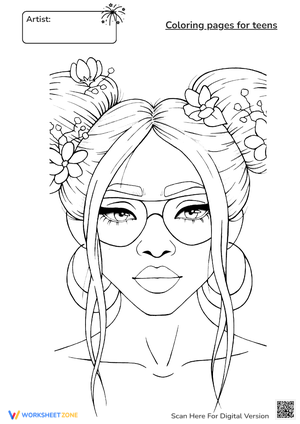
These 6th grade art printable pdf worksheets give teachers a low-prep set of resources covering line, value, color theory, texture, perspective, and design principles — in formats that fit a bell ringer, a guided lesson, or an independent work block without requiring a full project setup.
What's Inside the Set
Each worksheet addresses one concept at a time. That matters at sixth grade because students are absorbing new vocabulary and new technique simultaneously, and overloading both into one task produces the same result every time: stalling, skipped directions, and work that stops halfway through. A tight scope — one skill, one task, one response area — gives students a realistic target and a better chance of finishing something they're actually satisfied with.
- Line and contour: varied line types, gesture drawing, blind contour from direct observation
- Value and shading: gradient scales, pressure control exercises, shading three-dimensional forms
- Color theory: color wheel relationships, warm and cool sorting, expressive palette planning
- Texture: implied versus actual texture, invented texture samples, cross-hatching and stippling
- Perspective: horizon lines, vanishing points, one-point perspective room and street drawings
- Design principles: identifying and applying balance, contrast, emphasis, and repetition in compositions
- Art history and critique: artist observation response worksheets, vocabulary matching, structured written reflection
Recurring Technical Errors Worth Addressing Before They Become Habits
Color theory is where the gap between knowing and doing becomes most visible. Sixth graders who correctly label complementary colors on a diagram will still reach for orange and red the next painting day because they look good together — the vocabulary task doesn't automatically transfer to studio decision-making. A color planning worksheet that asks students to write their palette choices and name the color relationship before touching paint creates exactly the pause that a definition exercise alone doesn't.
Value work exposes a specific mechanical problem: most students press too hard too early. They end up with a gradient that jumps from white to dark gray with nothing in between. A worksheet that divides the gradient bar into six labeled steps — white, very light, light, medium, dark, very dark — and asks students to fill each step separately gives them a concrete physical target instead of the vague instruction to "shade gradually," which experienced drawers understand and beginners do not.
In perspective drawing, students usually place the vanishing point correctly but then draw their vertical lines at a slight angle. It looks almost right — which is exactly the problem. The error is small enough to feel acceptable and gets reinforced with every repetition. A worksheet with a pre-printed horizon line and a small reference diagram in the corner catches this before the habit forms.
Lesson-Planning Strategies for Working These Worksheets Into Your Week
The most reliable use for 6th grade art printable pdf worksheets is the first 5 to 8 minutes of class. A line design task or a texture sample box requires no color decisions and no setup beyond pencil and paper. Monday mornings especially benefit from a structured drawing warm-up — students arrive with attention scattered after the weekend, and a concrete visual task settles the room in the opening minutes far more reliably than verbal prompts to get focused.
The other consistent window is the end of a project cycle — those 10 minutes after cleanup when paint is drying and a project is physically finished but class hasn't ended. A critique or artist observation worksheet fills that gap cleanly without generating new studio mess. These worksheets also serve as dependable sub plans: a well-formatted task with a model example and a clear response area lets students work without a live demonstration. A substitute with no art background can distribute a perspective worksheet, read the short directions aloud, and manage the period without needing to explain technique.
Sorting worksheets into four labeled categories — warm-ups, skill practice, sub plans, reflection — takes about 20 minutes to set up once and saves real time every week. Instead of searching for something that fits a given day, teachers pull from a category that matches the lesson context. A color planning worksheet lives in the skill practice folder and comes out before a painting unit; a critique form lives in the reflection folder and comes out when studio work wraps.
Adjusting These Worksheets for the Full Range of Learners in the Room
Sixth grade is when many students hit a genuine wall of self-consciousness about their drawing ability. They start comparing their work to photorealism, decide they can't draw, and stop taking risks in the studio. Worksheets that break technique into visible, achievable steps — shade this sphere, control line weight along this path, map this room with one vanishing point — give those students concrete, provable wins. That matters more at this grade than at fourth or fifth, because the anxiety about visual ability is sharper at 11 and 12, and a student who feels like a failure in September is harder to bring back by March.
The most practical adjustment is keeping the same core prompt while changing the entry point and the output requirement. A value worksheet where most students shade an object independently becomes a guided trace for students who freeze at blank space — they concentrate on pressure control rather than drawing accuracy. For students ready to push further, the same worksheet can include an extension box asking them to redo the shading using cross-hatching rather than blending. The task stays the same; the amount of open-ended problem-solving shifts.
Frequently Asked Questions
What materials do these worksheets require?
Every worksheet works with pencils and basic colored pencils. None of the tasks call for paint, special paper, or art-room tools beyond a standard supply box. That makes them practical for homeroom art blocks, intervention periods, and days when the full supply cabinet isn't accessible.
How many worksheets fit comfortably in a single class period?
One, used with clear purpose. Stacking two or three tasks into a 50-minute period tends to produce rushed work because students stop observing carefully and start filling in response areas just to finish. A single shading exercise or color planning task paired with brief class discussion fills a period and produces better student output than a packet approach.
Do these work as sub plans without any teacher setup?
6th grade art printable pdf worksheets are among the more dependable sub plan options in an art room because each one includes a model or worked example that students can reference without a live demonstration. A substitute with no art background can distribute a perspective worksheet, read the short directions aloud, and manage the period. Worksheets with a reflection question at the bottom — "What was hardest? What would you change?" — give students a clear stopping point and give the returning teacher something concrete to discuss.
Are these appropriate for students who have had no formal art instruction?
Yes. The model examples and step-by-step formats on skill practice worksheets mean students aren't starting from scratch. That said, a 2-minute live demonstration before distributing a shading or perspective task still makes a noticeable difference — students who watch pencil grip and line pressure in real time make fewer mechanical errors than students who read the same information in the directions. Use each worksheet as the main structure, but don't skip the demo when time allows.
Can these resources support assessment as well as practice?
These resources work well as formative checks — quick evidence of whether a student can apply a skill, not just define it. A completed value scale shows immediately whether a student has developed pressure control; a labeled color wheel shows whether vocabulary has moved from recognition to active use. For summative grading, a finished studio project is a stronger instrument, but 6th grade art printable pdf worksheets collected across a unit give a clear developmental picture that's sometimes easier to document than a single finished piece.