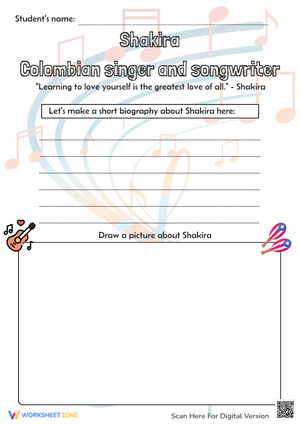
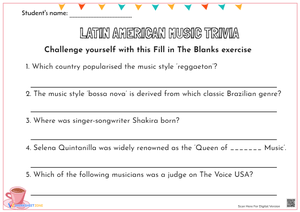
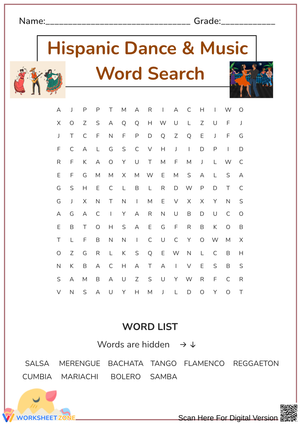
These 6th grade music worksheets pdf resources bridge the gap between active music-making and the notation knowledge that supports it — a gap middle school music teachers feel most clearly when a student can clap a syncopated pattern confidently but can't identify which note values they just performed. Each worksheet focuses on one or two skills so the task stays manageable within a single class period and leaves room for the clapping, singing, or playing that should follow.
Skills These Worksheets Build
The set covers the content areas grade 6 music teachers return to most often across a school year:
- Rhythm values and rests: Students identify note durations, complete measures in 4/4 and other meters, and write beat counts beneath notated patterns.
- Staff reading in treble and bass clef: Tasks ask students to name pitches on lines and spaces, use ledger lines correctly, and connect note names to keyboard or instrument positions.
- Dynamics and articulation symbols: Students match Italian terms and printed symbols to performance descriptions, then rank markings from softest to loudest.
- Tempo vocabulary: Exercises include ordering terms from Largo through Presto and identifying where tempo changes appear in short notated excerpts.
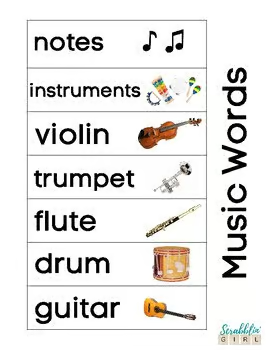
- Music vocabulary for form, texture, and instrument families: Matching and sorting tasks review terms students encounter in both listening and performance contexts.
- Guided listening response: Structured prompts direct students to describe tempo, dynamics, texture, and instrument family using specific music terminology.
- Short composition: Students write a one- or two-measure rhythm, apply dynamic markings, or arrange a simple melodic idea — connecting theory to creative decision-making rather than stopping at recall.
The Grade 6 Notation Errors These Worksheets Surface
Several predictable misconceptions show up at this grade level, and knowing them in advance makes the written tasks more useful as diagnostic tools. The most consistent: students who understand that a dot adds half the original value will still count a dotted quarter note incorrectly when they apply it inside a measure. Give them "1-and, 2" and they write "1-2, 3" — the abstract rule is there, the rhythmic application in context isn't. The rhythm-completion worksheets catch this before it becomes an ensemble rehearsal problem.
Bass clef reading exposes a different issue. Students memorize GBDFA for lines and ACEG for spaces, then under task conditions revert to treble clef logic and write E for a note sitting on the first line from the bottom. What surfaces in student work is the correct mnemonic written above a wrong letter answer — a sign the two clef systems haven't connected yet, not a sign of carelessness. Exercises that ask students to identify the same pitch in both clefs within the same worksheet make that disconnect visible while there's still instructional time to address it.
Dynamics create a reading-order problem. Students see "mf," read the f first, and rank mezzo-forte louder than forte. It corrects quickly once the prefix logic is made explicit — but it appears often enough in sixth-grade work that a short explanation before students attempt the ranking task saves a full round of corrections afterward.
Where These Worksheets Fit Into the Teaching Week
The strongest use pattern is the worksheet-to-activity link. Students complete a rhythm exercise, then immediately clap or speak that same pattern aloud. They mark dynamics on paper, then apply those markings in a short two-phrase performance. This keeps written theory work from functioning as isolated paperwork — and transitions into active music-making become smoother because students have already processed the concept they're about to use.
For daily logistics, a short worksheet handles the opening 6 to 8 minutes on rotation days, especially when class size shifts mid-period as students leave for band or orchestra. These same worksheets hold up well for sub plans. Keeping two or three current worksheets in a dedicated sub folder — updated at the start of each unit — means the content stays aligned with what the class is actually working on. A vocabulary or note-reading worksheet paired with a guided listening task gives substitutes something structured and self-contained without requiring classroom music expertise on their end. Kennedy Center Education and Smithsonian Folkways both maintain classroom-ready audio resources organized by grade level and music concept, which are useful for selecting listening excerpts to pair with the response worksheets.
These 6th grade music worksheets pdf materials also work well for early finishers and catch-up assignments, since students complete them without instruments or additional materials. A student who missed a class on dynamics can work through the matching and ranking worksheet independently, check answers against a key, and rejoin the class sequence without needing a separate re-teaching session.
Adjusting the Worksheets for a Range of Learners
Sixth grade music classes routinely place students with years of private instruction alongside students encountering staff notation for the first time. The recognition-based worksheets — labeling clef lines and spaces, matching dynamic symbols, identifying instrument families — serve as the entry point for students still building foundational fluency. Students with stronger backgrounds can move directly to application tasks: writing a rhythm that totals exactly five beats, transposing a short melodic line to bass clef, or composing a four-beat pattern that requires at least one dotted value and at least one rest.
For the listening response worksheets, one adjustment handles most readiness gaps: provide a vocabulary list for students who need it, remove it for students who should be working from memory. Same printed material, one small change, no additional prep time. A well-chosen collection of 6th grade music worksheets pdf resources spans both ends of the readiness range without requiring teachers to build entirely separate assignments from scratch.
Standard Alignment
These worksheets align with the National Core Arts Standards for Music at the Grade 6 level. Three anchor points:
- MU:Pr4.2.6 — Analyze how expressive qualities (dynamics, tempo, articulation) are conveyed through notation. The dynamics ranking and tempo vocabulary worksheets address this standard at both recognition and application levels.
- MU:Re7.1.6 — Describe how musical features support expressive intent in a listening example. The guided listening response worksheets provide the written structure and vocabulary framework this standard requires.
- MU:Cr1.1.6 — Generate rhythmic, melodic, and harmonic ideas for simple compositions. The mini composition worksheets connect to this standard directly, asking students to make and explain notation choices rather than simply recall them.
Teachers in states with frameworks closely modeled on NAfME guidance will find these worksheets fit without modification. In states with independent frameworks, the skills map onto rhythm and notation, music vocabulary, listening and responding, and beginning composition — categories that appear in nearly every state music curriculum at this grade level.
Frequently Asked Questions
How long does each worksheet take to complete?
Most worksheets in the set take 6 to 12 minutes. That range fits bell work, center rotations, and the review portion of a period. Shorter completion time is intentional — it leaves room for the follow-up performance or discussion that makes written theory work transfer into actual musical skill.
Are these accessible for students with no prior music training?
Yes. The recognition-based worksheets — symbol matching, staff labeling, vocabulary sorting — are accessible for students encountering formal notation for the first time. Use those as the entry point and move toward application tasks once basic vocabulary is in place.
Do these work for ensemble classes as well as general music?
Several worksheets transfer directly to ensemble rehearsal prep — particularly those covering rhythm values, dynamics, and notation vocabulary that students encounter in band or choir repertoire. A rhythm-completion worksheet reinforcing dotted values is directly relevant the week a piece using those exact patterns comes up in rehearsal.
Where do these worksheets fit best within a unit plan?
Distributed across a unit rather than front-loaded. Using a note-reading worksheet early, returning to a rhythm task mid-unit, and adding a listening response near the end builds spaced retrieval into the plan without extra preparation. Students who work through the complete set of 6th grade music worksheets pdf resources across a unit encounter the same skills in new formats multiple times — which consolidates learning more reliably than a concentrated review session the day before a quiz.












 Interactive Worksheet Maker
 Quiz Maker
 Word Search Maker
 Crossword Puzzle Maker
 Word Scramble Generator
 Sentence Scramble Generator
 Handwriting Worksheet Generator
 Name Tracing Generator
 Fill In The Blank Generator