


























Views
Downloads
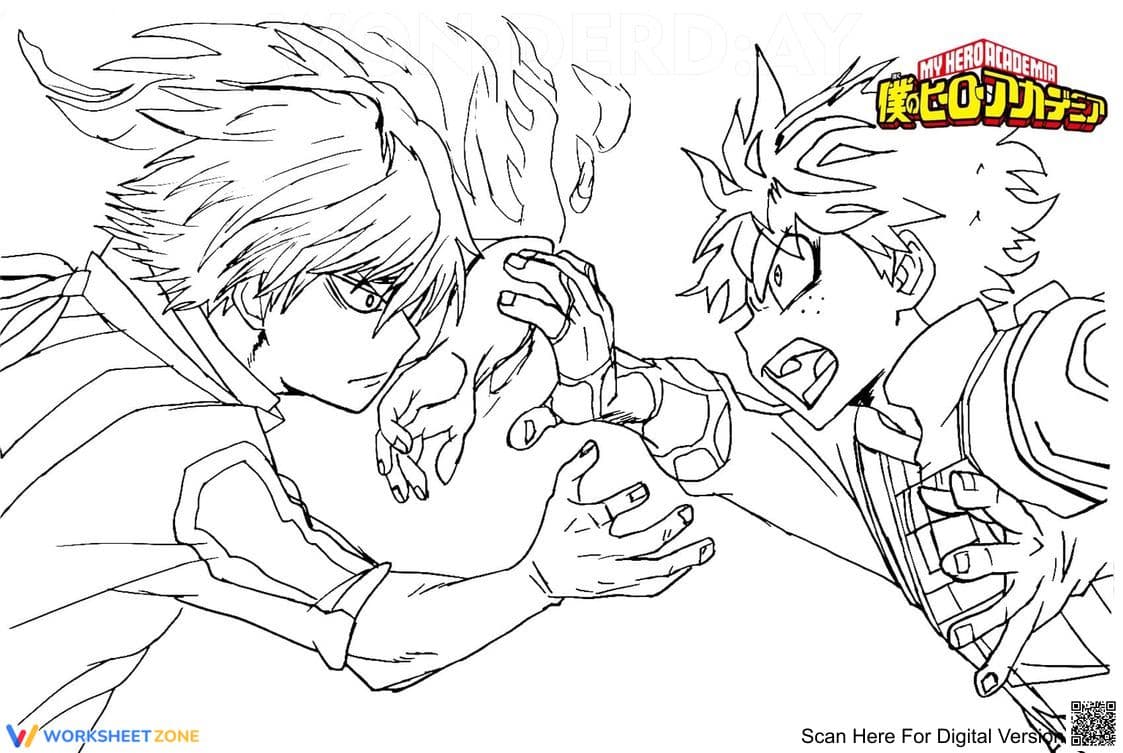

Deku and Todoroki Coloring Page | Printable Art Activity
Paste this activity's link or code into your existing LMS (Google Classroom, Canvas, Teams, Schoology, Moodle, etc.).
Students can open and work on the activity right away, with no student login required.
You'll still be able to track student progress and results from your teacher account.
This printable anime coloring page features Deku and Todoroki in a dynamic action scene, helping middle school students develop fine motor control and explore advanced color theory. Students apply shading, contrast, and color blending techniques to bring these popular manga characters to life while engaging in creative self-expression.
At a Glance
- Grade: Grade 6–7 · Subject: Fine Art
- Standard:
VA:Cr1.1.6a— Combine concepts to generate an innovative idea for art-making- Skill Focus: Color blending, shading, fine motor control
- Format: 1 page · 1 task · No answer key · PDF
- Best For: Early finishers and creative art electives
- Time: 20–30 minutes
This single-page PDF download features a highly detailed line-art illustration of Izuku Midoriya (Deku) and Shoto Todoroki clashing with their signature powers. The clean, high-resolution black-and-white outlines provide clear boundaries for coloring, making it suitable for colored pencils, markers, or pastels. The layout includes complex background elements and detailed character designs that challenge students to plan their color schemes and light sources carefully before applying pigment.
This zero-prep activity integrates into your classroom routine in three simple steps. First, print the single-page PDF document, taking less than 1 minute of preparation. Second, distribute the sheets along with coloring utensils to your students, requiring only 30 seconds of transition time. Finally, review the completed artwork or display it on a classroom gallery wall, taking about 5 minutes to celebrate student creativity. This workflow makes the worksheet an excellent option for emergency sub plans or mindfulness breaks.
Standards Alignment
This activity aligns with the National Core Arts Standard VA:Cr1.1.6a, which focuses on combining concepts to generate innovative ideas for art-making. By selecting color palettes that represent the characters' opposing elements of fire, ice, and energy, students practice visual storytelling. Both standard codes can be copied directly into lesson plans, IEP goals, or district curriculum mapping tools.
How to Use It
Use this worksheet as a creative extension during a unit on color theory or character design. Introduce the activity after direct instruction on warm and cool colors, prompting students to use cool tones for Todoroki's ice and warm tones for his fire. For a formative assessment, observe how students manage spatial awareness and line boundaries, noting their ability to control coloring tools. The activity typically takes 20 to 30 minutes to complete.
Who It's For
This worksheet is designed for sixth and seventh-grade students, particularly those interested in anime, manga, and graphic illustration. It serves as an engaging resource for general art classes, after-school clubs, or as a calming mindfulness activity for students needing a sensory break. Pair this coloring page with a short writing prompt about character conflict or a lesson on the history of Japanese manga art styles.
This educational coloring resource supports fine motor development and artistic expression in middle school classrooms, aligning with the National Core Arts Standard VA:Cr1.1.6a. According to the ScienceDirect TpT Analysis (2024), integrating popular culture themes like anime into middle school art curricula increases student engagement and task persistence. By coloring the detailed action scene featuring Deku and Todoroki, students practice spatial reasoning, color relationships, and precision control. The single-page layout provides a structured yet open-ended canvas that allows educators to assess student understanding of warm and cool color contrasts. This worksheet serves as a practical tool for art teachers seeking to bridge student interests with formal design principles, ensuring high participation rates during independent practice. The standard code and associated skills can be easily extracted for lesson planning.


