


























Views
Downloads
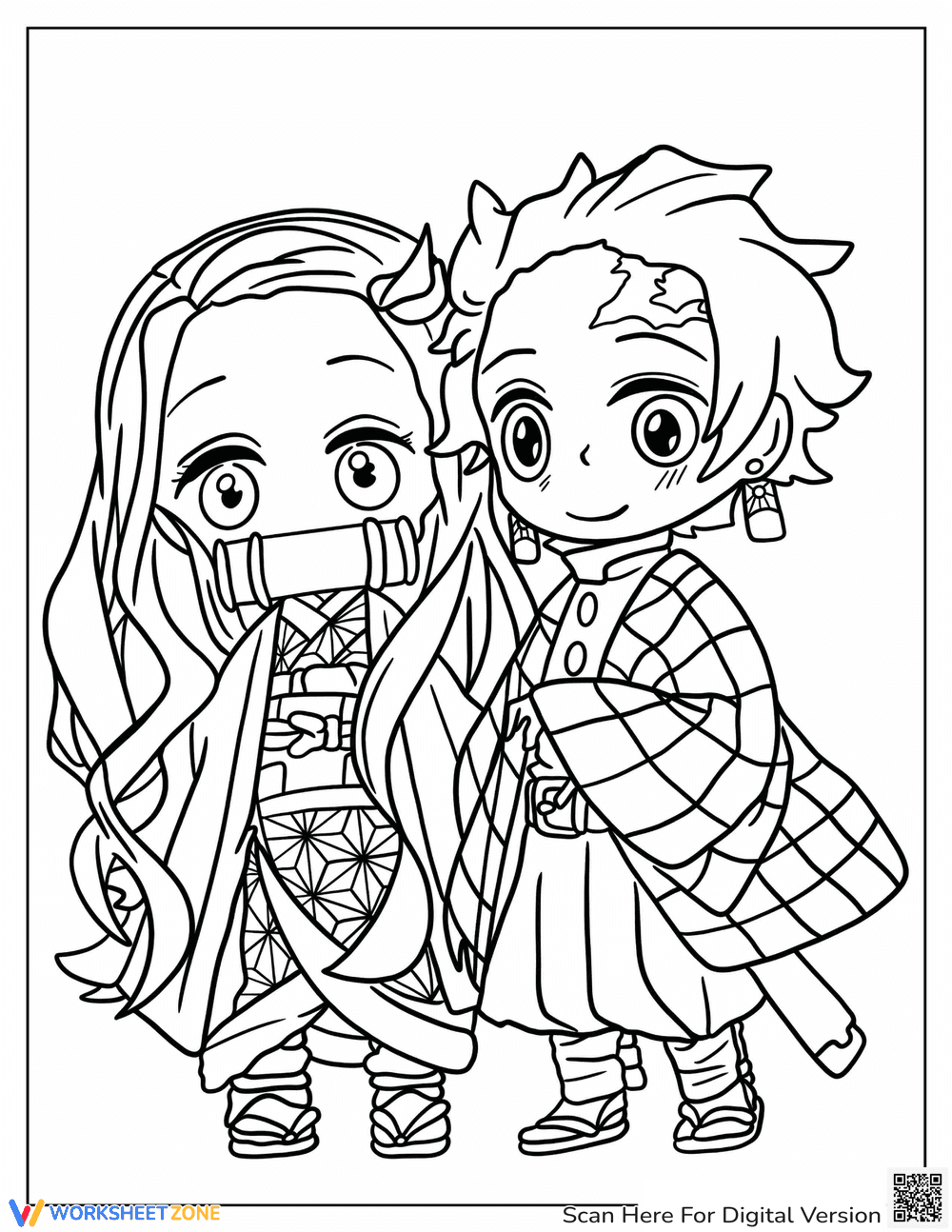

Demon Slayer Coloring Page | Printable Art Activity
Paste this activity's link or code into your existing LMS (Google Classroom, Canvas, Teams, Schoology, Moodle, etc.).
Students can open and work on the activity right away, with no student login required.
You'll still be able to track student progress and results from your teacher account.
This printable Demon Slayer coloring page provides middle-grade students with a creative outlet to practice fine motor control and color theory. Featuring chibi-style Tanjiro and Nezuko, this activity encourages artistic expression and focus. Students apply shading, blending, and color selection techniques to bring these popular anime characters to life.
At a Glance
- Grade: 5-6 · Subject: Fine Art
- Standard:
VA:Cr2.1.5— Experiment and develop skills in multiple art-making techniques- Skill Focus: Fine motor control and color blending
- Format: 1 page · 1 task · Answer key not applicable · PDF
- Best For: Early finishers and creative brain breaks
- Time: 20–30 minutes
This single-page PDF download features a high-resolution, clean line-art illustration of chibi Tanjiro and Nezuko from the popular anime series. The worksheet is designed with clear borders and bold outlines, making it accessible for varying skill levels. It requires zero teacher preparation, contains no complex instructions, and serves as a standalone creative task that students can begin immediately.
This activity fits into a zero-prep classroom workflow in three simple steps. First, print the single-page PDF (takes less than 1 minute). Second, distribute the sheets to students along with coloring utensils like colored pencils or markers (takes 1 minute). Third, review student progress by observing their color choices and shading techniques during the activity. The total teacher preparation time is under 2 minutes, making this worksheet an ideal option for emergency sub plans, transition periods, or morning work.
This activity aligns with the National Core Arts Standard VA:Cr2.1.5, which focuses on experimenting and developing skills in multiple art-making techniques and approaches. By selecting color palettes and applying medium-specific techniques, students demonstrate control of their chosen tools. Additionally, it supports ELA visual literacy standards by encouraging students to translate character traits into visual representations. Both standard codes can be copied directly into lesson plans, IEP goals, or district curriculum mapping tools.
Use this worksheet during transition times or as a reward after direct instruction. For example, introduce it during a unit on color theory to let students practice warm and cool color schemes. Alternatively, use it as a quiet mindfulness activity after high-stakes testing. Teachers can conduct formative assessment by observing pencil grip, pressure control, and spatial awareness. Expected completion time ranges from 20 to 30 minutes depending on the coloring medium used.
This worksheet is designed for fifth and sixth-grade students, particularly those motivated by anime and pop culture. It serves as an engaging tool for reluctant artists or students needing sensory regulation. To differentiate, pair this coloring page with a short character analysis writing prompt or an anchor chart detailing color wheel relationships to deepen the academic connection.
Integrating structured creative activities like this coloring sheet supports student focus and fine motor development. According to the ScienceDirect TpT Analysis, incorporating popular culture themes, such as anime characters, significantly increases student engagement and task persistence in middle-grade classrooms. This worksheet aligns with standard VA:Cr2.1.5 by requiring students to experiment with color application and spatial organization. By focusing on chibi Tanjiro and Nezuko, students practice precision coloring, which reinforces hand-eye coordination and spatial reasoning. Research indicates that these low-stakes artistic tasks reduce academic anxiety and improve cognitive readiness for subsequent core subjects. Educators can confidently integrate this resource to support visual arts standards while providing a structured, calming transition activity that requires no prior instruction or setup.


