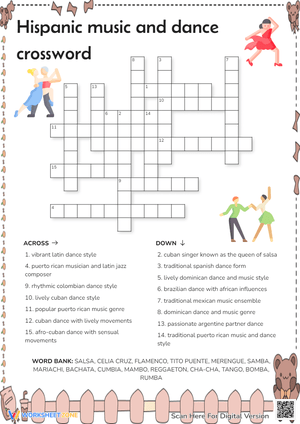
Dance Worksheets Printable for 6th Grade
Dance worksheets printable for 6th grade give teachers a concrete way to close the gap between what students can do with their bodies and what they can say about movement. The set covers vocabulary practice, choreography planning, movement observation, and written reflection — each worksheet built to take 3–8 minutes and hand off directly to the movement portion of a lesson.
The Specific Skills Targeted
The five movement elements — body, space, time, energy, and relationships — anchor the vocabulary work across the set. Students don't just memorize definitions; they sort terms, match examples to elements, and fill in blanks inside movement descriptions. The goal is for a student to watch a classmate's phrase and say "she's using a low level with a sustained tempo" rather than "it looked slow and close to the ground."
- Vocabulary sorting and matching: students categorize terms under body, space, time, energy, and relationships, then apply them to described movement scenarios.
- Choreography planning grids: structured formats where students map counts, levels, pathways, and transitions for a short movement phrase.
- Observation prompts: students watch a performance and annotate what they see — energy shifts, floor patterns, group formations, and moments of stillness.
- Reflection frames: short written responses tied to performing, including self-assessment of execution and artistic intent.
- Cross-curricular connection tasks: prompts that link movement concepts to rhythm in music, narrative structure in ELA, or spatial reasoning across other subjects.
Movement Vocabulary Errors Students Consistently Make
The most frequent error in 6th grade dance work is conflating descriptors from different elements. Students use "fast" and "high" interchangeably — both feel like adjectives for intensity, so the distinction between time and space gets lost. Worksheets that sort vocabulary into element columns make this visible before it becomes a habit, because students have to decide where "sustained" belongs versus where "elevated" belongs, and those answers are not the same.
Choreography planning reveals a separate problem. Students write plans that look complete but collapse under performance conditions. "Walk across the stage" fills one count slot in a planner, but when they discover it takes six counts to cross the space, the whole phrase structure falls apart. Worksheets that require students to assign count values to each movement — "4 counts: rise from low to high, arms initiating, end in stillness" — surface this mismatch before anyone steps in front of the class.
On observation tasks, students default to describing feeling rather than form. "The dance felt powerful" doesn't get flagged as incomplete because it sounds like a real answer. Observation worksheets that ask students to name the specific movement quality that created that feeling — and require citing a movement element — push past surface impression into the kind of analytical language that actually transfers to their own choreography work.
How to Fit These Worksheets Into a Dance Unit Week by Week
The most reliable placement for dance worksheets printable for 6th grade is as a bridge between instruction and movement — not as an activity that competes with dancing. Four minutes on an observation worksheet before class discusses a video clip gives students something specific to say. Without it, discussion stays at "I liked the jumping part." With it, students bring notes on energy quality, floor patterns, and specific count moments to the conversation.
Vocabulary worksheets work well as the first five minutes of a unit introduction. The real payoff comes when the teacher loops back mid-lesson: "You matched 'sustained' to the time element earlier — show me what that looks like in your arms." That movement from paper to body and back again is where the written work earns its place in a dance class. It stops feeling like an interruption and starts feeling like preparation.
For station days, the set distributes naturally: one station for vocabulary review, one for count-based choreography planning, one for observation of a recorded phrase. Mixed-ability groups move through the same circuit without needing separate materials. For sub days or schedule disruptions, any observation worksheet paired with a recorded performance gives a substitute teacher a complete, self-running lesson structure — no dance background required.
Adjusting These Worksheets for a Range of Student Experience
Grade 6 dance classes are rarely homogeneous. Some students arrive with years of studio training; others are walking into formal movement instruction for the first time. The vocabulary and observation worksheets let both groups start in the same place — sorting terms and identifying movement qualities don't require technique, just attention — but the depth of expected output shifts based on what each student is ready for.
Students who need more guided support do well when the planning grids are narrowed to two or three decisions instead of a full phrase. Ask them to choose one level and one direction change for four counts, then perform it. That's achievable without overwhelming them with compositional choices before they've developed the movement vocabulary to make those choices meaningfully. More experienced students can use the same planner to build a multi-phrase sequence, annotate transitions, and add notes on intended energy quality — the format holds up either way.
Observation tasks scale the same way. A student still building dance literacy circles three terms from a provided word bank that describe the performance. A student with stronger analytical background writes in their own language, identifies the specific counts where a shift occurred, and ties what they saw to a named movement element. Each worksheet stays the same; the expectation adjusts.
Standard Alignment
These worksheets align to the National Core Arts Standards — Dance across all four artistic processes. The Creating process (Anchor Standards 1–3) is addressed by choreography planning grids, where students generate, organize, and refine movement ideas. The Performing process (Anchor Standards 4–6) connects to self-assessment reflection frames. Responding (Anchor Standards 7–9) aligns with the observation and analysis worksheets. Connecting (Anchor Standards 10–11) maps to cross-curricular prompts that link movement to music, narrative, and cultural context. At the 6th grade band, students are expected to apply movement vocabulary analytically and make intentional choreographic choices — both of which appear explicitly throughout the set.
The element-based vocabulary framework also reflects the movement concepts outlined in SHAPE America's physical education standards. Teachers placing these resources in a PE or integrated arts context find the terminology aligns without requiring any translation between standards documents.
Frequently Asked Questions
Can these worksheets be used outside of a dedicated dance classroom?
Yes. General music teachers, PE instructors, and classroom teachers running arts integration units all use dance worksheets printable for 6th grade within their existing lesson structures. The vocabulary and observation worksheets need no dance-specific room setup — a short video clip or a live teacher demonstration is enough to make the tasks meaningful.
How long does each worksheet take to complete?
Most worksheets in the set take between 4 and 8 minutes depending on task type. Vocabulary matching runs shorter; choreography planning and reflection frames run longer. Teachers typically use the shorter vocabulary worksheets as lesson warm-ups and the planning grids as the core of a creation block.
Are these resources workable for students with no prior dance training?
The vocabulary and observation worksheets give beginners a genuine entry point. A student doesn't need technique to identify whether a dancer's level is high, middle, or low, or to place "sharp" under energy rather than space. That accessible starting point makes the set usable in a first-week unit introduction without any prerequisite movement experience.
How does the set support assessment beyond performance grades?
Choreography planners, observation guides, and reflection frames document thinking that doesn't appear in a performance score. A student still developing physical coordination can show clear understanding of structure, intentional movement choices, and honest self-evaluation through written work alone. Dance worksheets printable for 6th grade used this way give teachers evidence of learning that performance grades miss entirely.
Clear All