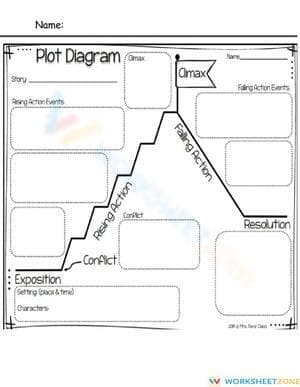
6th grade analyzing story structure printable worksheets give middle school teachers a direct path from labeling plot parts to explaining how those parts function within a complete narrative. The defining instructional shift at grade 6 is this: students who already know what a climax is now need to explain what it does — how one chapter raises the stakes, how a detail in the rising action makes the ending possible, how the resolution reframes everything that came before.
The Specific Skills Each Worksheet Targets
The set covers the full range of narrative elements: characters, setting, conflict, major events, climax, falling action, and resolution. But identification alone is not the goal. Each worksheet moves students toward a second layer — explaining why an element belongs where the author placed it. A story map that asks only "Where does the story take place?" is less useful than one that follows up with "How does that setting create the conditions for the conflict?"
Students work through several distinct task types across the set:
- Plot diagram completion — Students place events on a rising arc and note the structural function of each, not just the sequence.
- Story mapping — Tracks character, setting, problem, major events, and resolution in a format that connects elements to each other rather than listing them in isolation.
- Sequencing with cause-effect reasoning — Students order events and identify which event drives the next shift in the plot, including moments where the author's pacing speeds up or slows down deliberately.
- Short constructed responses — Asks students to explain a structural choice in writing, using text evidence to support the claim. This is the task that most directly mirrors what CCSS RL.6.5 actually requires.
When students practice these task types together — diagram, map, sequence, response — they build a habit of reading narratives for structure rather than just following the surface story.
Frequent Errors in Student Work Worth Watching For and Addressing
The most persistent problem in grade 6 story structure work is climax misidentification. Students choose the scene with the highest drama rather than the moment with the greatest structural consequence. In a survival story, they mark the moment the character nearly drowns rather than the moment the character decides to turn back toward home — the decision that actually resolves the conflict. A well-built worksheet addresses this by pairing two questions: What happens at this point in the story? and How does this event change what happens next? Those two questions together do more to fix climax confusion than any reteach of the definition.
A second, quieter error: students treat setting as pure description. They write "the story takes place in a small town in winter" and stop. Grade 6 students need to push past surface detail — the winter setting matters because it limits the character's options, tightens the conflict, or creates an emotional parallel to the character's internal struggle. Worksheets that prompt students to explain what the setting makes possible help build that analytical habit rather than leaving it to chance.
How to Build These Worksheets Into Your Weekly ELA Routine
A three-part block works well with this set. Start with five to eight minutes of modeling — use a shared excerpt, mark the plot arc together, and name the structural choices the author made. Then release students to work through a worksheet on a shorter passage individually or with a partner. Close the block with a two- or three-sentence written response asking students to explain how one section of the plot shapes the whole story. That final step is what turns practice into evidence of comprehension.
6th grade analyzing story structure printable worksheets also fit naturally into classroom setups that require low-prep independent tasks. Some specific ways teachers use them:
- Centers: Run plot diagram work at one station and cause-effect sequencing at another. Students rotate with the same analytical lens but different task formats.
- Homework: A single worksheet with a short passage and two analysis questions travels home clearly and comes back as readable formative data.
- Intervention small groups: Use the story mapping worksheet before asking students to complete a full plot analysis — the map gives them a record of the story to refer back to when writing.
- Exit ticket replacement: A constructed-response question from a worksheet takes the place of a verbal share-out at the end of class, giving the teacher something concrete to review before the next lesson.
Because the materials print cleanly without prep, teachers can keep this skill visible across the week — a sequencing warm-up on Monday, partner plot diagram work mid-week, written response on Friday — rather than covering it in one lesson and moving on.
Standard Alignment
CCSS.ELA-LITERACY.RL.6.5 asks students to analyze how a particular sentence, chapter, scene, or stanza fits into the overall structure of a text and contributes to the development of theme, setting, or plot. That standard is more demanding than the grade 5 equivalent, which focuses on the narrative arc as a whole. At grade 6, students must analyze the function of a specific text unit — one chapter, one scene, one pivotal sentence — within the larger structure. The worksheets in this set address that standard directly: students do not just map the story, they explain the contribution of individual moments to the whole.
This standard appears most often in close reading units and in narrative writing instruction, where understanding structure as a reader transfers directly into a student's revision decisions as a writer. Teachers using these worksheets alongside a narrative writing unit often find that the analytical moves students practice as readers show up quickly in how they discuss their own drafts.
Adjusting the Work for Different Readers in the Same Room
6th grade analyzing story structure printable worksheets span a range of entry points. For students still building confidence with narrative elements, the story mapping worksheet works well with some entries pre-filled — character names listed, the setting identified, the first event provided — so the student directs analytical energy toward conflict and resolution rather than getting stuck at the retrieval stage. That kind of partial entry keeps cognitive load manageable without reducing the analytical expectation.
Students who have the basics down benefit most from the open-ended constructed-response tasks, particularly prompts that ask them to compare how two short passages structure a similar conflict, or to identify a moment where the author deliberately slows the pacing and explain the effect. Those questions require genuine text analysis rather than pattern-matching against a plot diagram shape.
For students in between, pairing the story map with a structured response prompt — "Use your completed map to explain how the setting shapes the conflict in two to three sentences" — keeps both tasks within reach while maintaining a clear analytical target. That combination also makes assessment straightforward: the map shows what the student noticed; the response shows what the student understands about it.
Frequently Asked Questions
What does story structure analysis actually look like at the 6th grade level?
It looks like students doing two things at once: identifying plot elements and explaining what those elements accomplish. A student who correctly labels the climax is only partway there. The grade 6 expectation is that the student can also explain why that scene is the turning point — what changes because of it, how it shapes the resolution, and how it connects to the story's central message. These worksheets make that two-step thinking a repeatable classroom habit rather than an occasional test prompt.
Can these worksheets help students who are reading below grade level?
Yes, with some adjustments. The story mapping worksheet offers the most support because students record information as they read rather than reconstructing the plot after finishing. For students reading well below grade level, pairing the worksheet with a shorter, below-grade-level passage is fine — the analytical skill being assessed is structural thinking, not decoding. The goal is practice identifying function, and that work transfers regardless of text difficulty.
How do these worksheets support the move from reading comprehension to literary analysis?
6th grade analyzing story structure printable worksheets make that transition concrete by requiring both recording and reasoning. When students complete a plot diagram and then write two sentences explaining how the climax changes the rest of the story, they are doing exactly what literary analysis asks — using textual detail to support a claim about how a text is constructed. That moves well beyond a comprehension check and into the territory of textual argument, which is the target skill across grades 6 through 8 in CCSS.
How much class time does each worksheet take?
A plot diagram worksheet paired with a short passage fits comfortably into a 45-minute period with time for a closing discussion. Story mapping with a written response may stretch into a second day if students are writing in complete sentences and revising answers. The set is not meant to be worked through in order on consecutive days — teachers pull individual worksheets based on where students are in the unit and what the data from the previous lesson shows.















 Interactive Worksheet Maker
 Quiz Maker
 Word Search Maker
 Crossword Puzzle Maker
 Word Scramble Generator
 Sentence Scramble Generator
 Handwriting Worksheet Generator
 Name Tracing Generator
 Fill In The Blank Generator