


























Views
Downloads
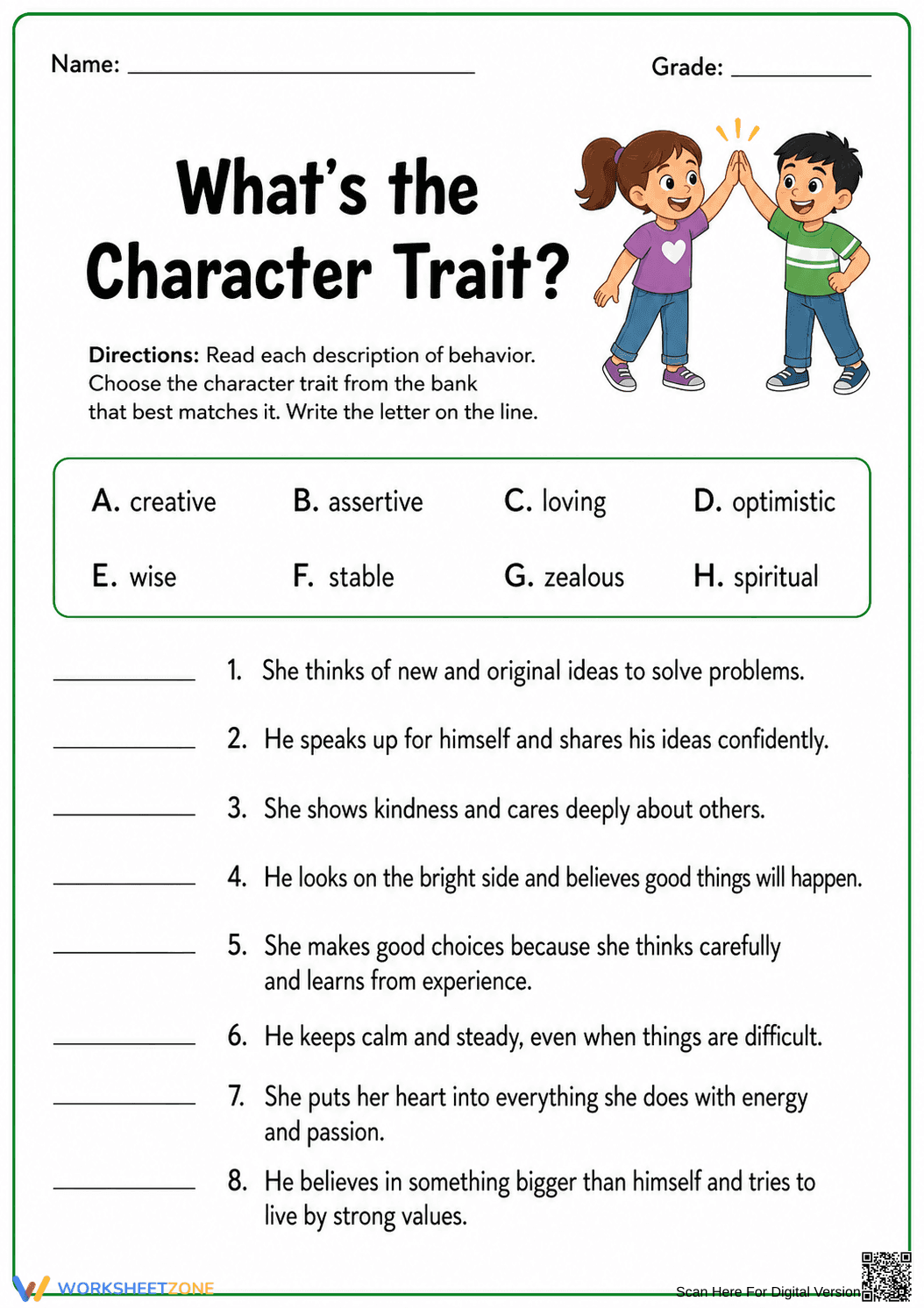

Grade 4 Character Traits — Printable No-Prep Worksheet
Paste this activity's link or code into your existing LMS (Google Classroom, Canvas, Teams, Schoology, Moodle, etc.).
Students can open and work on the activity right away, with no student login required.
You'll still be able to track student progress and results from your teacher account.
This character traits worksheet helps students connect specific behaviors to descriptive vocabulary words. By reading short scenarios and matching them to a word bank, learners practice inferring personality traits from actions. This foundational reading comprehension skill strengthens their ability to analyze characters in longer literary texts.
At a Glance
- Grade: 4 · Subject: ELA
- Standard:
CCSS.ELA-LITERACY.RL.4.3— Infer character traits from specific actions and behaviors- Skill Focus: Character Traits
- Format: 1 page · 8 problems · Answer key included · PDF
- Best For: Independent practice
- Time: 10–15 minutes
This single-page resource features eight distinct behavioral descriptions and a corresponding word bank of eight character traits, including words like optimistic, assertive, and zealous. Students read each sentence and write the letter of the matching trait on the provided line. A complete answer key is included to ensure accurate grading and provide immediate feedback.
This resource is designed for immediate classroom implementation with absolutely no teacher preparation required:
- Print (1 minute): Simply print the single-page PDF and the accompanying answer key.
- Distribute (1 minute): Hand out the worksheet to students. The clear directions and word bank make it entirely self-explanatory.
- Review (3 minutes): Use the provided answer key to quickly check student responses or facilitate a whole-class review session.
With a total prep time of under two minutes, this worksheet is an excellent addition to any emergency sub plan or last-minute literacy center.
This activity is aligned to CCSS.ELA-LITERACY.RL.4.3: Describe in depth a character, setting, or event in a story or drama, drawing on specific details in the text (e.g., a character's thoughts, words, or actions). It also supports vocabulary acquisition by introducing nuanced descriptive words. Both standard codes can be copied directly into lesson plans, IEP goals, or district curriculum mapping tools.
Teachers can utilize this worksheet during independent reading rotations to reinforce character analysis skills after a mini-lesson. It also serves as an effective morning work assignment to activate critical thinking at the start of the day. As students complete the eight matching tasks, teachers can use this as a formative assessment to observe whether learners are relying on context clues to deduce the meaning of unfamiliar words like "zealous" or "assertive." Expect students to complete this activity within a 10 to 15-minute timeframe.
This worksheet is primarily designed for fourth, fifth, and sixth-grade students developing their reading comprehension and social-emotional vocabulary. The straightforward matching format provides built-in scaffolding for English Language Learners and students needing additional support with character analysis. It pairs perfectly with any fictional reading passage or a direct instruction lesson on identifying character motivations.
Mastering the ability to infer character traits from specific actions and behaviors is a critical component of advanced reading comprehension. According to Fisher & Frey (2014), explicit vocabulary instruction combined with contextual analysis significantly improves students' ability to comprehend complex literary texts. By aligning with CCSS.ELA-LITERACY.RL.4.3, this worksheet ensures that learners are not just memorizing definitions, but actively applying their understanding of human behavior to textual evidence. When students practice connecting a character's actions to specific descriptive traits, they build the analytical framework necessary for deeper literary critique and stronger narrative writing. This targeted practice bridges the gap between basic reading fluency and higher-order inferential thinking, equipping students with the tools they need to succeed in middle school language arts and beyond.


