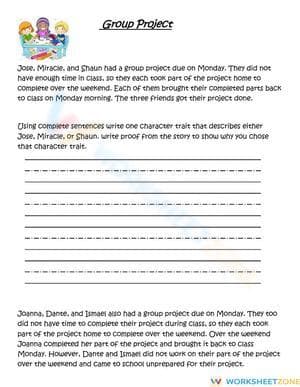
These analyzing character printable worksheets for 6th grade give teachers something they can drop into a lesson without spending the period explaining the format — students read a brief set of directions and get to work. At sixth grade, character analysis stops being about personality labels and starts being about evidence: what a character says under pressure, how they treat someone with less power, what they choose to do when the right answer costs them something. That shift is exactly what these worksheets push students to make.
The Specific Thinking Work in Each Worksheet
Each worksheet moves students through three connected steps: name a trait, find the moment in the text that supports it, and explain what that moment reveals about the character's motivation or role in the plot. That third step is where sixth graders most often stall, and it is the step that separates reading comprehension from literary analysis.
Across the set, students work with a range of text-based tasks:
- Identifying traits that must be inferred from dialogue, actions, or internal thought — not traits stated directly by the narrator
- Selecting and citing a specific passage or scene rather than summarizing a general impression
- Explaining motivation: what the character wants, what stands in the way, and how that tension drives decisions
- Tracking change from the character's opening situation to a later turning point
- Writing short explanatory responses that connect character behavior to plot events
The format holds across fiction genres. Teachers use the same worksheet with a realistic fiction novel, a Greek myth, a historical fiction excerpt, or a class read-aloud. That consistency matters because students spend less cognitive energy adjusting to a new task structure and more energy on the actual literary thinking. Teachers who use analyzing character printable worksheets for 6th grade across multiple units report that students internalize the three-step analysis move by the third or fourth use — after that, the thinking routine transfers even when the worksheet is not in front of them.
Student Errors That Show Up Consistently in Character Work
The most persistent problem is treating a stated feeling as a character trait. A student reads "Marcus felt embarrassed" and writes "embarrassed" as the trait, when the more useful inference is "self-conscious" or "easily affected by others' opinions." These worksheets push past that by asking students to identify traits that explain behavior across multiple moments, not emotions that describe a single scene.
A second error involves evidence selection. Students who understand they need to cite a line often choose the most dramatic moment rather than the most revealing one. A character crying at the climax feels significant, but the brief exchange from earlier — where she quietly covers for a friend without being asked — tells readers far more about who she actually is. Prompts in the worksheets ask students to explain why a particular moment supports the trait, which forces them to defend their evidence choice rather than default to the obvious scene.
A third pattern is motivational confusion. Students write "she was angry" as the explanation for a character's decision when anger is the emotional state, not the underlying goal. Distinguishing between how a character feels and what a character wants requires repeated practice with prompts that hold students accountable to that distinction. These worksheets build that habit across multiple uses.
How to Work These Worksheets Into Your ELA Lesson Plans
The most direct use is a focused reading response after students finish a chapter or short text. The trait-evidence-explanation sequence takes most students 10 to 15 minutes, which fits cleanly into the window after shared reading and before whole-class discussion. That stack of completed worksheets tells the teacher more than a hands-up question does: who can infer, who can cite, and who can explain — before anyone speaks.
Beyond that core use, the worksheets fit several other practical moments in the week:
- Bell ringer: Students open class with one trait and one supporting citation from the homework reading. It holds accountability and surfaces comprehension gaps before the lesson starts.
- Literature circles: Each student completes one worksheet independently, then the group compares which traits and textual moments they chose. Disagreements about evidence make for some of the most substantive literary conversations sixth graders have.
- Sub plans: A generic character worksheet paired with a short story is one of the more reliable independent tasks — the directions are self-contained and students can manage the work without real-time teacher support.
- Two-day structure: Day 1 focuses on trait identification and evidence collection. Day 2 shifts to motivation, change over time, and written explanation. Splitting the task this way reduces cognitive overload and gives teachers a cleaner formative read at each stage.
Adjusting Each Worksheet for a Range of Readers
Not all sixth graders arrive at character analysis from the same starting point. Some students can name a trait but struggle to select precise evidence. Others find a quotation easily but cannot explain what it reveals. Adjustments work best when they target the specific step where a student's thinking breaks down — not when they reduce the overall goal.
For students still building inference skills, adding a trait bank removes one obstacle without lowering the rigor. Sentence starters — "This moment shows ___ because ___" — give students a sentence-level entry point without doing the literary thinking for them. For students reading below grade level, working with a shorter excerpt from the same class text keeps the analysis task intact while reducing the demand of holding a longer narrative in memory.
Students who finish quickly can extend their analysis by comparing two characters across the same moment: who responds differently, and what does that difference reveal? That comparative layer uses the same worksheet structure with a more demanding question added on top. Teachers using analyzing character printable worksheets for 6th grade with multilingual learners often find that sentence-level prompts do more than open-ended boxes — not because the task is simpler, but because the sentence support lets students focus on the literary thinking rather than the construction of the sentence itself.
Standard Alignment
These worksheets connect directly to CCSS.ELA-LITERACY.RL.6.3, which asks sixth graders to describe how a story's or drama's plot unfolds in a series of episodes and explain how the characters respond or change as the plot moves toward a resolution. The three-part structure built into each worksheet — identify a trait, cite the textual moment, explain its impact on events — maps to that standard's expectation that students connect character behavior to plot development rather than describe personality in isolation.
RL.6.1, which addresses citing textual evidence to support analysis, underlies the evidence prompts throughout the set. In practice, these two standards are inseparable in a character analysis task: students cannot fulfill RL.6.3 without the evidence habits RL.6.1 requires. The worksheets treat them together rather than as separate skills, which reflects how most teachers actually plan this work at sixth grade — citing and analyzing are not taught on separate days; students are asked to do both at once.
Frequently Asked Questions
Can these worksheets be used with any novel or short story, or do they require a specific text?
The worksheets are text-agnostic, which is their main practical advantage. Teachers have used them with realistic fiction novels, mythology units, historical fiction excerpts, and short read-alouds. Because the prompts focus on traits, evidence, and motivation rather than plot-specific questions, the same worksheet applies across whatever the class is reading — including texts that change from year to year as curriculum adoptions shift.
How do these worksheets support students who struggle with inference?
The prompt structure builds inference practice by separating the steps: students name the trait first, then find the moment, then explain the connection. That sequence is more manageable than an open-ended "analyze this character" prompt because it breaks a complex analytical move into three named tasks. Teachers can also add a trait bank or a modeled example for students who need a stronger entry point before working independently.
How do these worksheets fit into a summative assessment plan?
Treating analyzing character printable worksheets for 6th grade as formative tools rather than summative ones gets teachers the most value from them. Completed worksheets after a chapter show who can infer, who can cite, and who can connect character to plot — and they show that while there is still time to respond with a mini-lesson or a regrouping before the unit essay. Reserving them only for assessment misses the diagnostic work they do best.
What point in the unit works best for introducing these worksheets?
Most teachers introduce the first character worksheet after the initial read-aloud or shared reading session that establishes a main character — not at the unit's start when students lack enough text to draw on, and not at the end when the formative window has closed. The early-middle of a unit gives students enough material to analyze while leaving time for the teacher to act on what the responses reveal.















 Interactive Worksheet Maker
 Quiz Maker
 Word Search Maker
 Crossword Puzzle Maker
 Word Scramble Generator
 Sentence Scramble Generator
 Handwriting Worksheet Generator
 Name Tracing Generator
 Fill In The Blank Generator