


























Views
Downloads

Printable Character Traits Graphic Organizer | Grade 4
Paste this activity's link or code into your existing LMS (Google Classroom, Canvas, Teams, Schoology, Moodle, etc.).
Students can open and work on the activity right away, with no student login required.
You'll still be able to track student progress and results from your teacher account.
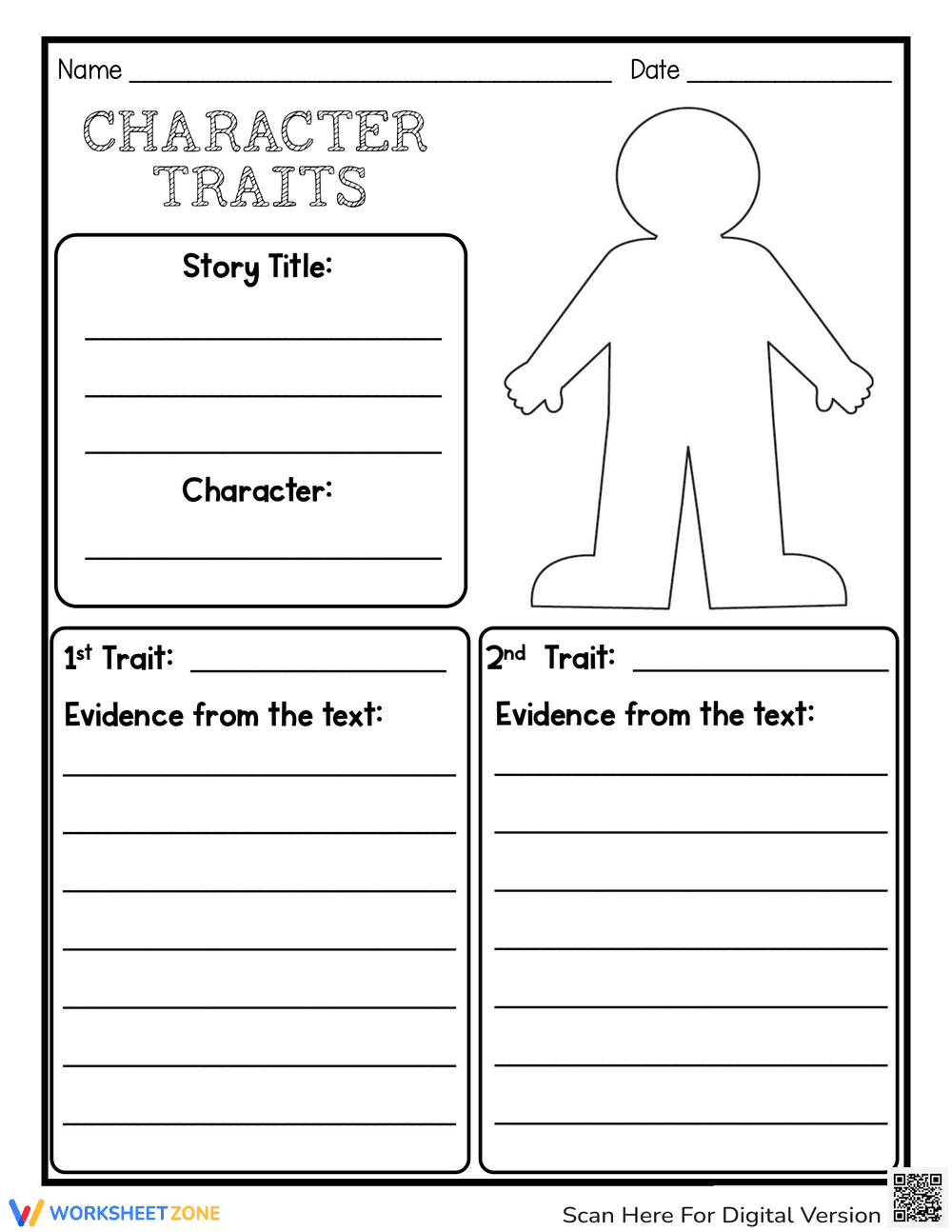
This printable character traits graphic organizer helps students analyze literary characters by pairing trait identification with direct textual evidence. Students identify a character, select two distinct traits, and cite supporting details from the text. This structured layout reinforces reading comprehension and critical analysis across elementary grades.
At a Glance
- Grade: Grade 4 · Subject: English Language Arts
- Standard:
CCSS.ELA-LITERACY.RL.4.3— Describe a character in depth drawing on specific details in the text- Skill Focus: Character analysis and textual evidence
- Format: 1 page · 2 evidence tasks · Graphic organizer · PDF
- Best For: Independent reading response and literature circles
- Time: 15–20 minutes
This single-page PDF features a clean, student-friendly layout designed to minimize distractions. It includes dedicated spaces for the story title and character name, a character silhouette visual anchor, and two large lined boxes for recording character traits alongside corresponding textual evidence. The clear structure guides students to justify their character descriptions using direct quotes or specific plot points.
Implement this resource instantly with a simple three-step workflow:
- Print (1 minute): Photocopy the single-page PDF for your class.
- Distribute (1 minute): Hand out the organizer during independent reading or literature circles.
- Review (5 minutes): Use the completed organizers for quick formative assessment.
With a total teacher preparation time of under 2 minutes, this worksheet serves as an excellent emergency sub plan or exit ticket.
This resource aligns directly with the Common Core State Standard `CCSS.ELA-LITERACY.RL.4.3`, which requires students to describe a character in depth by drawing on specific details from the text. Additionally, it supports `CCSS.ELA-LITERACY.RL.3.3` by prompting younger readers to explain how a character's actions contribute to the sequence of events. Both standard codes can be copied directly into lesson plans, IEP goals, or district curriculum mapping tools.
Use this graphic organizer during the independent practice portion of a reading lesson. After direct instruction on characterization, have students complete the sheet using their current independent reading books. Alternatively, use it as a formative assessment tool during guided reading: observe whether students can locate specific quotes to support their chosen traits, noting who needs additional scaffolding. Students typically complete this activity in 15 to 20 minutes.
This worksheet is designed for students in grades 3 through 6 who are developing their literary analysis skills. It is highly adaptable for English language learners and struggling readers who benefit from visual organizers and structured writing spaces. Pair this organizer with a short mentor text or an anchor chart detailing common character traits to provide vocabulary support during the activity.
This character traits graphic organizer aligns with evidence-based literacy practices outlined by Fisher & Frey (2014) regarding the gradual release of responsibility. By providing a structured framework, the worksheet scaffolds the transition from teacher-led modeling to independent textual analysis. The design prompts students to meet the demands of `CCSS.ELA-LITERACY.RL.4.3` by explicitly linking character traits to evidence from the text. Research indicates that visual organizers help intermediate students organize thoughts, improve comprehension, and retain key story details. This tool serves as a practical resource for teachers seeking to build reading skills, offering a clear pathway for students to demonstrate understanding of character development. The simple layout ensures students focus on finding evidence rather than navigating complex page designs, making it a reliable addition to any ELA curriculum.


