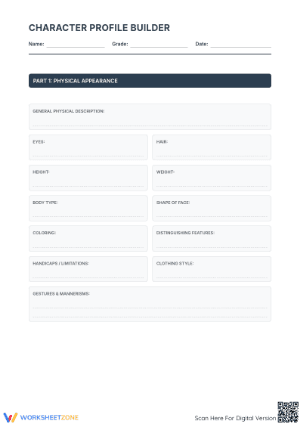
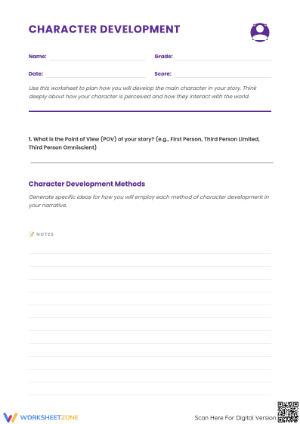
These 6th grade close reading passages pdf worksheets give teachers a text-to-task resource that earns its place across more than one spot in the week. The passages are short enough to reread inside a single class period but built around questions that push students past surface recall and into actual evidence-based reasoning. For sixth grade specifically, that shift — from "what happened" to "how do you know" — is where reading instruction gets serious, and where students need repeated, purposeful contact with real texts.
Skills These Worksheets Build
At the sixth-grade level, close reading works best when it develops several skills from a single text rather than running separate drills for each one. Each worksheet moves students through a set of skills that build on each other: understanding what the text says, explaining how ideas develop, and defending answers with precise evidence from the passage itself.
- Main idea and supporting details: Students identify the central argument or claim, then explain which specific details carry the most weight — not "the author mentions X" but why that detail matters to the point being made.
- Inference: Students read past what is explicitly stated and justify conclusions by pointing to the exact lines that led them there.
- Vocabulary in context: Students work out word meaning from surrounding sentences, which is how academic vocabulary actually sticks at this age rather than through isolated definition matching.
- Author's craft: Students track word choice, text structure, and tone — skills that become central in seventh and eighth grade but need to take root now.
- Evidence citation: Students practice pointing to the actual sentence or phrase that supports a claim, not just the general idea they pulled from memory.
That combination makes each worksheet usable across different instructional goals. A teacher running a constructed-response lesson and a teacher focused on annotation are working productively from the same text.
Where Sixth Graders Typically Go Wrong in Close Reading
The most predictable error at this level is summary disguised as inference. When asked what an author implies, sixth graders commonly write something like "the author talks about how water is important" — restating content rather than drawing a conclusion beyond it. The cleaner and more direct the prompts on each worksheet, the more visible that pattern becomes, and the easier it is to address in a whole-class correction before students move to independent work.
Evidence citation produces its own distinct problem: students often understand what supports their answer but cite the concept rather than the text. A student might write "the passage says animals need shelter" when the actual line reads something like "without cover from predators, most small mammals survive fewer than three winters." Training students to pull the specific line — not their own paraphrase of it — is a habit these worksheets build directly, because the text is right in front of them and short enough to scan back through. A third error worth flagging: conflating topic with main idea. Naming a topic is easy; identifying the author's central claim about that topic is the harder move, and it shows up as the sticking point in nearly every constructed response at this grade level.
Fitting These Worksheets Into a Real ELA Week
The most productive use of a close reading worksheet at this level is as a three-phase sequence inside a single period rather than a flat read-and-answer assignment. A first read focusing on gist takes about five minutes. A second read with annotation directions — mark the claim, circle evidence, underline unfamiliar words — takes another eight to ten. The final evidence-based question or short constructed response is where the instructional payoff lands. That rhythm gives teachers clear formative information: who tracked the text, and who summarized from memory — useful data to carry into the next day's lesson.
Beyond the full-lesson model, 6th grade close reading passages pdf worksheets also fit well in narrower spots: the first ten minutes of class as a structured entry task, small-group reteach sessions where the text stays constant but the support adjusts, and end-of-unit review when students benefit from returning to a familiar passage under mild time pressure. Because the format is print-ready, sending each worksheet home for make-up work or independent practice adds no reformatting burden on the teacher's end.
What Makes a Sixth Grade Passage Worth Rereading
A passage that functions as a genuine close reading tool has to reward returning to it — meaning the first read raises questions that the second and third reads can actually answer. For sixth graders, that usually means a text dense enough to carry academic vocabulary and a developing argument, but short enough that students can scan back and locate evidence without losing track of the task. 6th grade close reading passages pdf worksheets built around these principles give teachers a text that supports annotation, discussion, and constructed response without requiring students to manage three different documents at once.
The features that separate a strong passage from a filler reading exercise at this level:
- Length calibrated to the period: enough substance for real analysis, but manageable across two or three focused reads within one lesson.
- Prompts that funnel inward: questions that send students back into the passage rather than inviting outside opinion or general recall.
- Academic vocabulary worth unpacking: words embedded in sentences that hold enough context for students to work with.
- Varied task types: annotation directions, short-answer prompts, and at least one constructed-response slot so students practice the full range of text-based work.
Differentiating Support Without Swapping the Text
One practical advantage of a short, fixed text is that differentiation can happen around the passage without replacing it. All students read the same paragraph; what changes is the structure surrounding their task. One group might underline evidence for a teacher-supplied claim while another group writes their own claim and selects supporting details independently. Some students work with sentence-starter frames ("According to the text... / This suggests that...") while others write unguided paragraph responses. The worksheet holds the same lesson anchor for everyone.
For students who process text slowly, reading the passage aloud before distributing the worksheets removes the decoding obstacle without reducing the analytical demand. For students who finish early, extension prompts keep the cognitive challenge at the right level — "identify a second piece of evidence that seems to contradict your first answer" or "explain what the author chose to leave out and why that choice matters." These are not separate worksheets; they are planned adjustments a teacher makes with one text and a targeted set of questions.
Standard Alignment
These worksheets align primarily to CCSS.ELA-LITERACY.RI.6.1 — citing textual evidence to support analysis of both explicit statements and inferences drawn from the text — and RI.6.2, which asks students to determine a central idea and explain how it develops through specific details. Both standards sit at the structural core of sixth-grade ELA because they mark the transition from literal comprehension to text-based reasoning. Most worksheets in the set also address RI.6.4, vocabulary in context, which threads naturally through any close reading task. In practical terms, these three standards appear on nearly every sixth-grade benchmark assessment and constructed-response rubric, so consistent practice with close reading passages builds skill that transfers directly to those higher-stakes moments.
Frequently Asked Questions
Can one passage carry an entire class period?
Yes, when the work is layered intentionally. A first read establishes gist, a second read drives annotation, and a third read — or a written response — anchors students in specific evidence. The short length makes rereading possible without consuming the whole period; the focused prompts make each pass purposeful rather than repetitive.
What text types work best for sixth-grade close reading?
Both literary and informational texts work well, but informational passages — especially those with a clear argument or cause-effect structure — tend to make evidence-citing tasks more concrete for students who are still building the habit of returning to the text. Rotating across both types across the week keeps the skill practice varied without changing the instructional approach.
How do these worksheets fit into small-group or intervention instruction?
The same passage that anchors a whole-class lesson works in a small reteach group with adjusted support. Teachers can narrow the evidence hunt ("find two sentences in paragraph two that support this claim"), add sentence frames, or read the passage aloud before the group begins. The core text and task stay consistent; the support adjusts to the group's specific gap.
How often should teachers pull close reading passages at this grade level?
Two to three times per week is realistic for most sixth-grade ELA blocks. Teachers who use 6th grade close reading passages pdf worksheets consistently — rotating across informational, literary, and argumentative text types — tend to see annotation and evidence habits form faster than they do through occasional extended close reading units. Keeping individual sessions short lowers the stakes enough that students will take risks in their written responses instead of defaulting to safe restatements.















 Interactive Worksheet Maker
 Quiz Maker
 Word Search Maker
 Crossword Puzzle Maker
 Word Scramble Generator
 Sentence Scramble Generator
 Handwriting Worksheet Generator
 Name Tracing Generator
 Fill In The Blank Generator