


























Views
Downloads

Character Profile Builder | Essential Grade 5-9 ELA Guide
Paste this activity's link or code into your existing LMS (Google Classroom, Canvas, Teams, Schoology, Moodle, etc.).
Students can open and work on the activity right away, with no student login required.
You'll still be able to track student progress and results from your teacher account.
This Grade 5-9 character profile builder provides a comprehensive framework for students to construct multi-dimensional characters for narrative writing. By prompting students to consider both external physical traits and internal psychological motivations, the worksheet ensures that student-created characters feel authentic and grounded. It serves as a vital pre-writing tool that transforms vague ideas into detailed blueprints for storytelling.
At a Glance
- Grade: 5-9 · Subject: ELA
- Standard:
CCSS.ELA-LITERACY.W.6.3.B— Use description to develop experiences, events, and characters effectively- Skill Focus: Character Development & Analysis
- Format: 2 pages · 20 prompts · No answer key · PDF
- Best For: Creative writing and literary analysis
- Time: 20–40 minutes
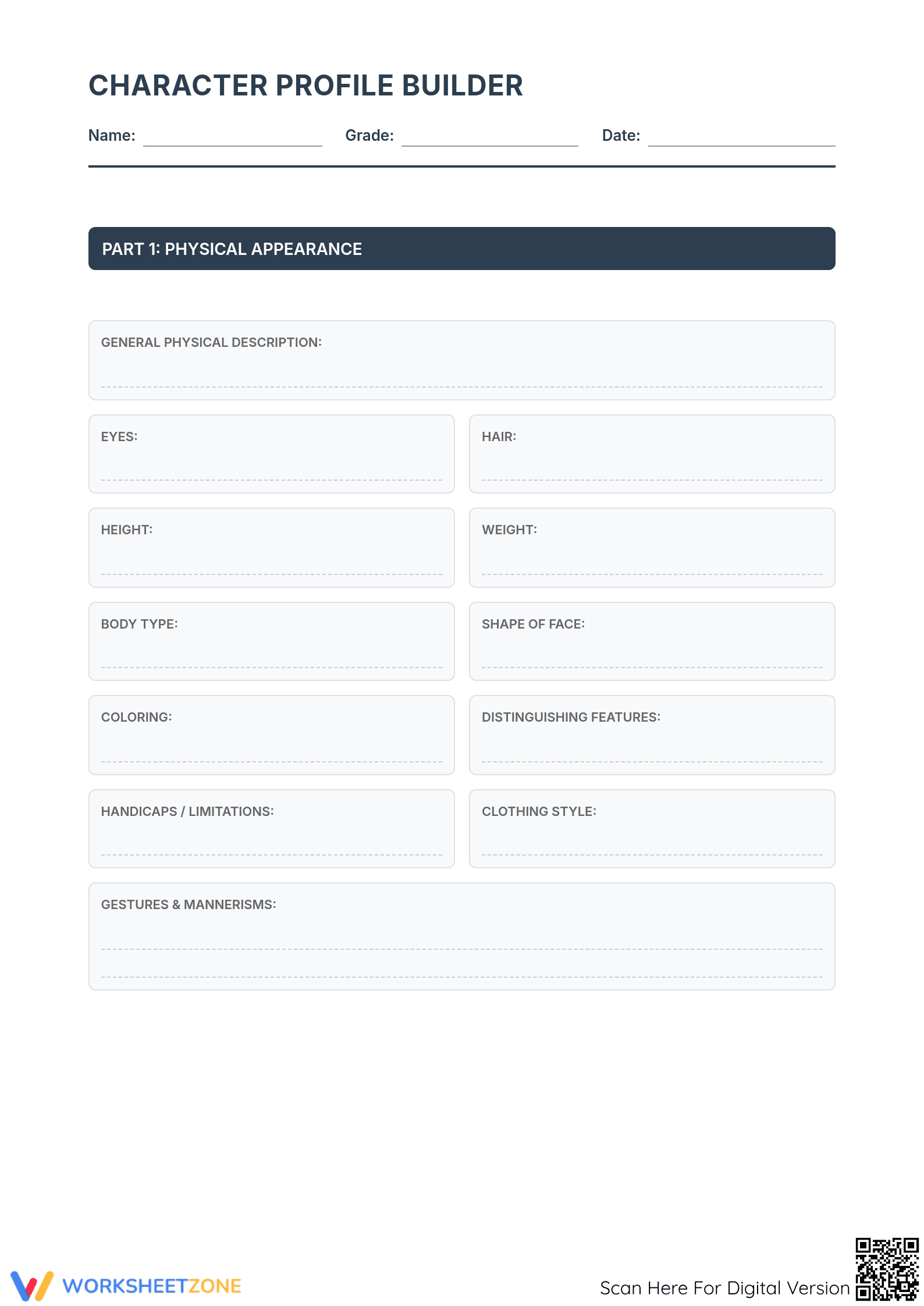
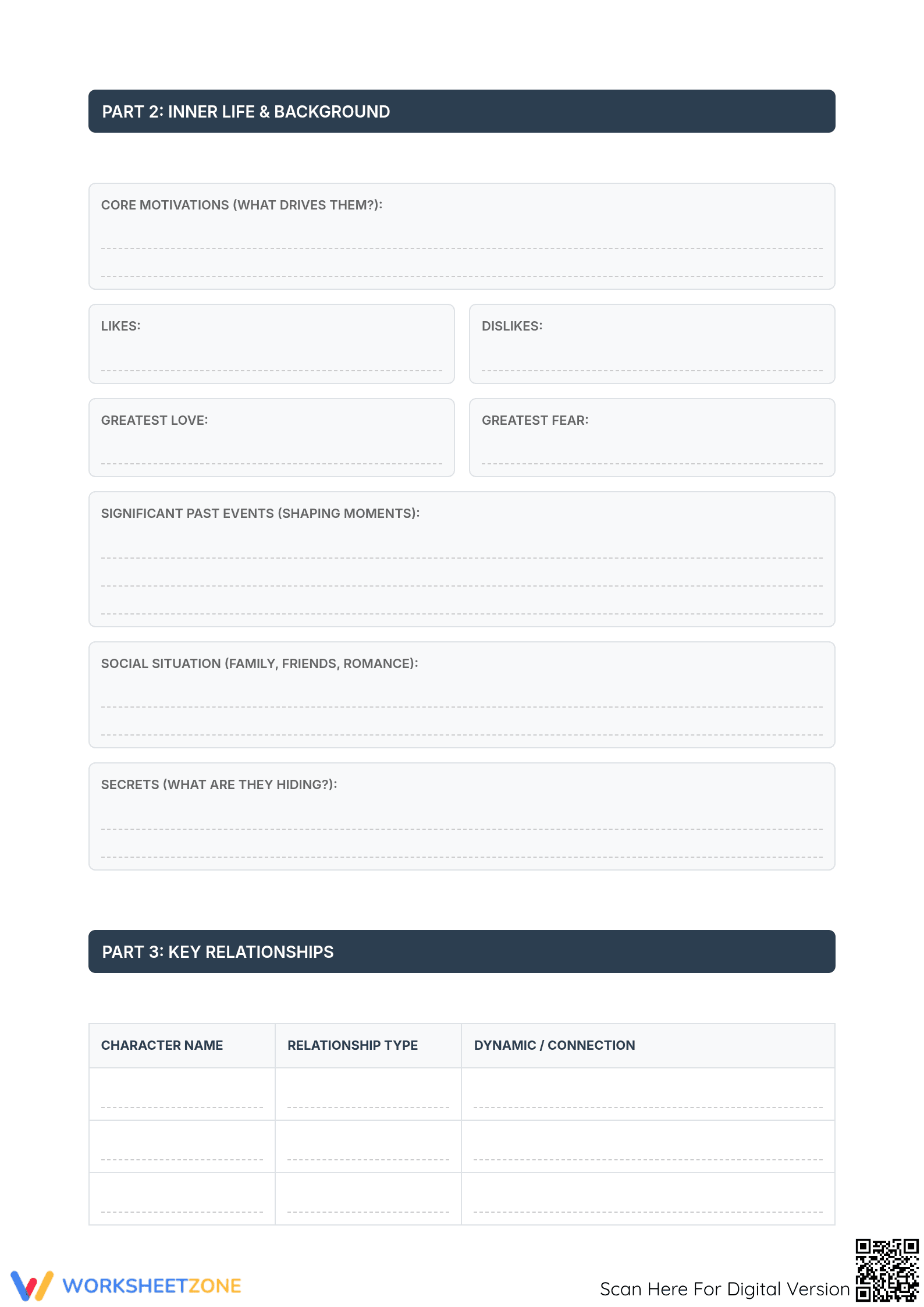
The worksheet is organized into three distinct sections across two printable pages. Part 1 focuses on physical appearance, including specific fields for gestures, clothing style, and distinguishing features. Part 2 transitions into the character's inner life, prompting students to define core motivations, fears, and significant past events. Part 3 features a relationship dynamic table, allowing students to map out how their character interacts with others in the story.
Zero-Prep Workflow
This resource is designed for immediate classroom implementation with minimal preparation. The workflow is straightforward:
- Print: Select the two-page PDF and print double-sided copies.
- Distribute: Hand out the profile builder at the start of a creative writing unit.
- Review: Use the completed profiles as a formative assessment to check for character depth before drafting.
The self-explanatory prompts make this ideal for sub plans or independent writing centers.
Standards Alignment
The primary focus is `CCSS.ELA-LITERACY.W.6.3.B`, requiring students to use narrative techniques like description to develop characters. By completing the 20 prompts, students generate the raw material needed for their final drafts. It also supports `CCSS.ELA-LITERACY.RL.7.3` when used for literary analysis. These codes can be integrated directly into lesson plans or IEP goals.
How to Use It
Use this worksheet during the pre-writing phase. After brainstorming a story idea, have students complete this profile to define their protagonist. Alternatively, use it as a 'character autopsy' after reading a short story to identify textual evidence. Expect students to spend 20 to 40 minutes on the full spread. Checking the core motivations section ensures characters have clear, driving goals.
Who It's For
Tailored for grades 5 through 9, this resource is effective for reluctant writers who need specific prompts to spark imagination. It pairs well with character trait anchor charts or mentor texts. For differentiated instruction, allow students to sketch their character in the margins to supplement written descriptions.
According to research by Fisher & Frey (2014) on scaffolded writing, providing structured graphic organizers for character development significantly improves the quality of student narrative output. This worksheet addresses CCSS.ELA-LITERACY.W.6.3.B by requiring students to move beyond surface-level traits into the psychological motivations and social dynamics that drive plot progression. Data from the NAEP suggests that students who utilize pre-writing frameworks demonstrate higher proficiency in descriptive writing tasks compared to those who begin with a blank page. This resource serves as a bridge between abstract character concepts and concrete narrative execution, ensuring that every student has a roadmap for complex characterization. The inclusion of gestures and mannerisms specifically targets higher-order descriptive skills often missing in standard middle-school writing samples.


