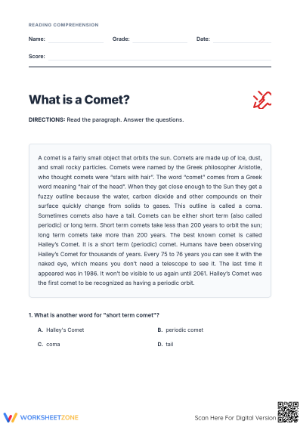
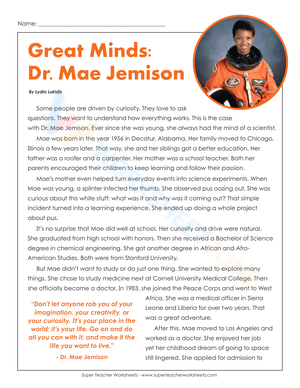
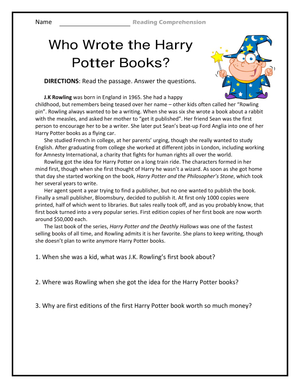
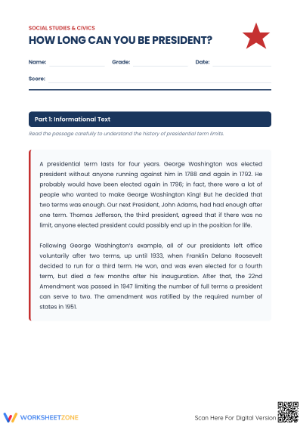
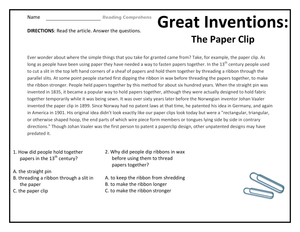
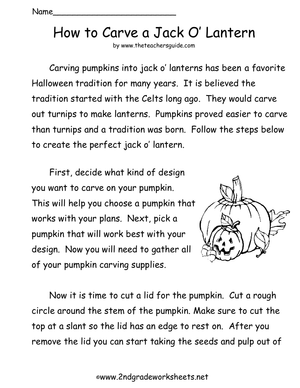
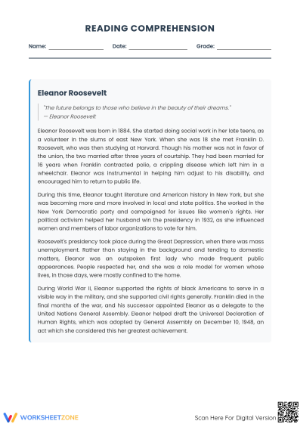
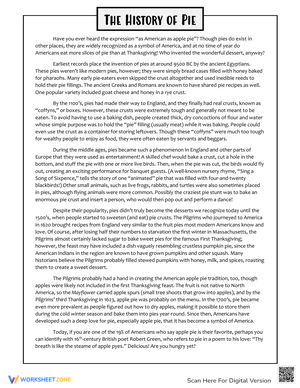
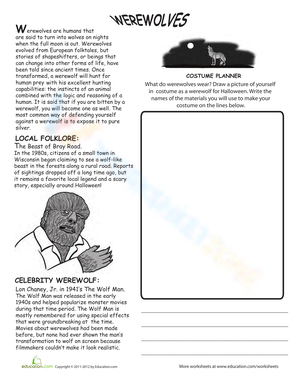
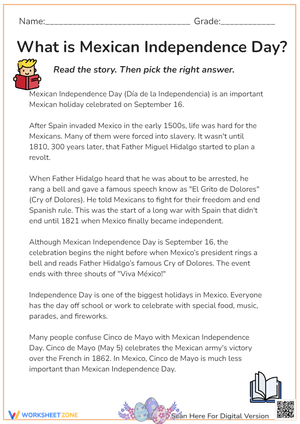
These informational text printable worksheets for 6th grade give teachers something directly useful: nonfiction passages paired with questions that ask students to do the actual reading moves — citing specific evidence, naming the central idea, and explaining how the text is organized. That last part matters at this grade. Sixth graders are no longer asked just what a text says; they're asked why a detail belongs there and how the author arranged the information, and a worksheet that skips that distinction is just comprehension practice from two grades earlier.
The Specific Skills Each Worksheet Targets
Each worksheet focuses on one or two of the moves that define reading informational text at the middle school level. The questions are not general recall checks — they send students back to the passage to explain what they found there and why it matters.
- Identifying the central idea and distinguishing it from details that are interesting but secondary
- Citing textual evidence — locating the specific line or phrase that supports the answer, not just the one that appears nearby
- Summarizing a passage without lifting whole sentences, which sixth graders do more consistently than most teachers expect
- Analyzing text structure — not simply labeling it as "cause and effect," but explaining how that organizational choice shapes the reader's understanding
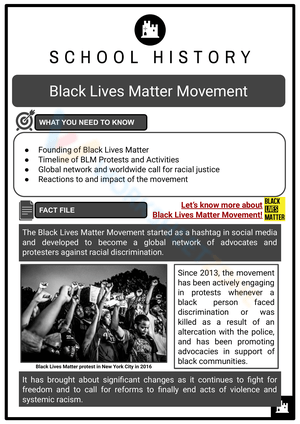
- Reading text features: what a subheading narrows, what a caption adds that the paragraph does not state directly, what a diagram clarifies
- Using context clues to work through academic vocabulary without letting an unfamiliar term shut down comprehension entirely
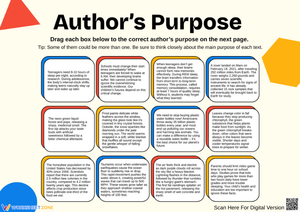
The more challenging worksheets in the set add questions about author's point of view and purpose. Those require students to consider what the author chose to emphasize and what that reveals about stance — a genuine analytical move that separates students who are reading to learn from those who are reading to finish.
Student Mistakes Worth Anticipating Before the Lesson
The most consistent error on evidence questions is not that students can't find evidence — it's that they find something that sounds relevant and stop without testing whether it actually answers the question. A student will underline "Scientists identified the organism in 2003" as proof of the author's claim about environmental policy because the sentence appears in the same paragraph as the claim. The line is not wrong; it is just not doing the job the question requires. Students who make this move have located the neighborhood but not the right house.
A second pattern: students who handle main idea reasonably well in fiction will struggle with informational text because they look for a character's lesson rather than the author's central argument. This breakdown shows up most clearly when the passage uses a problem-solution structure. Students identify the problem, assume that is the central idea, and miss the author's actual point — which is usually about the nature or implications of the solution. One question per worksheet that asks "what is the author's point about this situation, not just what the situation is" tends to surface that gap before the unit assessment does.
Text features bring a third issue. Students trained on narrative text skip headings and captions by instinct — those elements don't exist in stories, so students have learned to ignore them entirely. When a worksheet includes a separate question about a subheading or caption alongside the paragraph-level questions, teachers can see immediately whether the student is reading the full informational text or just the prose portion of it. That distinction often explains why a student's summary sounds thin even when their decoding is solid.
Fitting These Worksheets Into Your Weekly Plans Without Losing Instructional Time
The most efficient use is as a same-day check after a mini-lesson. Teach central idea or evidence citation for fifteen minutes, then hand out one worksheet. Students read and respond in the last eight or ten minutes of class. Teachers collect written evidence of what actually landed without making it a full homework assignment, and the results are specific enough to shape the next day's instruction.
In stations, keeping the routine tight matters: read, annotate two or three key lines, answer, then compare evidence choices with a partner before moving on. The comparison step is worth protecting. Students who explain their evidence choice aloud — even briefly — catch their own misreads in ways that silent individual work does not produce.
- Mini-lesson follow-up: one worksheet after direct instruction, used as a quick formative check tied to a single skill
- Intervention groups: stop after each question; ask students to read aloud the line they chose before explaining why it fits
- Monday morning review: a short passage and two evidence questions during the first ten minutes reactivates reading habits after the weekend without requiring new instruction
- Sub plans: the routine is self-contained and easy to restart without additional explanation from a substitute
For students who freeze when presented with a longer passage, splitting the worksheet into two sittings — annotate first, respond in the next sitting — removes processing pressure without reducing the rigor. That two-step approach also mirrors what careful close reading actually looks like: first read for gist, second read for evidence and structure.
Standard Alignment
CCSS.ELA-LITERACY.RI.6.1 requires students to cite textual evidence to support analysis of both explicit and inferential meaning — the core demand across most evidence-based questions in this set. RI.6.2 covers determining central idea and summarizing, which appears in nearly every worksheet where the passage presents an argument or explanation rather than a narrative. RI.6.5 asks students to analyze how specific sentences, paragraphs, or sections contribute to overall structure and development. RI.6.6 addresses point of view and purpose, which drives the more analytical questions at the harder end of the set.
These standards fall within the grades 6–8 text complexity band established by the Common Core ELA framework, which places informational and literary nonfiction alongside each other as parallel reading demands at this level. For teachers building units around RI.6.1 through RI.6.6, these informational text printable worksheets for 6th grade provide ready practice that extends the work already happening during whole-class instruction — without requiring teachers to construct original assessment items from scratch.
Adjusting the Set for a Range of Learners
The clearest adjustment point is the response demand, not the passage itself. A student who needs more support can highlight the two lines that best answer the question and give a verbal explanation before writing one sentence. A student ready for more can write a full evidence-based short response — explaining not just what the evidence says but why the author positioned it where they did. The intellectual work is present at both levels; the difference is how much sustained writing each student generates on their own.
For English learners working with academic vocabulary in nonfiction passages, a brief glossary at the top of the worksheet keeps the comprehension work intact without turning the task into a vocabulary exercise. Pre-teaching two or three domain-specific terms from the passage — three minutes in a small group before the worksheet begins — meaningfully changes what students can do with the evidence questions that follow.
Students reading well above grade level gain the most from structure and point-of-view questions, which require analysis rather than retrieval. Asking those students to write a second short response explaining what the author chose to omit — and why that absence matters — extends the task without requiring a separate worksheet. These informational text printable worksheets for 6th grade hold up across a wider range of ability levels than they first appear to when teachers look only at the passage length.
Frequently Asked Questions
What reading skills should 6th grade informational text worksheets address?
The most instructionally useful worksheets target central idea, textual evidence, summarizing, text structure, text features, and author's point of view or purpose. At the sixth-grade level, the best practice is matching each worksheet to the specific skill introduced in that day's instruction — so students are applying something they've seen modeled rather than encountering it without context.
How do I use these in small-group intervention without sessions running too long?
Work one question at a time. Before students write, ask them to find and read aloud the line they intend to cite. That single step reveals whether the student identified useful evidence or just found something nearby. The discussion that follows one question is usually more instructional than completing the full worksheet in silence.
Are these worksheets aligned to Common Core reading standards?
Yes. These informational text printable worksheets for 6th grade connect most directly to RI.6.1 (textual evidence), RI.6.2 (central idea and summary), RI.6.5 (text structure), and RI.6.6 (point of view and purpose). The most efficient use is pairing each worksheet with whichever of those standards is the current instructional focus, rather than using them as undifferentiated reading review.
How are informational text worksheets different from general reading comprehension practice?
General comprehension practice often asks students to recall what happened or define a vocabulary word. Informational text worksheets ask students to analyze how the text is built — what the author emphasizes, how evidence is arranged, what a structural choice reveals about meaning. That distinction matters in sixth grade because both state and Common Core assessments at this level reward analysis and evidence-based reasoning, not recall.












 Interactive Worksheet Maker
 Quiz Maker
 Word Search Maker
 Crossword Puzzle Maker
 Word Scramble Generator
 Sentence Scramble Generator
 Handwriting Worksheet Generator
 Name Tracing Generator
 Fill In The Blank Generator