


























Views
Downloads

Grade 6 Character Development — Printable No-Prep Worksheet
Paste this activity's link or code into your existing LMS (Google Classroom, Canvas, Teams, Schoology, Moodle, etc.).
Students can open and work on the activity right away, with no student login required.
You'll still be able to track student progress and results from your teacher account.
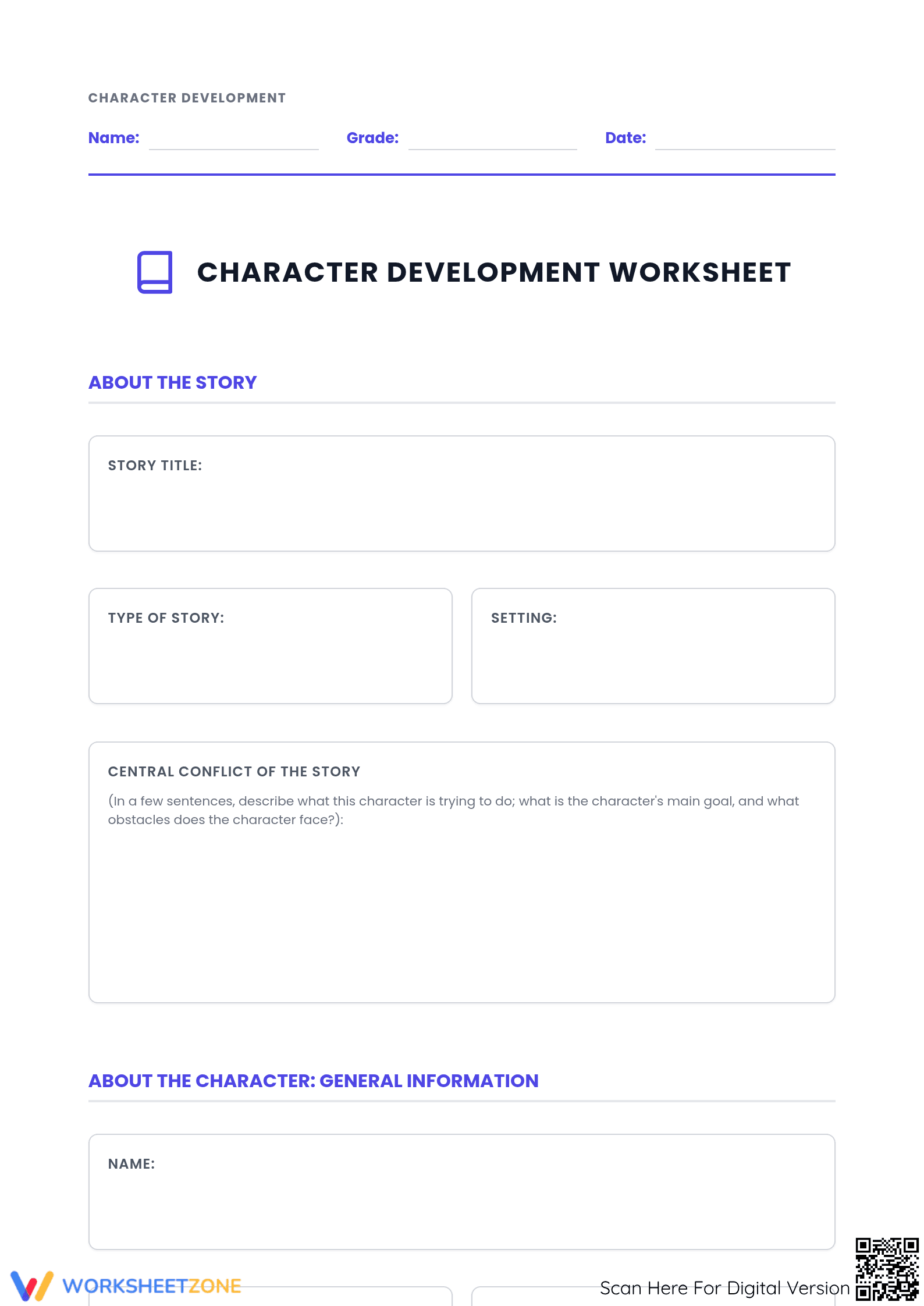
This printable character development worksheet helps middle school students analyze literary figures by breaking down their traits, motivations, and conflicts. By completing this graphic organizer, students will deeply examine how a character interacts with the setting and plot, leading to stronger reading comprehension and more nuanced literary analysis.
At a Glance
- Grade: 6 · Subject: ELA
- Standard:
CCSS.ELA-LITERACY.RL.6.3— Analyze how characters respond or change as the plot moves toward a resolution- Skill Focus: Character Analysis
- Format: 2 pages · 11 prompts · PDF
- Best For: Independent reading response
- Time: 20–30 minutes
What's Inside
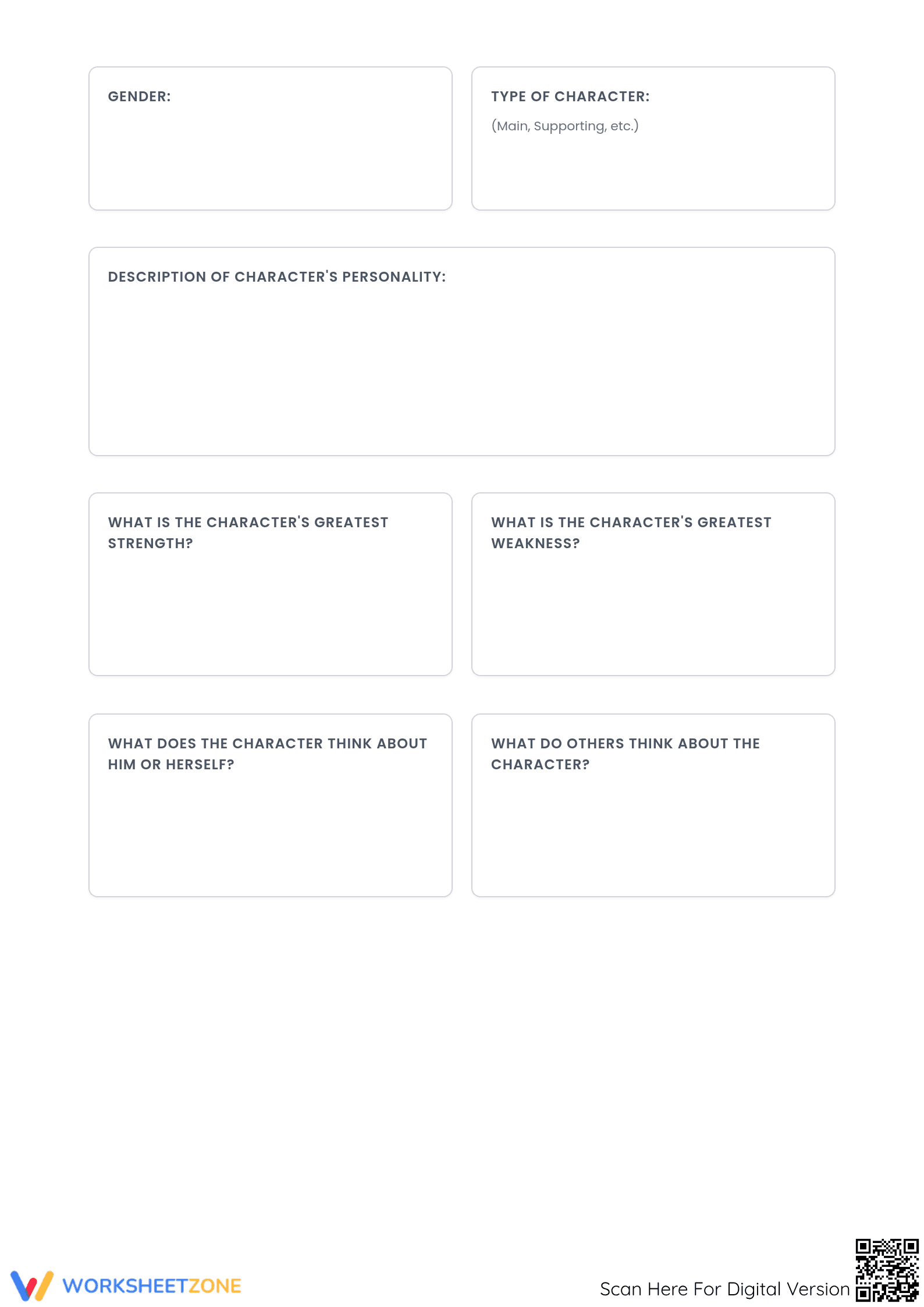
Inside this two-page resource, educators will find a comprehensive graphic organizer designed to dissect any fictional character. The worksheet features 11 distinct prompt boxes that guide students through identifying basic story elements, such as setting and central conflict, before moving into deeper character traits. Students will document the character's personality, greatest strengths and weaknesses, self-perception, and how other characters view them.
Zero-Prep Workflow
- Print (1 minute): Simply print the two-page PDF. No special formatting or answer keys are required since it pairs with any fiction text.
- Distribute (1 minute): Hand out the organizers before or after a reading block.
- Review (3 minutes): Quickly scan student responses to gauge their understanding of character motivations and text evidence.
Total teacher prep time is under two minutes. This versatile format makes it an ideal, self-explanatory activity for emergency sub plans or independent reading centers.
Standards Alignment
This resource is aligned to CCSS.ELA-LITERACY.RL.6.3, requiring students to describe how a particular story's or drama's plot unfolds in a series of episodes as well as how the characters respond or change as the plot moves toward a resolution. It also supports general reading comprehension standards by prompting students to cite text-based evidence for character traits. Both standard codes can be copied directly into lesson plans, IEP goals, or district curriculum mapping tools.
How to Use It
This worksheet is highly adaptable for various instructional moments. Use it during independent reading time as a structured accountability tool, or assign it after a whole-class read-aloud to facilitate a deep examination of the protagonist's development. Expected completion time ranges from 20 to 30 minutes depending on the complexity of the text. For a quick formative assessment, observe how students fill out the "What do others think about the character?" section; this reveals whether they can infer traits from dialogue and secondary character interactions rather than just explicit narration.
Who It's For
This resource is primarily designed for middle school students in grades 5 through 8. It serves as an excellent scaffold for learners who struggle with abstract literary analysis, providing concrete boxes to organize their thoughts. Pair this worksheet with any short story, novel chapter, or a direct instruction lesson on direct versus indirect characterization.
Effectively analyzing character development is a foundational skill for advanced reading comprehension and literary critique. According to Fisher & Frey (2014), providing students with structured graphic organizers significantly improves their ability to extract complex information from texts, synthesize multiple viewpoints, and retain critical narrative details. This worksheet directly supports CCSS.ELA-LITERACY.RL.6.3 by requiring students to analyze how characters respond or change as the plot moves toward a resolution. By breaking down abstract concepts like internal conflict, personal weaknesses, and external perception into manageable, discrete prompts, educators can effectively reduce cognitive load and foster deeper, more meaningful engagement with literature. Regular, structured practice with these targeted analytical tasks ensures students move beyond surface-level reading. Ultimately, this empowers learners to understand the intricate mechanics of storytelling, character motivation, and authorial intent, building a strong foundation for high school-level textual analysis.


