




























Views
Downloads

Essential Character Development Worksheet | Grades 5-9

Paste this activity's link or code into your existing LMS (Google Classroom, Canvas, Teams, Schoology, Moodle, etc.).
Students can open and work on the activity right away, with no student login required.
You'll still be able to track student progress and results from your teacher account.
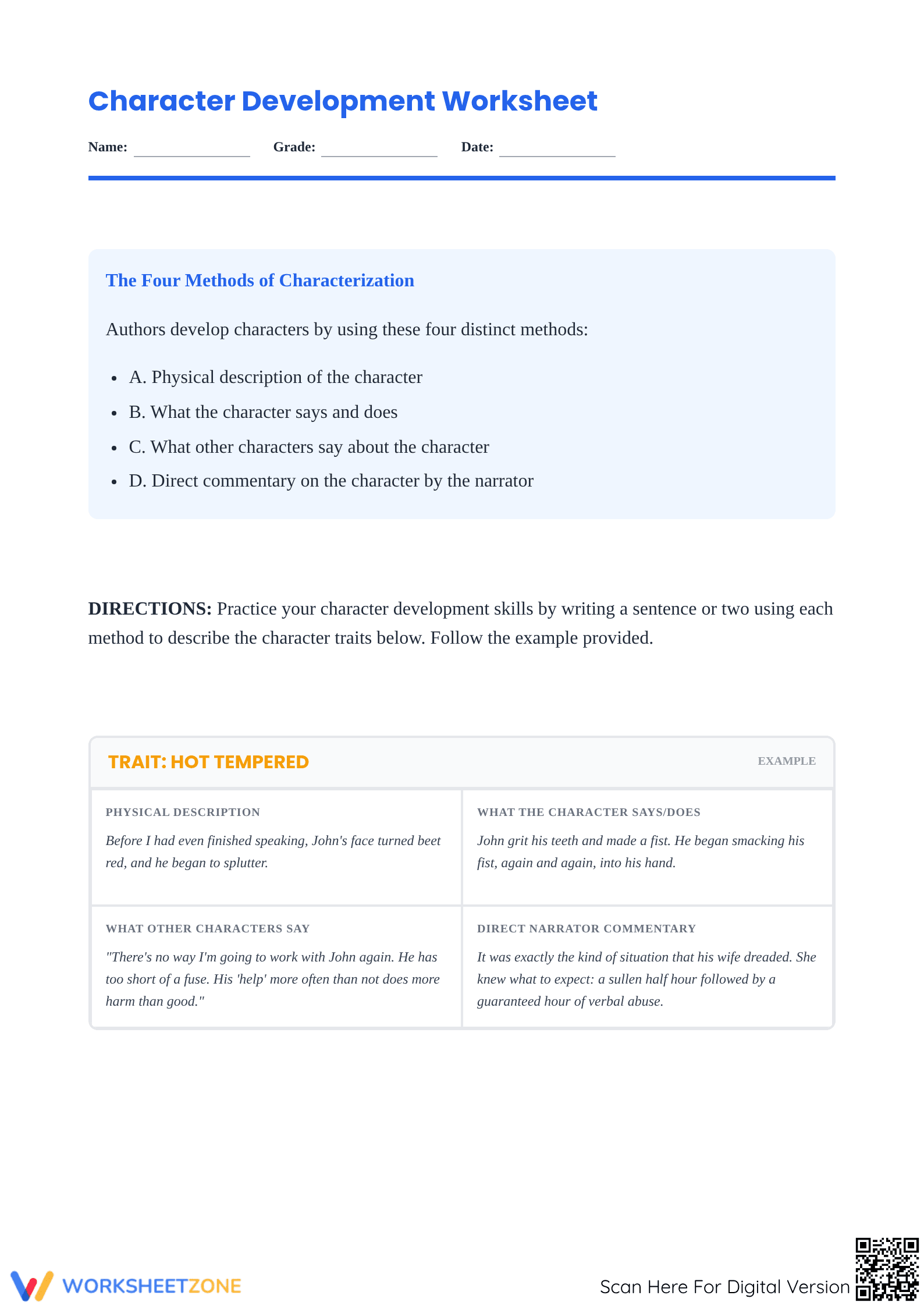
This Grade 5-9 character development worksheet helps students master the art of showing rather than telling through structured writing practice. Students apply four distinct methods of characterization—physical description, dialogue/actions, external perspectives, and narrator commentary—to bring specific traits to life. It is an ideal resource for improving narrative writing and literary analysis skills.
At a Glance
- Grade: 5-9 · Subject: ELA
- Standard:
CCSS.ELA-LITERACY.RL.8.3— Analyze how dialogue or incidents reveal aspects of a character- Skill Focus: Methods of Characterization
- Format: 3 pages · 16 tasks · No-prep · PDF
- Best For: Creative writing and literary analysis practice
- Time: 30–45 minutes
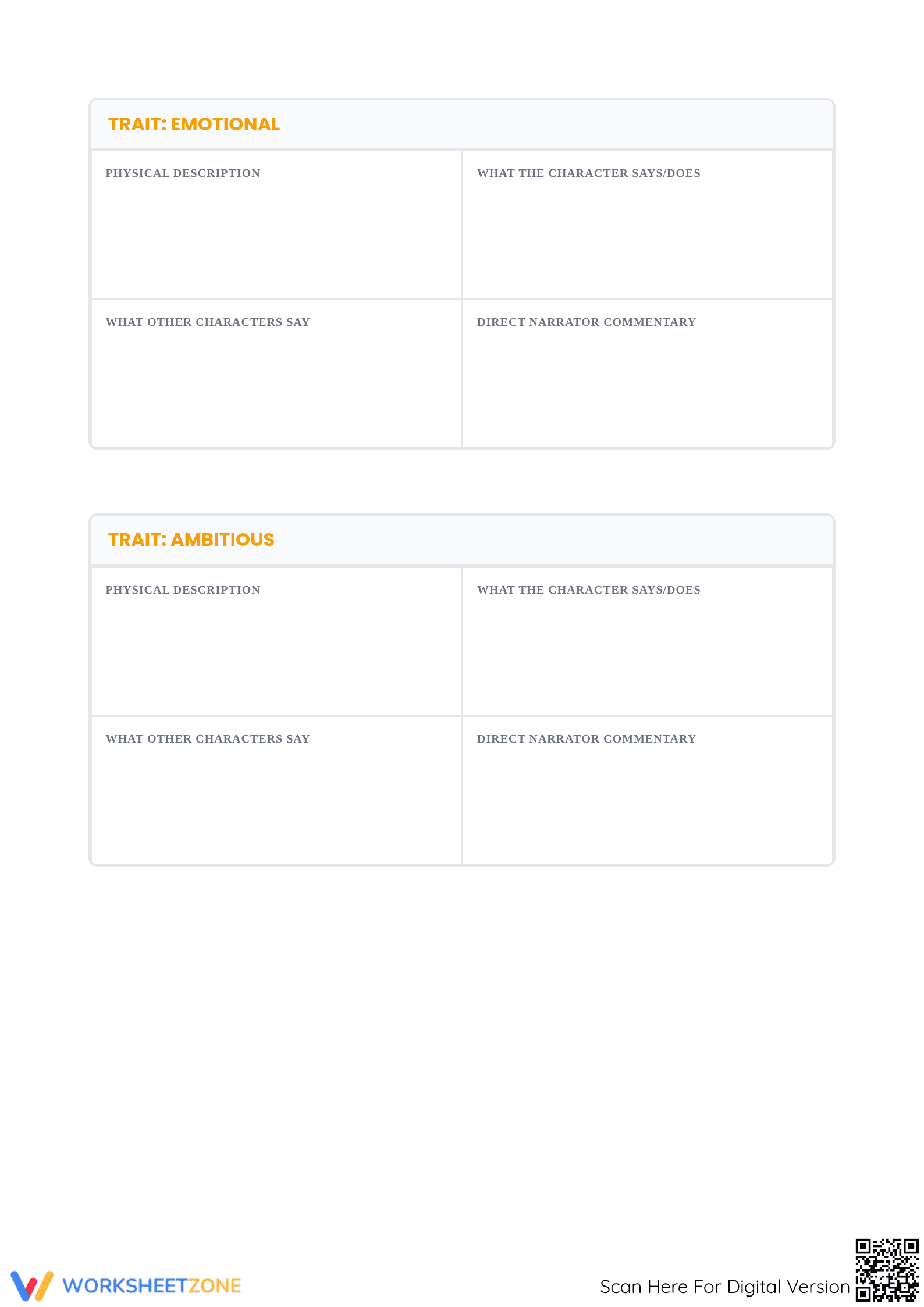
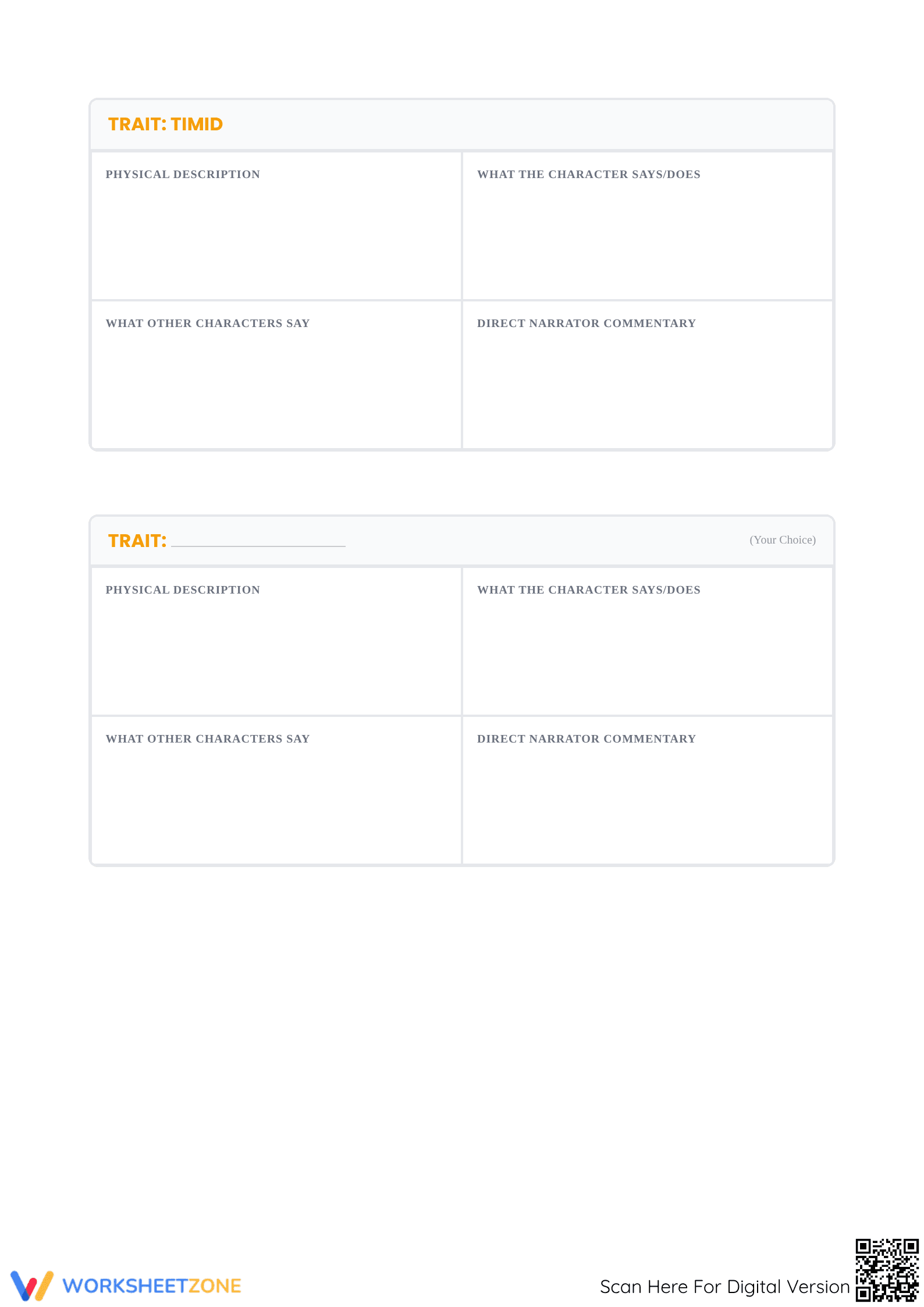
What's Inside: The packet contains three pages of focused practice. Page one introduces the four methods of characterization with a complete "Hot Tempered" example. Pages two and three provide structured grids for four additional traits: Emotional, Ambitious, Timid, and a student-selected trait. Each grid requires four unique sentences, totaling 16 creative writing prompts that reinforce indirect characterization techniques.
Zero-Prep Workflow: Teachers can implement this resource in under two minutes. Simply print the three-page PDF and distribute it to students as a standalone lesson or a supplemental activity during a novel study. Because the first page includes a clear definition and a worked example, students can work independently with minimal teacher intervention, making it an excellent choice for emergency sub plans.
Standards Alignment: This resource aligns with `CCSS.ELA-LITERACY.RL.8.3`, which requires students to analyze how particular lines of dialogue or incidents in a story reveal aspects of a character. By practicing the creation of these elements, students gain a deeper understanding of how authors construct complex personas. This standard code can be copied directly into lesson plans, IEP goals, or district curriculum mapping tools.
How to Use It: Use this worksheet during the guided practice phase of a lesson on narrative techniques. After discussing characterization frameworks, have students complete the Emotional and Ambitious sections. For formative assessment, circulate and check if students are successfully using "What other characters say" to imply a trait rather than stating it directly. Expected completion time is 30 to 45 minutes.
Who It's For: This resource is designed for middle and early high school students who need to move beyond basic adjectives in their writing. It is particularly effective for English Language Learners who benefit from the structured sentence-level practice. Pair this with a short story or a character anchor chart to provide a complete instructional cycle for diverse learners.
According to Fisher & Frey (2014), the gradual release of responsibility is most effective when students are provided with clear models before transitioning to independent application. This worksheet follows that pedagogical structure by providing a comprehensive example before tasking students with 16 original characterization sentences. By focusing on CCSS.ELA-LITERACY.RL.8.3, the resource ensures that students are not just identifying traits but are actively constructing the evidence required for sophisticated literary analysis. Research from the NAEP suggests that students who can manipulate multiple perspectives in writing demonstrate higher proficiency in reading comprehension. This 3-page PDF provides the necessary scaffolding for students to master the four primary methods of character development, ensuring they can both decode and encode complex character traits in various literary contexts.


