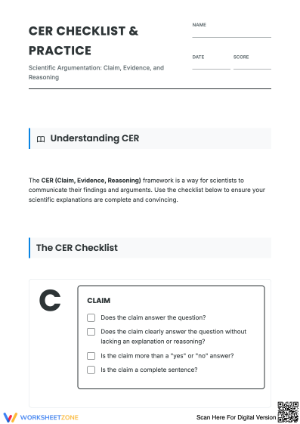
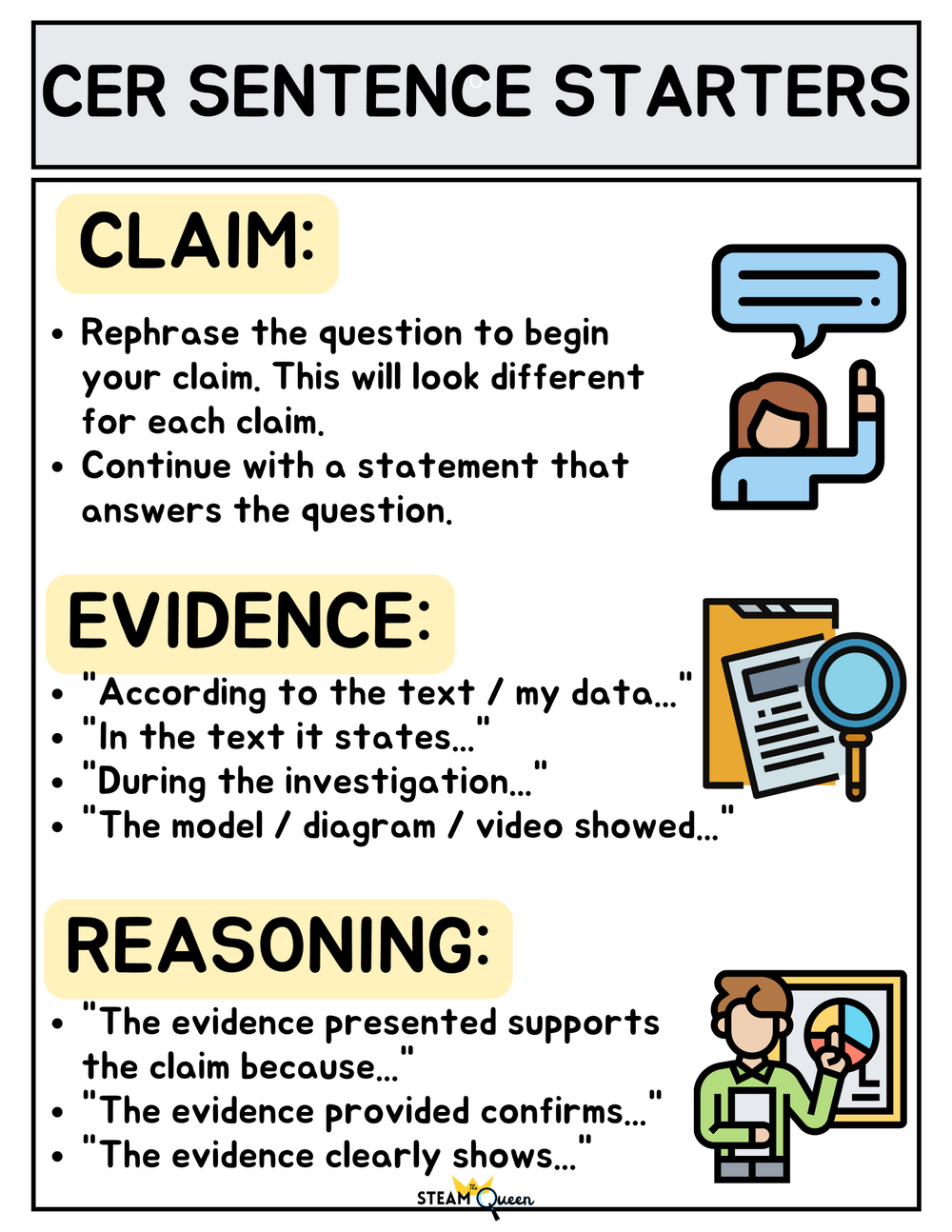
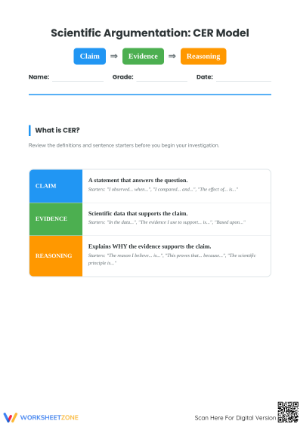
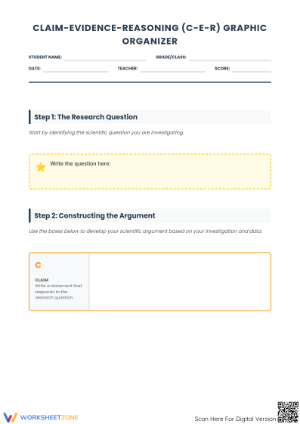
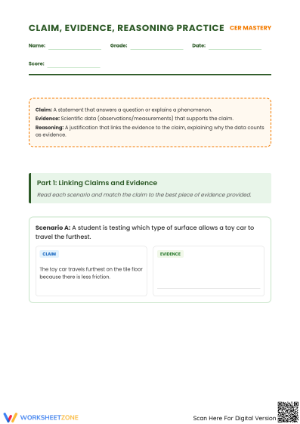
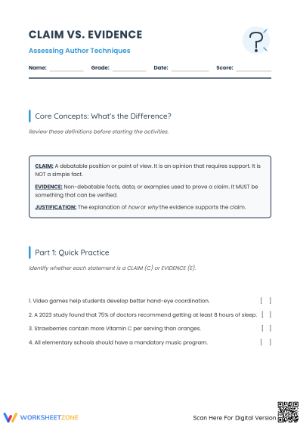
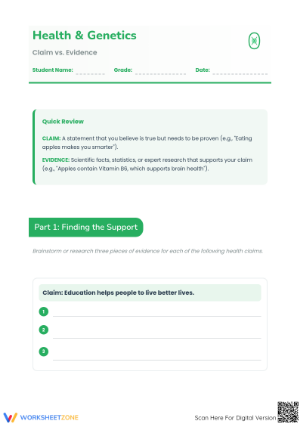
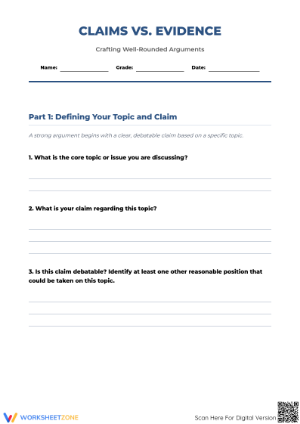
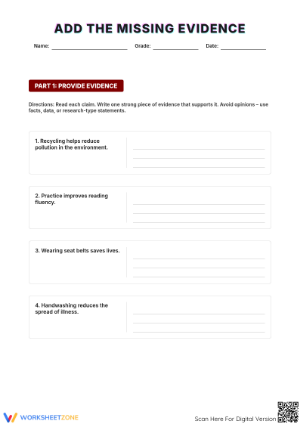
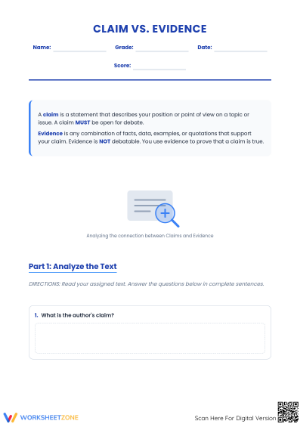
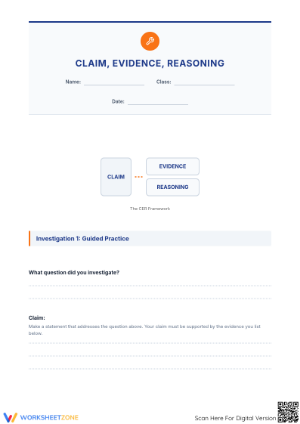
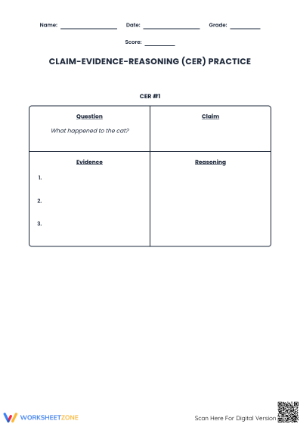
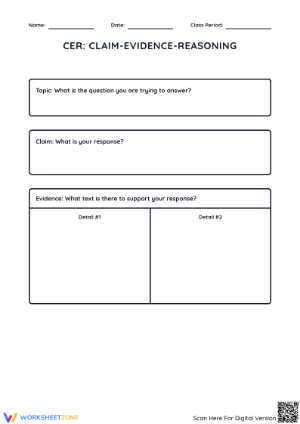
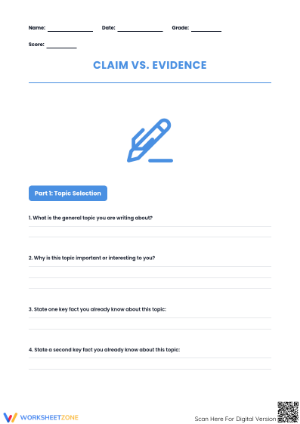
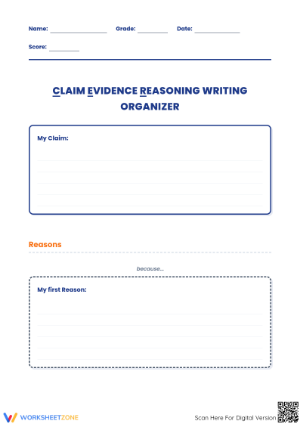
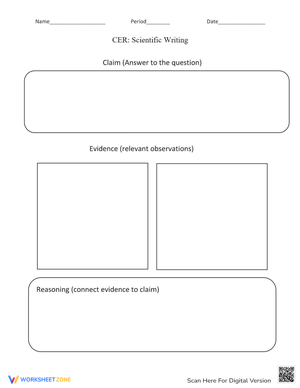
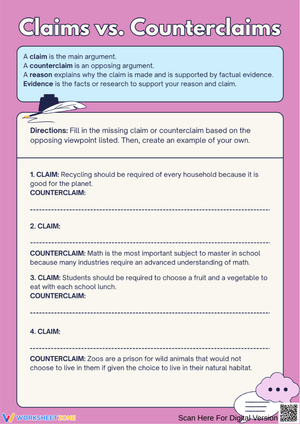
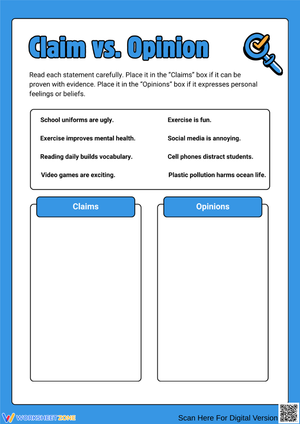
These 6th grade claim evidence reasoning worksheets give teachers a structured way to slow argument analysis down into three visible, teachable steps—and to use that practice during reading instruction, not just as a writing exercise. The set works across ELA, science, and social studies because CER is a reading-thinking routine first. Teachers get short, focused tasks they can use as warm-ups, exit tickets, or the core of a small-group lesson without needing a full writing block.
The Three Moves These Worksheets Build
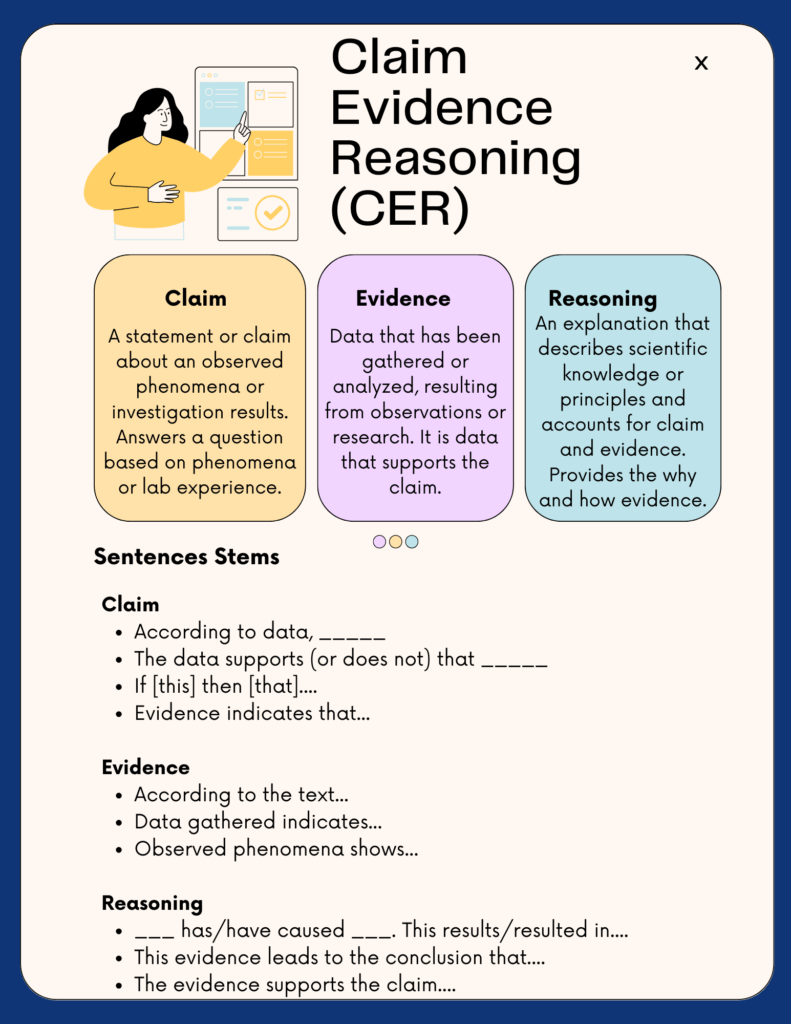
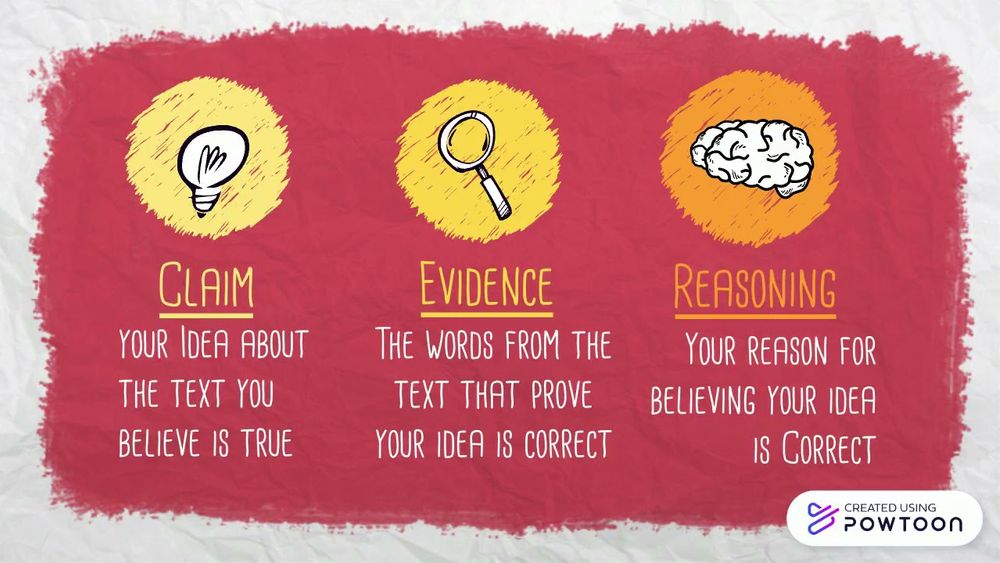
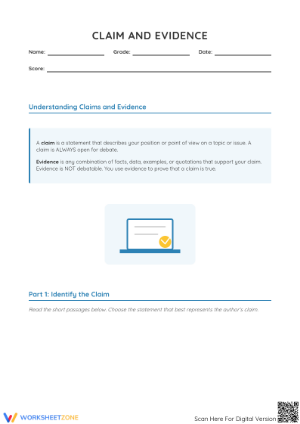
Each component of CER asks something different of sixth graders, and that difference matters for how the worksheets are arranged. Claim practice teaches students to distinguish an author's central position from the details around it—harder than it sounds, because informational text often buries the main argument rather than stating it up front. Evidence tasks push students to choose the detail that most directly supports the claim, not just any interesting sentence from the passage. Reasoning asks students to explain why that detail matters—the logical connection, in their own words, between the evidence and the point it is supposed to prove.
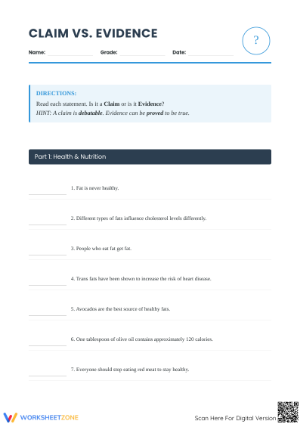
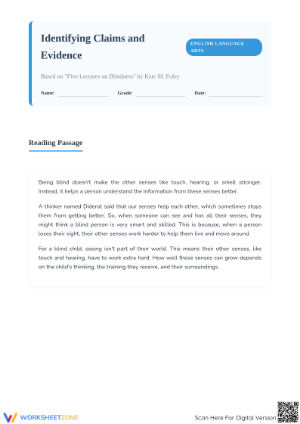
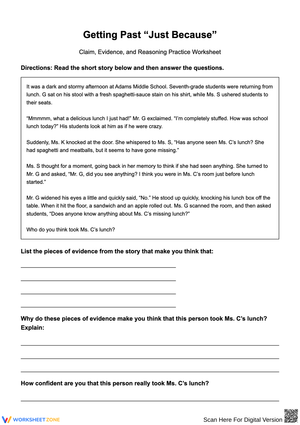
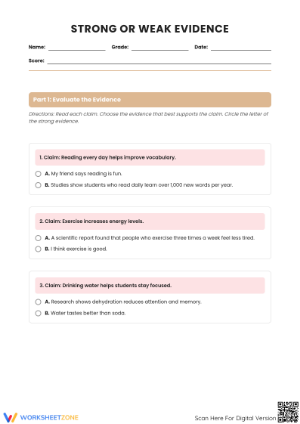
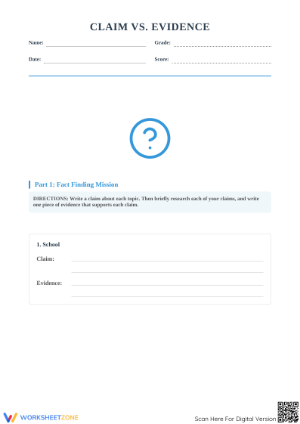
Across the set, worksheets combine these moves in different configurations. Some ask students to sort provided claim, evidence, and reasoning statements drawn from a short passage. Others give students the claim and ask them to locate the strongest supporting detail, then write a reasoning sentence. A third type presents a completed CER response and asks students to evaluate whether the evidence is actually relevant to the claim or whether a better detail exists in the same text. That variation prevents the work from becoming a fill-in routine—students have to think each time rather than repeat the same motion.
Mistakes Students Make That These Worksheets Help Teachers Catch
The most consistent error in CER work is selecting evidence by emotional weight rather than logical relevance. A student reading an article about ocean pollution who spots the sentence "scientists estimate that 8 million metric tons of plastic enter the ocean each year" will often choose it as evidence for nearly any claim about the topic—because the number sounds significant. But if the claim is specifically about government inaction, that statistic is adjacent to the argument, not directly supportive of it. Worksheets that present multiple plausible evidence choices—rather than asking students to locate any supporting detail—force that discrimination in a useful way.
Reasoning is the piece that most clearly reveals the limits of a student's analytical thinking at this grade level. The default weak response looks like this: "This proves the claim because it is evidence that supports it." That sentence names the function without performing it. The logic is circular. Students need to complete the explanatory move—to say why the specific detail connects back to the author's argument—not just label it. Sentence frames like "This detail shows that..." or "The author uses this to demonstrate..." give students a syntactic entry point without doing the thinking for them. Several worksheets in the set include those frames for students who are still building that reasoning habit.
Standard Alignment
The primary standard these worksheets address is CCSS.ELA-LITERACY.RI.6.8: "Trace and evaluate the argument and specific claims in a text, assessing whether the reasoning is sound and the evidence is relevant and sufficient." That word evaluate is the one teachers sometimes underweight in planning. RI.6.8 does not just ask students to locate an argument—it asks them to judge the quality of the support. That distinction creates two clear instructional targets: identification first, then evaluation. Teachers can sequence the worksheets accordingly, using claim- and evidence-identification tasks early in a unit and shifting to evaluation tasks once students are secure with the basic structure.
A set of 6th grade claim evidence reasoning worksheets also connects to CCSS.ELA-LITERACY.W.6.1, which asks students to support claims with clear reasons and relevant evidence in their own writing. CER practice during reading lessons builds the cognitive model students need before they write. They have seen and named the structure repeatedly, so when they try to produce it, they have a reference point. That sequence—analyze first, produce second—tends to close the gap between students who understand CER as a vocabulary list and students who actually apply it in a written response.
How to Build These Worksheets Into Your Lesson Plans
The most reliable placement is the first five to eight minutes of class, before the main reading or writing block. A short passage with a single claim-identification question activates argument-reading thinking and gives the teacher quick formative information before the lesson continues. That two-minute scan of student warm-ups—looking for who identified a supporting detail instead of the actual central argument—is often more informative than a longer check at the end of class, when other factors have already shaped the work.
For small-group reteach, the most effective move is to model one complete CER example aloud, naming each decision explicitly: "I'm looking for the claim—the author's main point, not a supporting detail. Now I'm choosing the evidence that most directly proves that point. And now I'm explaining why this specific detail connects back to the argument." After the model, students attempt the next item independently while the teacher watches. The errors that surface in those first independent attempts show exactly where each student's reasoning breaks down.
When teachers use 6th grade claim evidence reasoning worksheets as exit tickets, the results sort quickly into three stacks: students who missed the claim, students who chose weak evidence, and students who wrote circular reasoning. Each stack points to a different next-day grouping. That three-minute sort replaces the need for a separate diagnostic task and makes the following small-group lesson specific rather than general.
Adjusting the Worksheets Across Ability Levels
For students working below grade level in reading, the most effective adjustment is to reduce the number of decisions required at once. Give them the claim already identified, offer two or three evidence options and ask them to select and mark the strongest one, then ask them to complete a reasoning sentence frame. That keeps the intellectual demand on explanation—the hardest and most instructionally valuable step—rather than spreading the cognitive load equally across all three parts before students are ready for that.
Students who move through identification tasks quickly need evaluative work. Ask them to assess whether a given CER response is strong: Is the evidence relevant to this specific claim? Does the reasoning explain the logical connection, or does it just restate the evidence? Could a different detail from the passage support the claim more precisely? That kind of analytical judgment is closer to what RI.6.8 actually requires and keeps high-readiness students working rather than waiting.
For English language learners, the sentence frames built into several worksheets carry much of the syntactic load without removing the analytical requirement. Students still supply the thinking—which detail supports the claim and why—but the frame removes the added burden of generating academic sentence structure at the same time the reasoning work is still developing. That separation of language demand from content demand keeps each worksheet accessible without making it trivial.
Frequently Asked Questions
What does claim evidence reasoning mean in sixth grade?
In Grade 6, CER is a framework for analyzing argument structure. Students identify the author's main position (the claim), locate a detail from the text that directly supports it (evidence), and explain why that detail proves the point (reasoning). Teachers use it during reading because it gives students a named process for evaluating arguments rather than reading past them.
How do I teach students to write reasoning instead of just restating the evidence?
Model the difference between description and explanation explicitly and repeatedly. Evidence says what the text states; reasoning says what it means for the claim. Sentence frames force students to complete the logic rather than repeat the fact—"This shows that..." requires a student to finish a thought. Brief, consistent practice builds that habit faster than a single extended writing assignment can.
Are these worksheets useful for subjects other than ELA?
Yes. The CER structure transfers directly to science, where students support a conclusion from lab observations, and to social studies, where students evaluate whether a source supports a historical interpretation. Keeping the same language and structure across subjects helps students recognize argument analysis as a transferable thinking skill rather than a class-specific exercise.
How should I pace the set across a unit?
A well-structured 6th grade claim evidence reasoning worksheets set includes enough task variation—identification, sorting, selection, and evaluation—to support two to four weeks of regular practice depending on how frequently you use them. One worksheet per week as a recurring warm-up builds spaced retrieval across the unit; clustering three or four during a dedicated argument reading unit provides concentrated practice. The set does not need to be used in linear order.












 Interactive Worksheet Maker
 Quiz Maker
 Word Search Maker
 Crossword Puzzle Maker
 Word Scramble Generator
 Sentence Scramble Generator
 Handwriting Worksheet Generator
 Name Tracing Generator
 Fill In The Blank Generator