


























Views
Downloads
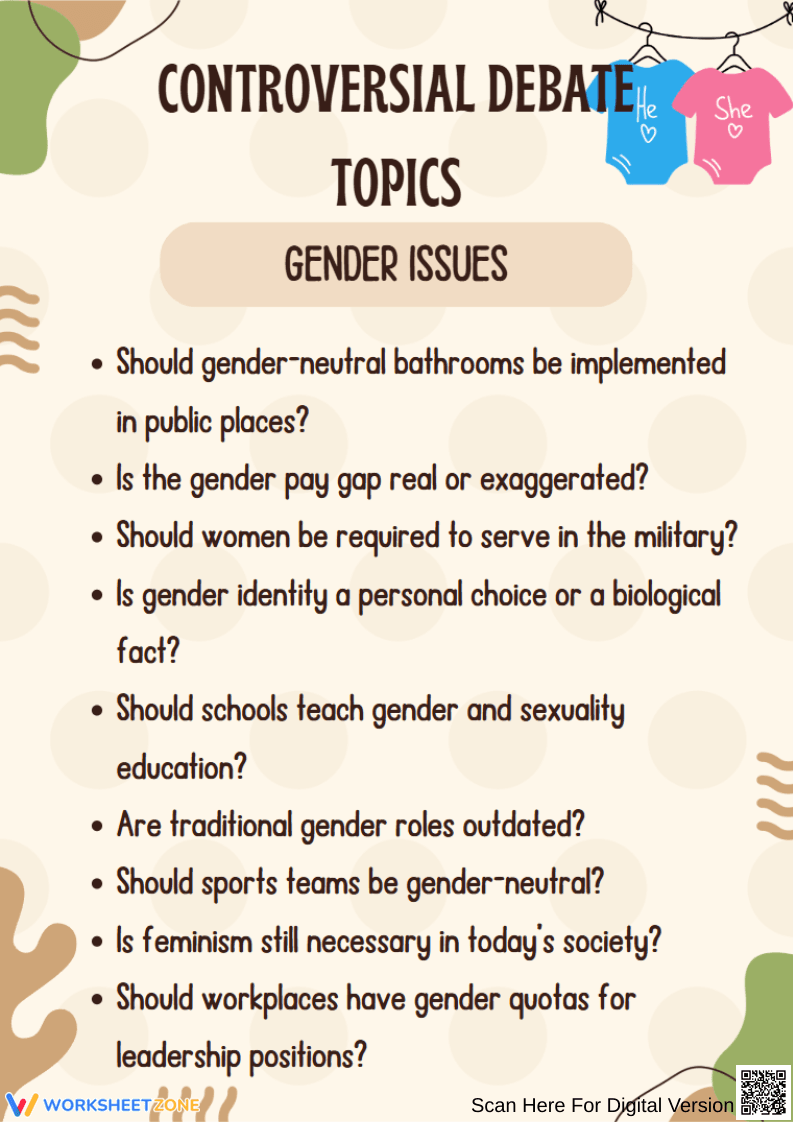

Gender Issues Debate Topics | Grade 8 Essential Guide
Paste this activity's link or code into your existing LMS (Google Classroom, Canvas, Teams, Schoology, Moodle, etc.).
Students can open and work on the activity right away, with no student login required.
You'll still be able to track student progress and results from your teacher account.
This Grade 8 communication worksheet provides a structured list of 9 high-interest debate prompts focused on complex gender issues. Students practice articulating evidence-based arguments and engaging in civil discourse. By examining multiple perspectives on topics like workplace quotas and educational curricula, learners develop the critical thinking skills necessary for effective social communication.
At a Glance
- Grade: 8 · Subject: Communication Skills
- Standard:
CCSS.ELA-LITERACY.SL.8.1— Engage in collaborative discussions, building on others' ideas and expressing their own clearly- Skill Focus: Persuasive Argumentation
- Format: 1 page · 9 prompts · Discussion-based · PDF
- Best For: Socratic Seminars and Speech Clubs
- Time: 30–45 minutes
The resource features a clean, one-page layout containing nine thought-provoking questions. These prompts cover a broad spectrum of societal issues, including gender-neutral facilities, the pay gap, and traditional roles. The worksheet is designed as a prompt sheet, allowing teachers to facilitate verbal debates or assign them as short-form persuasive writing tasks without the need for complex setup or additional materials.
Zero-Prep Workflow:
- Print: Select the PDF and print enough copies for the class in under 30 seconds.
- Distribute: Hand out the prompt list and have students select one topic to research or defend in about 1 minute.
- Review: Facilitate a structured debate or small-group discussion using the provided prompts as the anchor with zero additional prep time.
This resource is ideal for substitute plans or last-minute social studies extensions because it requires zero teacher preparation beyond the initial printing process.
Standards Alignment
This worksheet aligns with `CCSS.ELA-LITERACY.SL.8.1`, which requires students to come to discussions prepared, having read or researched material under study. It specifically supports the sub-standard of posing and responding to questions that connect the ideas of several speakers. Both standard codes can be copied directly into lesson plans, IEP goals, or district curriculum mapping tools.
How to Use It
Use this list as the foundation for a "Fishbowl" debate where a small group discusses a topic while the rest of the class observes and takes notes on the quality of the arguments. Alternatively, use it as a formative assessment for persuasive writing by asking students to choose one prompt and write a three-point thesis statement. Expect a full instructional session of 45 minutes for a deep-dive discussion.
Who It's For
This resource is tailored for Grade 5 through Grade 8 students in Social Skills or ELA classrooms. It is particularly effective for students who need practice with perspective-taking and respectful disagreement. Pair this worksheet with a graphic organizer for claim-evidence-reasoning (CER) to provide additional scaffolding for struggling writers or English Language Learners.
According to research by Fisher & Frey (2014) on purposeful classroom talk, structured academic controversy is a powerful tool for deepening conceptual understanding and improving student engagement. This worksheet facilitates that process by providing nine specific, high-stakes prompts that align with `CCSS.ELA-LITERACY.SL.8.1`. By engaging with these gender-related topics, students move beyond surface-level opinions toward evidence-based reasoning. The prompts are designed to challenge students to consider diverse viewpoints, a core component of social-emotional learning and communication mastery. Using these prompts in a middle school setting helps bridge the gap between personal belief and academic argument, ensuring that students meet the rigorous demands of college and career readiness standards. This resource serves as a reliable anchor for developing the civil discourse skills necessary in modern democratic societies.


