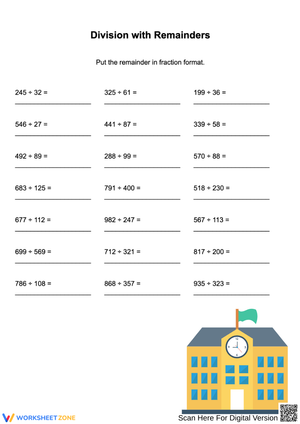
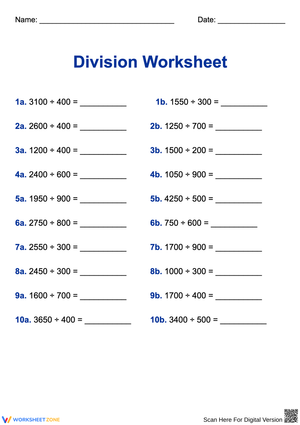
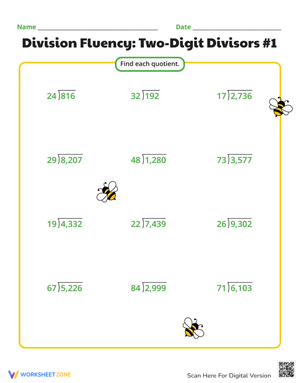
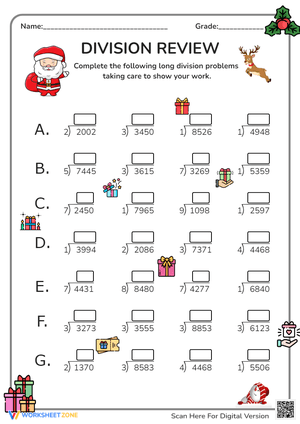
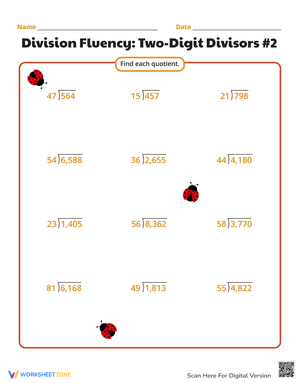
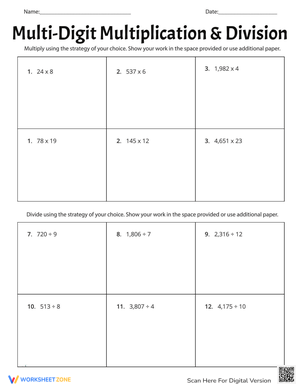
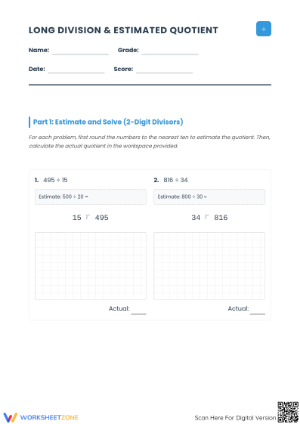
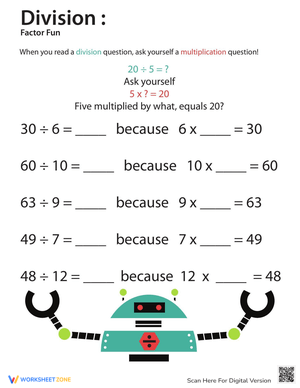
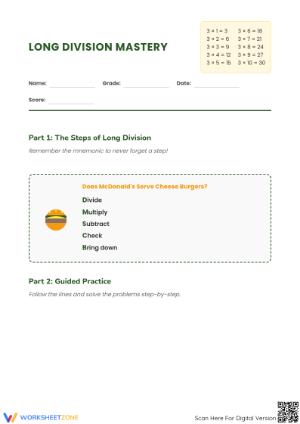
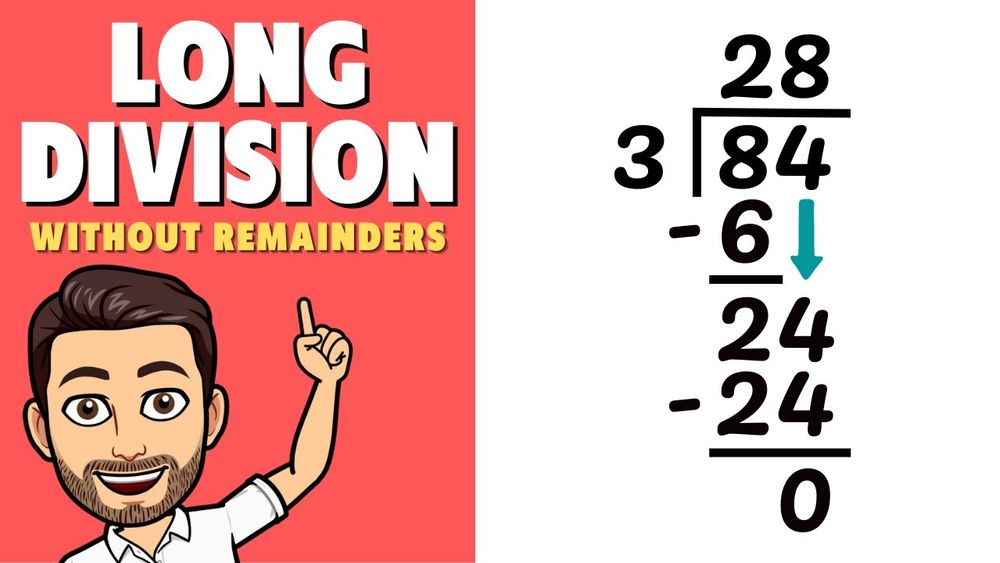
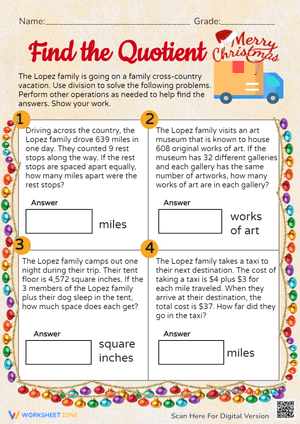
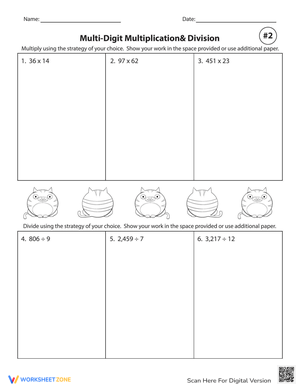
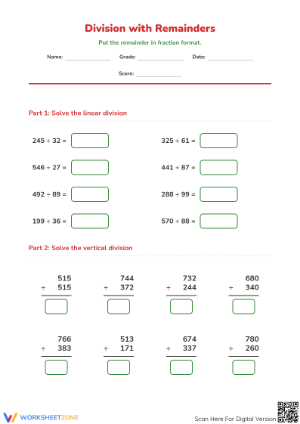
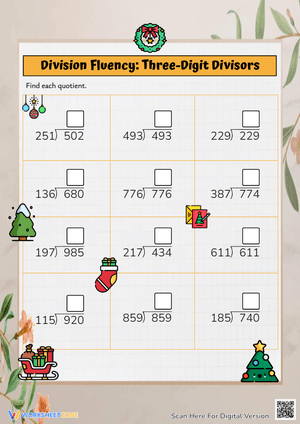
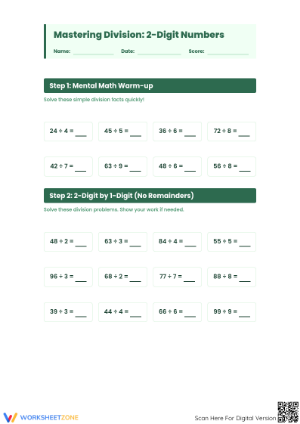
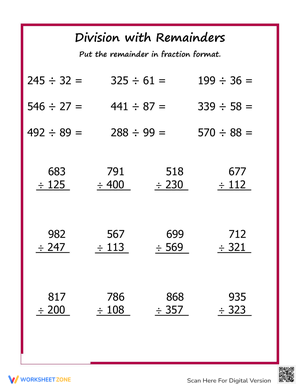
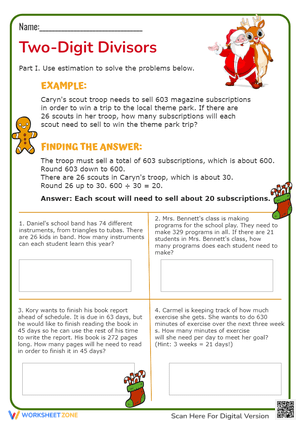
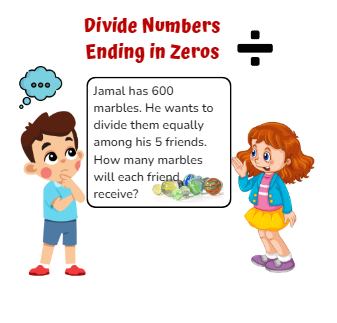
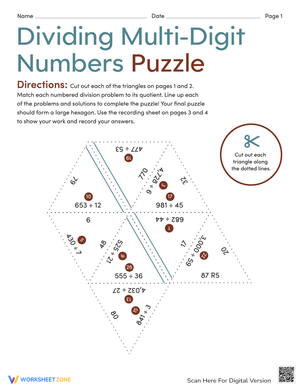
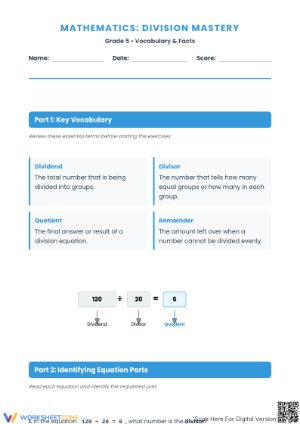
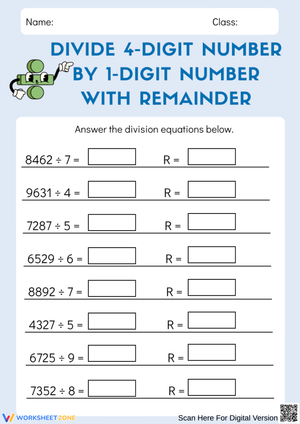
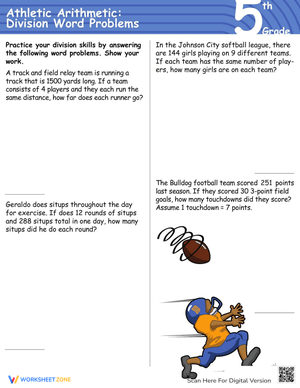
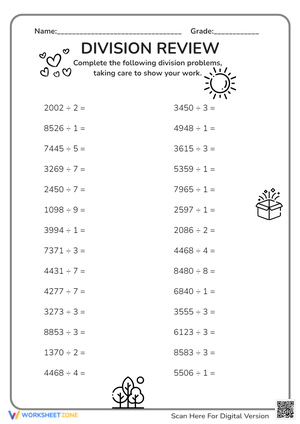
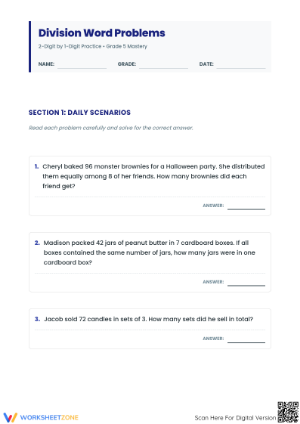
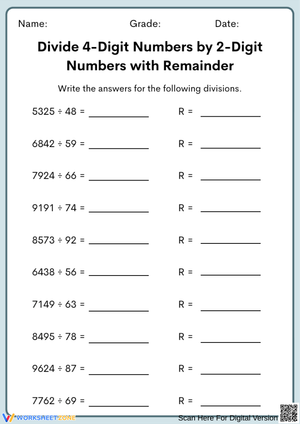
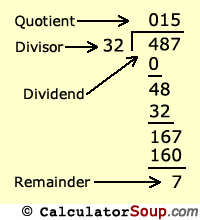
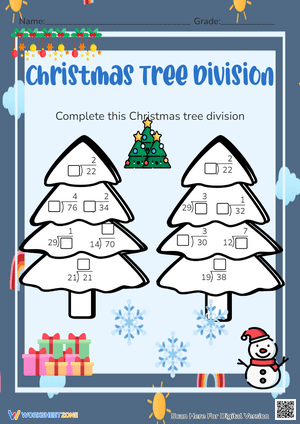
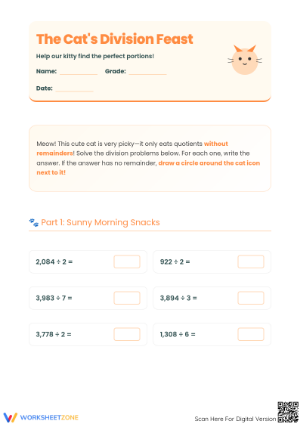
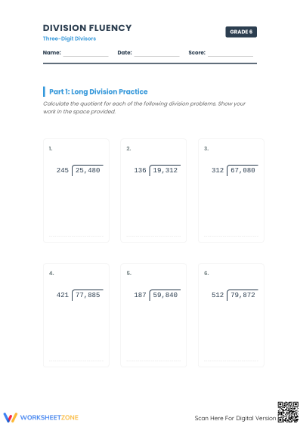
These division with multi digit numbers worksheets for 5th grade give teachers a focused set of long division practice covering four-digit dividends, one-digit and two-digit divisors, and remainder interpretation — all in a printable format that fits directly into a unit without additional setup. The set moves from accessible computation into more demanding multi-step work, so a teacher can pull one worksheet for a morning warm-up, assign the full set during an independent practice block, or save specific items for a Friday formative check.
What Each Worksheet Builds
The core sequence across these worksheets runs from three- and four-digit dividends divided by a one-digit divisor, through two-digit divisors, into mixed sets that include remainders and short word problems. That progression matters because the cognitive demand shifts at each step — not just in raw computation difficulty, but in the kind of estimation a student has to perform before placing the first quotient digit.
- Whole-number dividends up to four digits with one-digit divisors
- Four-digit dividends paired with two-digit divisors, where quotient estimation becomes noticeably harder
- Place-value tracking across each subtract-and-bring-down cycle
- Remainder interpretation in both pure computation and word-problem contexts
- Reasonableness checks through estimation or reverse multiplication
The word-problem items are not optional enrichment. They ask students to decide whether a remainder rounds the quotient up, gets discarded, or stands as a fractional part of the answer — a judgment that separates procedural execution from actual number sense. Students who can work the algorithm without error will still hesitate here.
Errors Worth Catching Before They Harden Into Habits
The most persistent error in fifth-grade long division is misplacing the first quotient digit. A student dividing 3,472 by 14 may correctly recognize that 14 doesn't go into 3, then look at 34, estimate 2, and write that 2 above the wrong column. Every subsequent digit inherits the misalignment, and the final answer looks plausible because the student never re-examined the opening step. This error is nearly invisible during a lesson but shows up unmistakably on a completed worksheet — which is exactly why visible written practice is worth assigning.
A second pattern is imprecise estimation with two-digit divisors. Students who divide confidently by 6 or 8 will stall when the divisor is 23 or 37 because they don't have automatic fluency with those multiples. They try a quotient digit, find the partial subtraction produces something negative, erase, and guess again — sometimes without understanding why the first attempt failed. A teacher reviewing a finished worksheet can count how many times a student revised a quotient digit; more than two revisions per problem across the full set is a signal worth acting on before the class moves into decimal division.
Subtraction errors embedded mid-problem form a third category. These are nearly always arithmetic slips rather than conceptual gaps in division, but they cascade through the rest of the computation the same way a structural error would. Building in an explicit check-your-subtraction step during initial instruction prevents most of them.
Standard Alignment
The primary alignment is Common Core State Standards for Mathematics 5.NBT.B.6, which requires fifth graders to find whole-number quotients with up to four-digit dividends and two-digit divisors using strategies based on place value, the properties of operations, and the relationship between multiplication and division. These worksheets address that standard directly — the problem types reflect the specific ceiling 5.NBT.B.6 sets, not a narrower one-digit-only version of the skill and not a reach into decimal quotients, which belong to a separate cluster.
One planning point worth noting: the standard names three strategies — place value, properties of operations, and the multiplication-division relationship — not the standard algorithm alone. A resource that asks students only to execute the algorithm without ever connecting back to multiplication or estimation addresses the standard partially. The most useful worksheet sets include at least a few problems where students verify a quotient by multiplying, which reinforces the inverse operation and catches division errors before submission.
Fitting These Worksheets Into a Week of Instruction
The most effective use of division with multi digit numbers worksheets for 5th grade across a unit is not assigning everything as one large block at the end of a lesson. A more productive approach is to give each worksheet a specific job: one worksheet follows the mini-lesson on quotient placement, another anchors partner correction work midweek, a third becomes a five-problem exit ticket on Friday. That structure produces sharper data at each checkpoint and prevents students from treating every item as interchangeable.
Some specific routines that work well in practice:
- Assign a computation-only worksheet immediately after direct instruction — before remainders or word problems are introduced — so students can automate the procedure before the demands increase
- Use a mixed worksheet for partner correction: one student works odd-numbered problems, the other checks; then they switch and compare written steps
- Pull four to six items from a remainder-focused worksheet as an exit ticket; marking only those items keeps feedback fast and targeted
- Keep a two-digit divisor worksheet in reserve for groups that finish early — it extends the skill without changing the format or requiring a different activity entirely
- Use completed worksheets as a reference during small-group conferences; visible written steps make it straightforward to point to exactly where the computation broke down
The printable format earns its place for a practical reason: the same set that supports independent practice on Tuesday can generate intervention groups on Thursday based on what the Tuesday work revealed — no reformatting, no new materials to prepare.
Using the Set Across Different Readiness Levels
Multi-digit division at fifth grade spans a wide readiness range, and a well-structured division with multi digit numbers worksheets for 5th grade resource handles that by covering both one-digit and two-digit divisors in the same set — making it possible to direct different groups to different items without switching materials entirely. Students who are still shaky with three-digit by one-digit division are not ready to track a two-digit divisor through four subtract-and-bring-down cycles. Assigning them a worksheet at that level produces confusion rather than practice.
For students who have internalized the algorithm, the better extension is not more of the same items but a different demand. Assign a worksheet that includes remainder word problems requiring a written sentence of explanation, or present two problems with different divisors and ask which produces the larger remainder and why. That pushes into mathematical reasoning rather than faster execution.
Students receiving intervention support benefit from a reduced item count paired with structured oral rehearsal. Pull three or four problems from a worksheet and have students verbalize each step before writing it. The oral step slows the process in a productive way — many students who rush through the algorithm can correctly narrate each action they are skipping on paper, which surfaces the disconnect between what they understand and what they actually record.
Frequently Asked Questions
What problem types should I expect in a Grade 5 long division set?
Strong sets include whole-number division with three- and four-digit dividends, both one-digit and two-digit divisors, and remainder problems that ask students to interpret the leftover quantity rather than simply note it. A few word problems should appear as core practice items — not optional extension — since 5.NBT.B.6 explicitly expects application alongside computation.
How does this resource align with Common Core 5.NBT.B.6?
Common Core 5.NBT.B.6 requires whole-number quotients with dividends up to four digits and divisors up to two digits, using place value strategies and the relationship between multiplication and division. Worksheet sets that stay within those parameters — and include multiplication checks or estimation tasks — meet the full intent of the standard, not just its surface computation requirement.
How do I use these worksheets for students at very different levels in the same class?
Separate the set by divisor type rather than total problem count. Students who need more support work through one-digit divisor items in full; students who are further along move directly into two-digit divisor problems. Because the format stays consistent across both groups, circulating is straightforward. Completed worksheets from both groups also give you comparable written evidence of where each student's process breaks down.
When should I assign these as homework?
Only after students can execute the algorithm independently in class. Sending division with multi digit numbers worksheets for 5th grade home before students have worked through the full process with teacher support turns the assignment into a source of frustration rather than reinforcement. A reliable checkpoint: if a student completes four consecutive problems in class without asking for help, the format is appropriate for independent work at home.














 Interactive Worksheet Maker
 Quiz Maker
 Word Search Maker
 Crossword Puzzle Maker
 Word Scramble Generator
 Sentence Scramble Generator
 Handwriting Worksheet Generator
 Name Tracing Generator
 Fill In The Blank Generator




 BACK TOSCHOOL