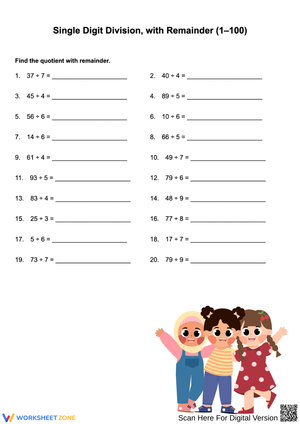
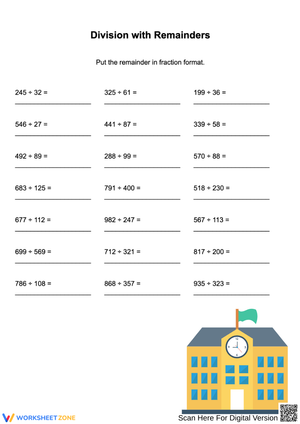
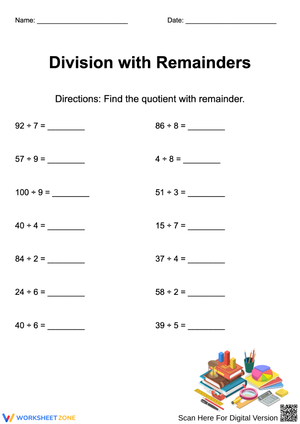
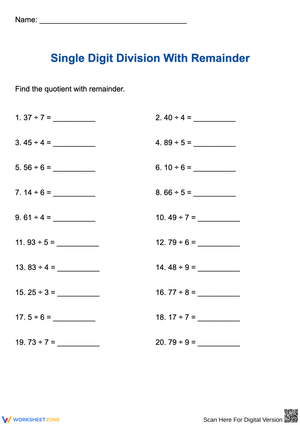
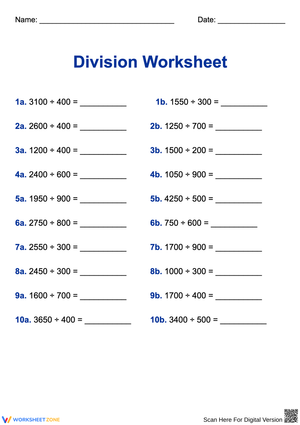
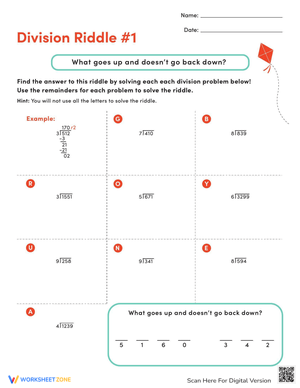
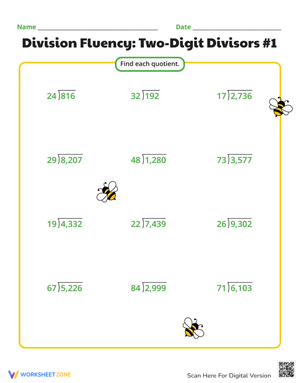
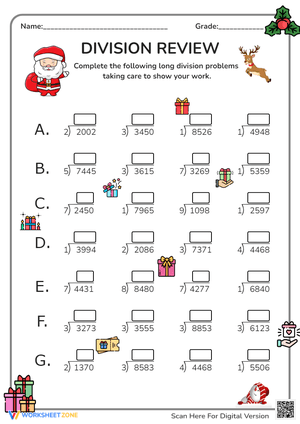
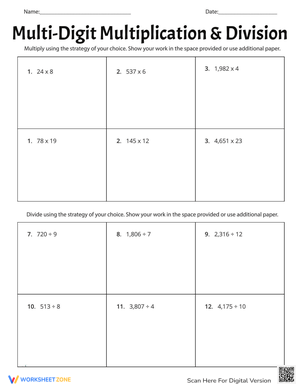
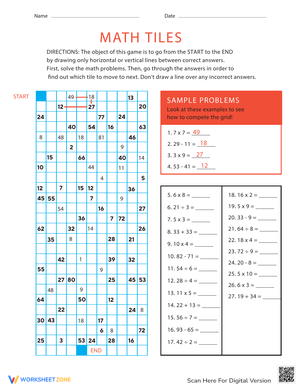
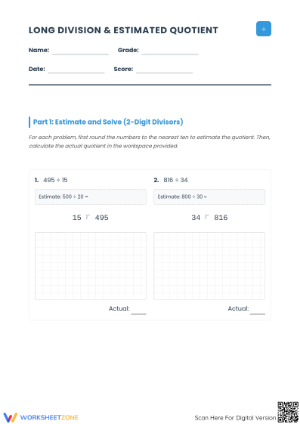
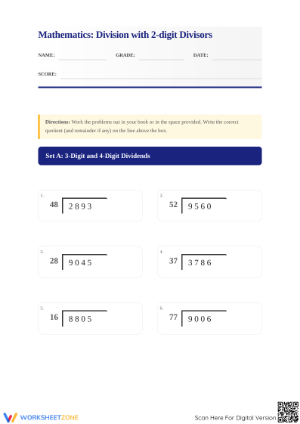
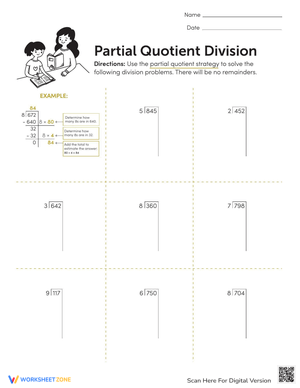
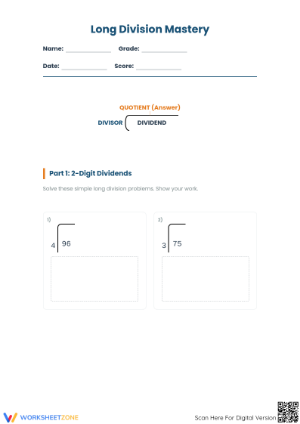
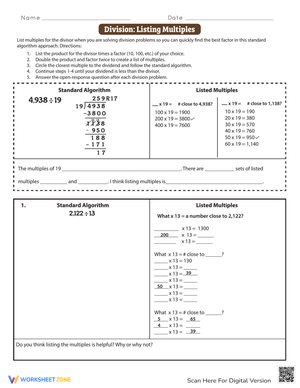
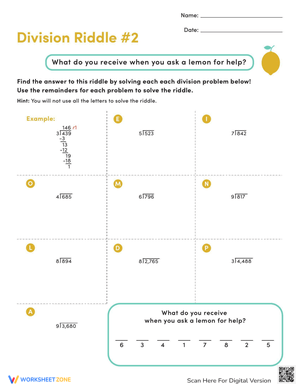
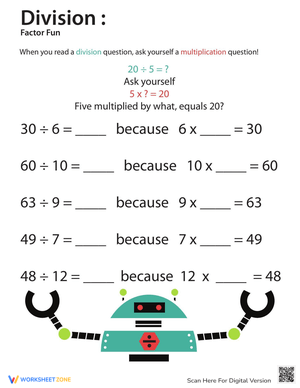
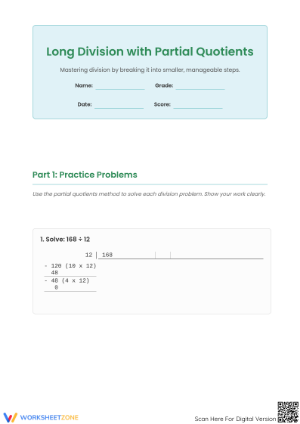
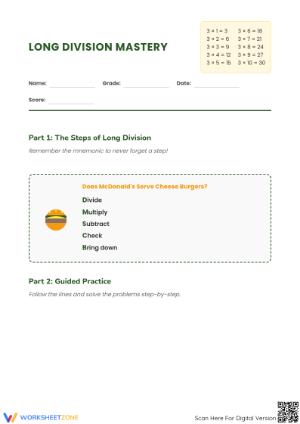
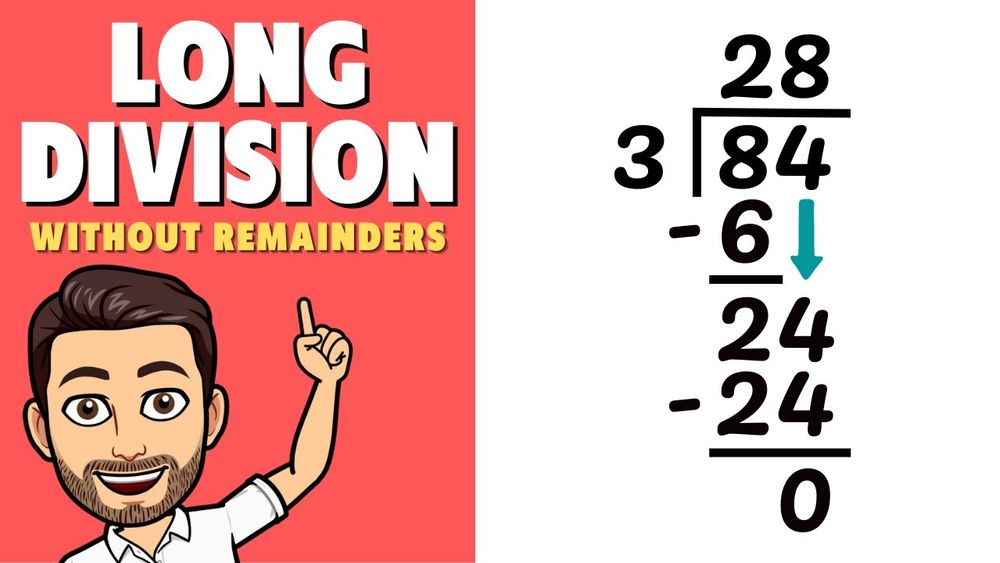
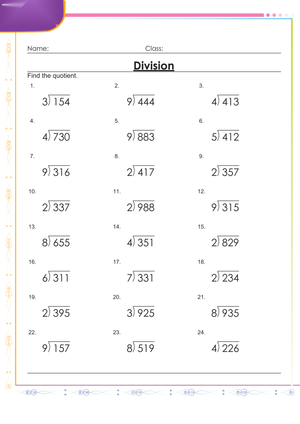
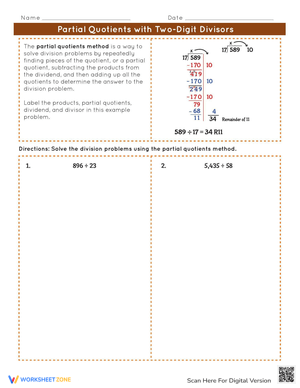
These 5th grade long division pdf worksheets give teachers a print-ready set organized by problem type — no-remainder work, remainder problems, and two-digit divisor practice — so targeted instruction can run without rebuilding materials each week. The collection addresses the full range of written computation Grade 5 students need to work through before long division stops being error-prone and starts being reliable.
What the Set Covers
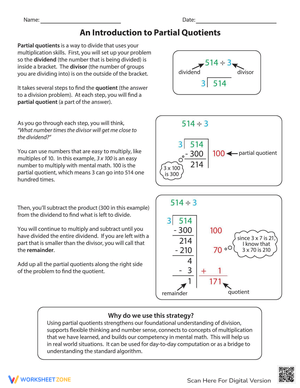
Each worksheet targets one problem type rather than mixing categories. That narrowed focus is deliberate: when students practice dividing a four-digit dividend by a one-digit divisor with no remainder, they can build familiarity with the step sequence — estimate, multiply, subtract, bring down — before the decision-making load increases. Remainder worksheets add the question of what to do with what's left over. Two-digit divisor worksheets require solid partial-quotient estimation, and that's where most fifth graders run into their first sustained difficulty.
- No-remainder division: Useful at the start of a unit or as a warm-up baseline. Students stay focused on the algorithm's structure without the added layer of interpreting and recording a remainder.
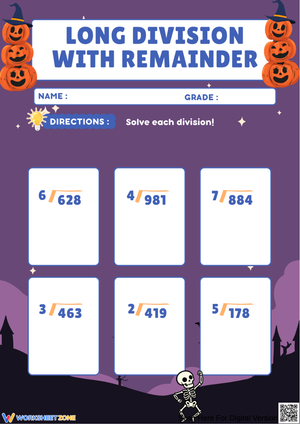
- Division with remainders: Students divide, record what's left, then verify by multiplying the quotient by the divisor and adding the remainder back to reach the original dividend.
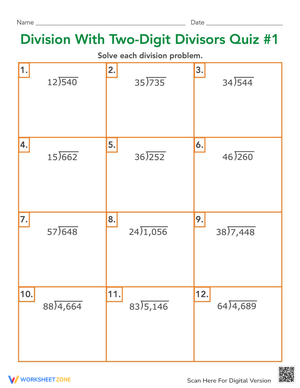
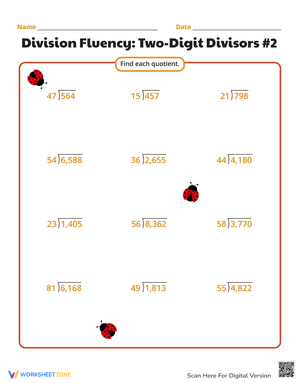
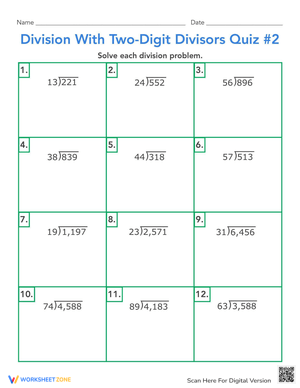
- Two-digit divisors: The most demanding work in the set. Students must estimate trial quotients and adjust when the first guess produces a partial product larger than the current dividend chunk.
- Mixed review: Draws from all three types. These worksheets reveal whether students are pattern-matching to a repeated format or actually reading each problem and responding to what it requires.
An inverse-check routine — multiply the quotient by the divisor, add any remainder, compare back to the original dividend — appears across most of the set. Students who use it consistently catch their own subtraction slips. Teachers who see a wrong check can immediately narrow down where in the sequence the error occurred, which is far more diagnostic than simply marking an answer incorrect.
Where Fifth Graders Break Down in Long Division Work
The most common breakdown is not forgetting the algorithm — it's losing track of place value mid-problem. A student who divides 4,284 by 6 correctly through the hundreds digit will sometimes write the next quotient digit in the wrong column, throwing off every digit that follows. On paper the number often looks plausible enough that the student doesn't flag it, especially without a check. This error persists into two-digit divisor work and creates compounding inaccuracies once problems get longer, so it's worth catching and naming early.
A second pattern shows up with two-digit divisors: students who round the divisor in the wrong direction consistently underestimate the partial quotient and end up with a remainder larger than the divisor. A student dividing by 43 who mentally rounds up to 50 instead of down will underestimate almost every time, then stall when the remainder doesn't resolve cleanly. Once teachers name that specific rounding decision and practice it as a separate step before applying it inside the full algorithm, the error rate drops quickly.
Subtraction alignment is a third area to watch. Students who make regrouping errors inside the subtraction step often have correct quotient estimates but wrong differences, which cascades through the rest of the problem. These tend to look like careless mistakes in the margin, but they usually signal that the student is tracking too many simultaneous operations without enough structure on the page to keep them separate.
Fitting Long Division Practice Into the Weekly Schedule
The most effective approach treats each worksheet as a single-skill checkpoint rather than a full-period assignment. A six-problem no-remainder set takes about eight minutes as Monday morning work — enough to activate the algorithm before the day's main instruction begins. By midweek, after direct instruction on remainders, a focused worksheet becomes the first independent attempt before any teacher feedback. That's a natural moment to circulate and collect formative data while students are still working through the problems.
Small-group rotations benefit from the separated problem types. One group completes a no-remainder set independently for fluency. A second group uses a remainder worksheet as the basis for a partner-check routine — each student solves, then the partner verifies using multiplication before anyone moves on. A teacher-led group tackles two-digit divisors with immediate feedback on the estimation step. Each station has one problem type, so the routine stays consistent even as difficulty increases. For sub days and homework folders, these resources are reliable because the format is self-explanatory — students don't need the directions re-taught, just the time to work.
For homework or end-of-unit review, 5th grade long division pdf worksheets hold up because the written format is already familiar to students. They focus on the computation rather than figuring out a new interface, and families can see exactly how the standard algorithm is organized on the page.
Standard Alignment
Common Core State Standards for Mathematics: 5.NBT.B.6 expects fifth graders to find whole-number quotients and remainders with up to four-digit dividends and two-digit divisors, using strategies based on place value, properties of operations, and the relationship between multiplication and division. Teachers typically introduce 5.NBT.B.6 in the third or fourth quarter of Grade 5, after students have secured multi-digit multiplication through 5.NBT.B.5. The two-digit divisor worksheets in this set address the most demanding portion of the standard — the part that requires quotient estimation and adjustment, not just fact recall — which is also where the standard's expectations most clearly separate fifth-grade work from what students practiced in Grade 4.
Matching the Right Worksheet to the Right Learner
For students not yet secure with the step sequence, the no-remainder worksheets are the right starting point. These students benefit from writing each step — estimate, partial product, difference, brought-down digit — on clearly separated lines rather than compressing everything into a tight long-division bracket. The extra white space reduces column-alignment errors and makes it easier to locate exactly where reasoning breaks down when you sit with a student and walk through their work together.
Students who are ready to move faster can work through the two-digit divisor worksheets and add a prediction layer: before solving each problem, they write a quotient range — "the answer will be between 40 and 50" — then compare the actual quotient to that estimate once the work is done. That addition shifts the task from computation practice into estimation reasoning without requiring a different resource. For students at grade level working through remainder problems, requiring both the standard algorithm and a written multiplication check on every item slows the pace productively without softening the rigor of the problem itself.
Because the problem types are sorted across the set, 5th grade long division pdf worksheets can be organized into leveled folders by skill without any cutting or reformatting. Intervention groups can return to the same worksheet type across multiple sessions to build consistency, then move to mixed-review worksheets only when accuracy on individual problem types is solid.
Frequently Asked Questions
Do the worksheets include both one-digit and two-digit divisors?
Yes. The set includes worksheets with one-digit divisors — with and without remainders — and separate worksheets dedicated to two-digit divisors. Teachers can sequence these from less demanding to more demanding, or pull specific worksheet types to address gaps that surface during a unit.
How many problems does each worksheet include?
Problem count varies by type. No-remainder and remainder worksheets carry enough problems for a focused warm-up or short independent practice block without running long. Two-digit divisor worksheets typically include fewer items because each problem requires significantly more time to complete accurately, especially when students are also showing a check.
Can these be used outside the division unit for spiral review?
That's one of the strongest ways to use this collection. 5th grade long division pdf worksheets return well during spiral review blocks, test-prep weeks, and intervention rotations because students already know the format — they need no re-teaching of directions, only the math. Pulling a focused worksheet for Friday morning work every few weeks maintains the accuracy gains from the unit in a way that a single concentrated instructional block rarely does on its own.
Are these formatted for printing without adjustments?
Yes. The resources are print-ready PDFs. Teachers can open and print without adjusting margins or reformatting the layout, which matters when planning is tight and the goal is getting materials into students' hands at the start of class.














 Interactive Worksheet Maker
 Quiz Maker
 Word Search Maker
 Crossword Puzzle Maker
 Word Scramble Generator
 Sentence Scramble Generator
 Handwriting Worksheet Generator
 Name Tracing Generator
 Fill In The Blank Generator




 BACK TOSCHOOL