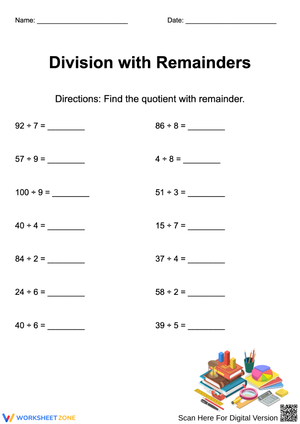
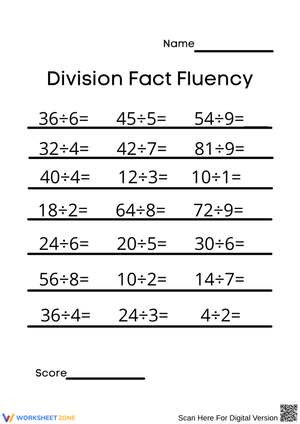
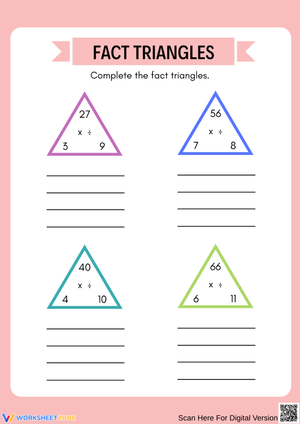
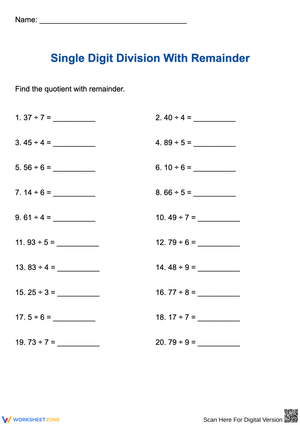
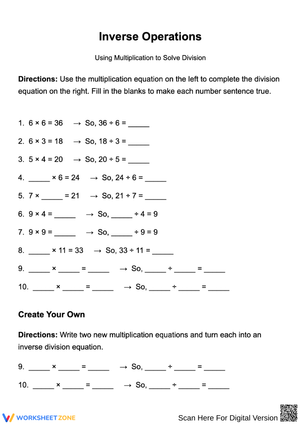
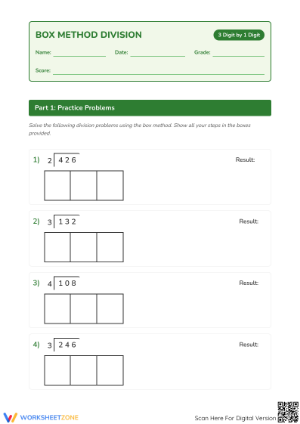
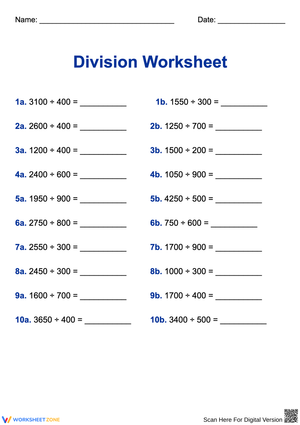
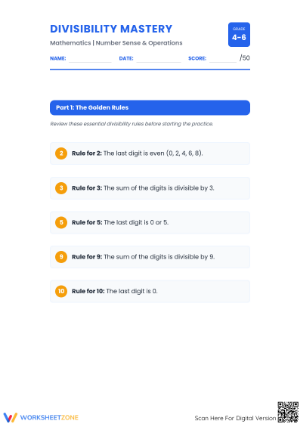
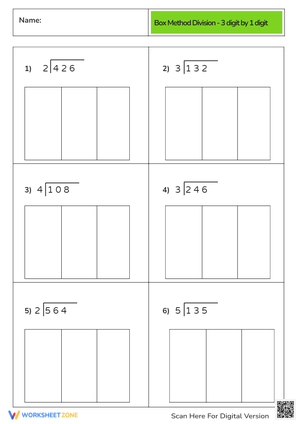
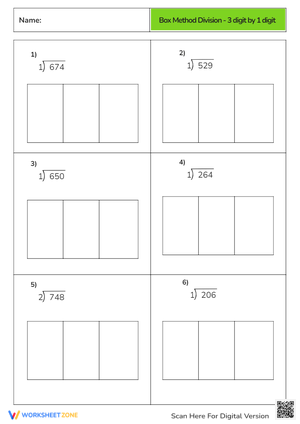
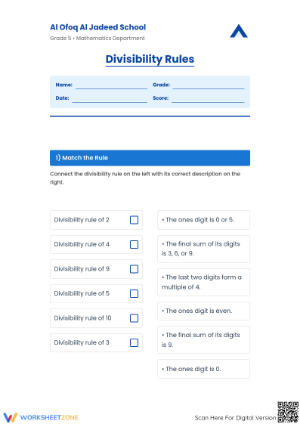
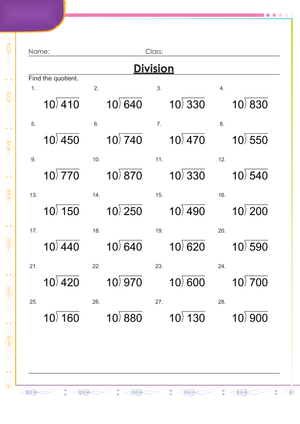
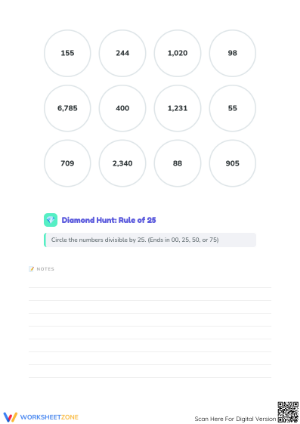
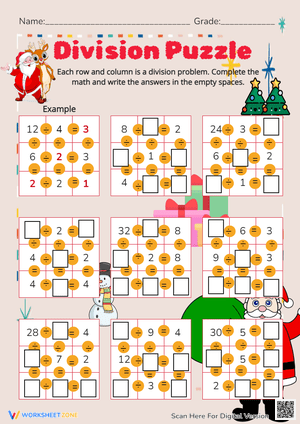
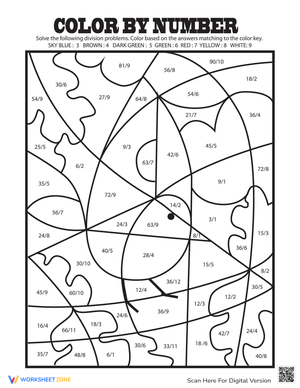
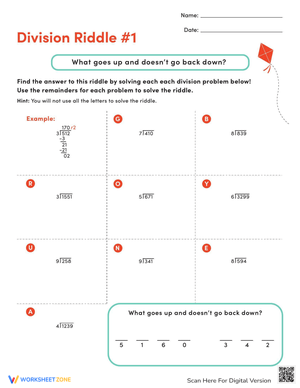
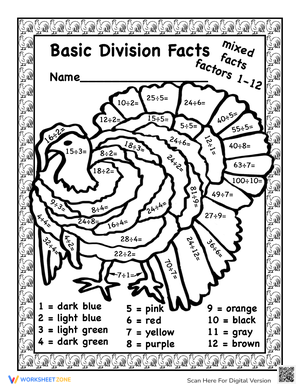
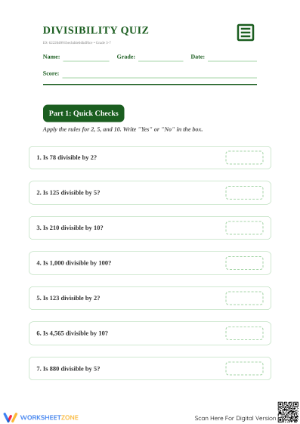
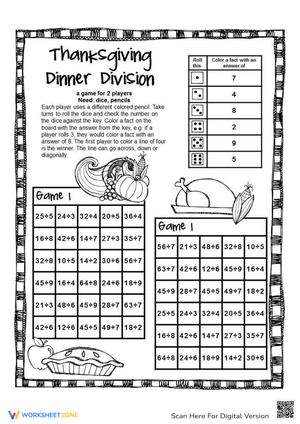
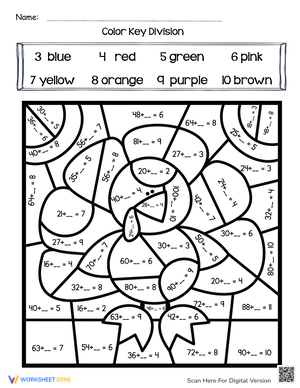
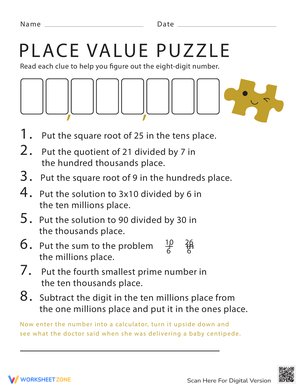
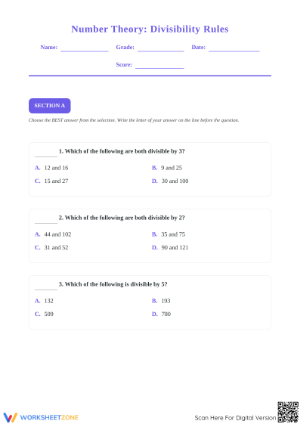
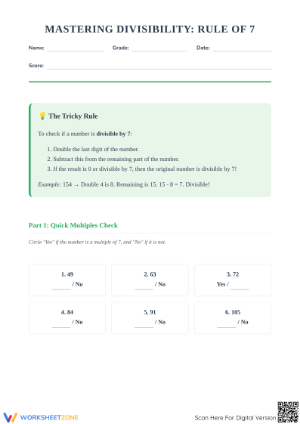
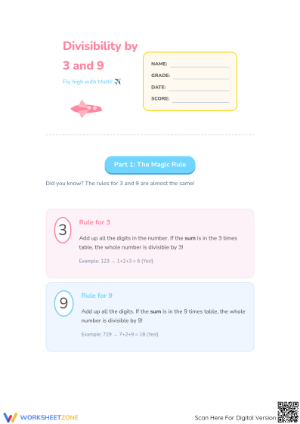
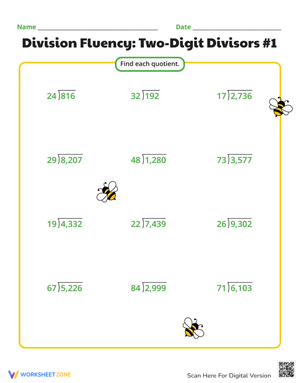
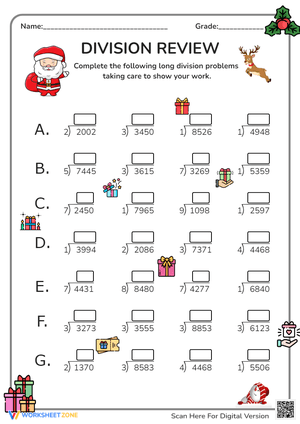
These 5th grade division worksheets resources give teachers a ready-to-print set built around the skills that define grade 5 division — long division with multi-digit dividends, remainder interpretation, two-digit divisors, and word problems that require students to choose a strategy, not just execute one. Each worksheet is a standalone, downloadable practice tool organized around the actual instructional progression teachers follow in upper elementary math.
What the Set Covers
Division changes character in grade 5 in a way teachers feel almost immediately. Students can no longer rely on memorized facts alone. They need to estimate before dividing, manage place value across multiple steps, and decide what a remainder actually means given a real context. Each worksheet targets one of those demands directly rather than mixing skills into a single undifferentiated review.
- Quotient estimation: students practice using compatible numbers and rounding to get a reasonable estimate before committing to a full computation — a habit that dramatically reduces errors in longer problems.
- Long division with one-digit divisors: worksheets with visible work space for the standard algorithm or partial quotients, keeping the divisor simple while students build multi-step fluency.
- Long division with two-digit divisors: items that require trial quotient estimation, multiplication checks, subtraction, and reasonableness evaluation at each step.
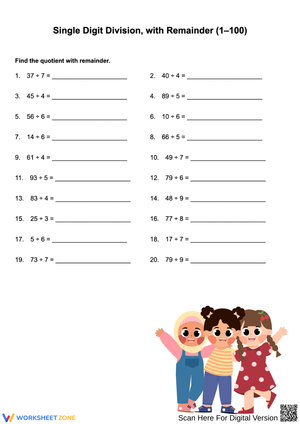
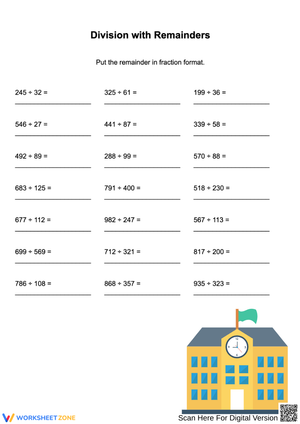
- Remainder interpretation: both computation and contextual reasoning — students determine whether to round up, discard the remainder, or express it as a fraction depending on the problem situation.
- Division word problems: multi-step classroom and measurement contexts where students identify the operation, set up the expression, and explain what the answer means.
- Mixed review: worksheets that combine fact fluency, long division, and word problems for spiral work or quick pre-assessment.
Teachers who download a 5th grade division worksheets set and find all the worksheets clustered at the same difficulty level end up creating their own progression — which defeats the point of a ready-to-print resource. Having separate worksheets for each skill means assigning exactly what matches where students actually are, not adapting a single mixed document on the fly.
Frequent Student Errors Worth Watching For
The most persistent grade 5 long division error is place-value misalignment during the bring-down step. A student working through 3,276 ÷ 6 will set up the problem correctly, divide the leading digits accurately, and then shift a digit when bringing down — arriving at a three-digit quotient instead of four. That error is invisible when you only check the final answer. It surfaces when you look at the written work, which is exactly why worksheets with visible step space are worth assigning over mental math exercises at this stage of instruction.
Remainder interpretation produces a separate and equally persistent category of mistake. Students who compute correctly will still write "546 remainder 3" as a final answer to a word problem asking how many full boxes can be packed — and not recognize that the remainder needs to be discarded. The reverse also appears: rounding a remainder up when the context requires rounding down. These are reasoning errors, not computation errors. They need targeted word problem practice to surface and address, and they will not disappear through additional procedural drill alone.
Standard Alignment
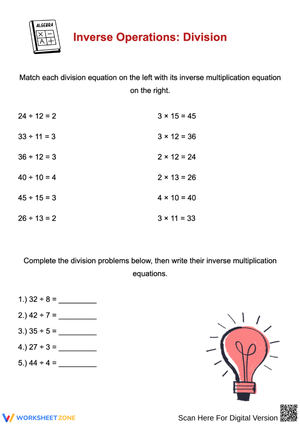
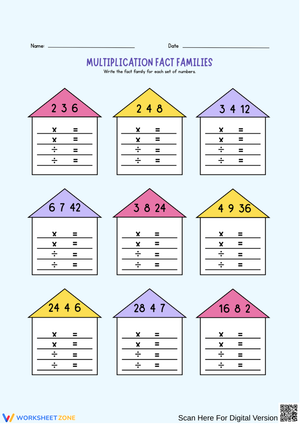
The central standard addressed across this collection is CCSS.MATH.CONTENT.5.NBT.B.6, which asks students to find whole-number quotients using up to four-digit dividends and two-digit divisors by drawing on place value, properties of operations, and the inverse relationship between multiplication and division. In classroom terms, that standard sits in the middle of grade 5 number sense — students have already built multiplication fluency and are now using that knowledge as the foundation for estimating and checking quotients.
The standard does not mandate a single algorithm, which is pedagogically significant. Partial quotients, area models, and the standard long-division procedure are all valid approaches. These 5th grade division worksheets resources include problem formats compatible with all three methods, so teachers aren't forced into one instructional path. That flexibility matters during the instructional stretch when some students are still working with partial quotients and others have moved to the standard algorithm — both groups need practice, and a single worksheet format doesn't serve both well.
Fitting These Worksheets Into Your Weekly Instruction
The most effective use of any printable division practice is matching the worksheet to a specific instructional moment rather than treating each one as generic review. A worksheet focused on one-digit divisors with full step-by-step work space belongs right after the mini-lesson where you modeled that process — not a week later when students have moved on. The narrower the skill focus, the more useful diagnostic information you recover from what students hand back.
A few specific places these worksheets fit naturally during the week:
- Bell ringer: four to six estimation or fact-fluency items to open math block, giving students a low-stakes start before new instruction begins.
- Mini-lesson follow-up: assign the worksheet targeting the exact strategy you modeled that day — partial quotients, estimation, or remainder interpretation — so students practice the method while it's still fresh. Eight minutes of focused, on-level practice immediately after modeling does more than twenty minutes of review two days later.
- Small-group pull: during independent work time, bring three to five students for guided practice with the remainder or two-digit divisor worksheets while the rest of the class works independently.
- Sub plans: a word problem worksheet with familiar formats gives students real math work they can complete with minimal adult support. Including a short fluency review at the start keeps the session from stalling at the beginning.
- Friday spiral review: pair a long division worksheet with a word problem worksheet to check retention across both procedural and reasoning skills before the weekend.
Differentiating the Set Across Ability Levels
Division skill in grade 5 varies more dramatically within a single classroom than most teachers anticipate. A student who never fully secured multiplication fact fluency in 4th grade will hit a real wall on two-digit divisor problems — not because the long division structure is beyond them, but because verifying each trial quotient requires fast mental multiplication, and slow retrieval creates cognitive overload right at the checking step. That's a different instructional problem than a student who understands the algorithm but makes place-value errors when bringing down.
For students who need additional support, assign the one-digit divisor worksheets with full work space and allow a multiplication reference chart. The chart removes the retrieval bottleneck so students can actually practice the multi-step structure — it doesn't remove the division thinking. For students who have the standard algorithm secure, move to word problems with multi-step structures and two-digit divisors, or use a worksheet that asks students to write their own division word problem for a given quotient. That task exposes whether students genuinely understand what division means in context, which is harder to fake than a correct computation. Students who consistently finish ahead of their peers during independent practice can work with remainders expressed as fractions, which bridges toward the decimal division that appears later in the year.
Frequently Asked Questions
What division skills deserve the most practice time in grade 5?
Two-digit divisor division, remainder interpretation, and quotient estimation need the most deliberate and extended practice. Fact fluency matters as a foundation, but students who can recite division facts still need time with multi-step long division and with reading remainders in context before they demonstrate the full standard. A productive week of practice includes both procedural worksheets and word problem worksheets — not one type exclusively.
Can I use one worksheet for both on-level and intervention students?
Rarely, and trying to make it work that way usually means the intervention student is overwhelmed while the on-level student is underchallenged. A more reliable approach is to sort the worksheets by skill tier and assign accordingly. One-digit divisor and fluency review worksheets work well for intervention groups. On-level students handle two-digit divisors and remainder word problems. Advanced students move into mixed review or multi-step problem formats. Keeping each worksheet focused on a specific skill makes it possible to match the right worksheet to the right student without modifying anything during the lesson.
Do the worksheets include answer keys?
Yes. Each worksheet in the collection includes an answer key, which makes self-checking routines and independent centers practical to run. For long division specifically, a worked answer helps students identify exactly which step went wrong — whether the error was in the initial estimate, the multiplication check, or the subtraction — rather than simply knowing the final answer didn't match.
Are these appropriate for 4th graders working ahead or 6th graders reviewing?
The 5th grade division worksheets collection is calibrated to 5.NBT.B.6 expectations, so the number sizes and contexts reflect grade 5 work. Advanced 4th graders with solid one-digit divisor fluency are ready for the accessible worksheets in the set. Sixth graders reviewing whole-number division before moving into fraction or decimal operations will find the two-digit divisor and word problem worksheets useful as a targeted refresher rather than a full course revisit.














 Interactive Worksheet Maker
 Quiz Maker
 Word Search Maker
 Crossword Puzzle Maker
 Word Scramble Generator
 Sentence Scramble Generator
 Handwriting Worksheet Generator
 Name Tracing Generator
 Fill In The Blank Generator




 BACK TOSCHOOL