


























Views
Downloads



Printable Three-Digit Division Practice | Grade 6 Math
Paste this activity's link or code into your existing LMS (Google Classroom, Canvas, Teams, Schoology, Moodle, etc.).
Students can open and work on the activity right away, with no student login required.
You'll still be able to track student progress and results from your teacher account.
This comprehensive Grade 6 math worksheet is designed to build procedural fluency in long division using three-digit divisors. Students will move beyond simple calculation to master the standard algorithm, ensuring they can handle complex dividends with accuracy. By the end of this activity, learners will demonstrate a deep understanding of multi-digit division in both abstract and real-world contexts.
At a Glance
- Grade: 6 · Subject: Math
- Standard:
6.NS.B.2— Fluently divide multi-digit numbers using the standard algorithm- Skill Focus: Three-Digit Long Division
- Format: 3 pages · 16 problems · Answer key included · PDF
- Best For: Independent practice and fluency building
- Time: 30–45 minutes
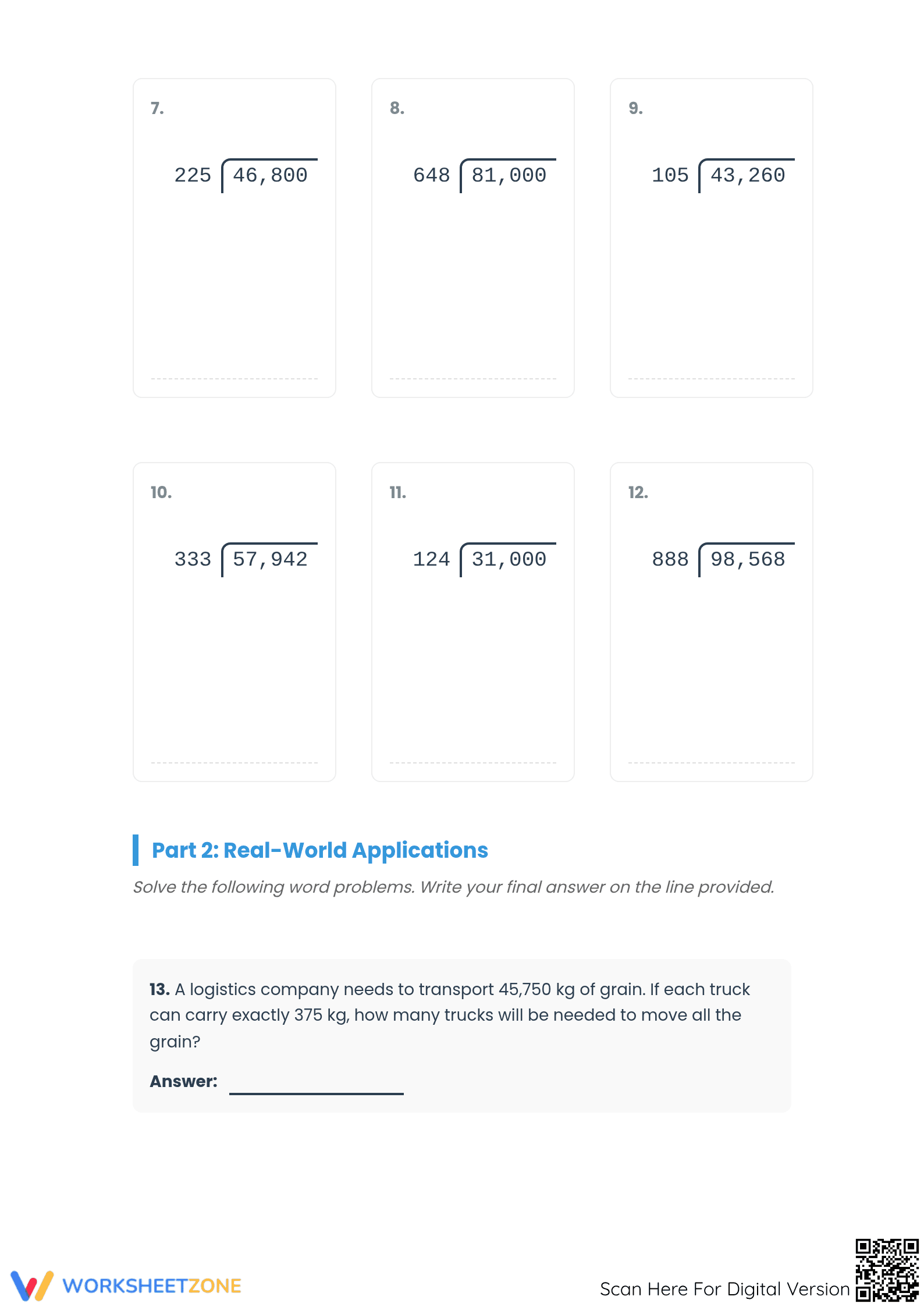
Inside this three-page PDF, you will find a structured learning path. Part 1 features twelve dedicated computation boxes where students calculate quotients for five-digit dividends. Part 2 transitions to four real-world application word problems, requiring students to interpret scenarios and determine the correct division setup. A full answer key provides step-by-step solutions for quick grading.
Skill Progression
- Guided Practice: Six problems provide ample space to help students maintain vertical alignment during the multi-step division process.
- Supported Practice: Problems 7-12 increase in complexity, challenging students to estimate quotients without instructional prompts or scaffolding frames.
- Independent Application: Four situational word problems force students to apply the standard algorithm to solve practical, non-routine challenges like logistics and capacity planning.
This progression follows the gradual-release model, moving from teacher-supported calculation to independent problem-solving mastery.
Standards Alignment
This resource is specifically aligned to CCSS.MATH.CONTENT.6.NS.B.2: "Fluently divide multi-digit numbers using the standard algorithm." It also supports the Mathematical Practice of attending to precision as students manage multiple steps of subtraction and multiplication within the division process. This standard code can be copied directly into lesson plans, IEP goals, or district curriculum mapping tools.
How to Use It
Use this worksheet as a summative assessment after direct instruction on long division algorithms. Alternatively, it serves as an excellent homework assignment to reinforce classroom learning. During the activity, observe if students are struggling with the multiplication or subtraction sub-steps, as this indicates a need for targeted intervention. Most students will complete the 16 tasks within 40 minutes.
Who It's For
This worksheet is ideal for Grade 6 students who have mastered two-digit division and are ready for the next level of complexity. It is also suitable for Grade 7 review or as an enrichment activity for advanced Grade 5 learners. Pair this resource with a long division anchor chart or an instructional video on quotient estimation for maximum student success.
The development of computational fluency in Grade 6 serves as a critical bridge between elementary arithmetic and the algebraic thinking required in middle school. This worksheet addresses CCSS.MATH.CONTENT.6.NS.B.2 by providing targeted practice with three-digit divisors, a task that demands high cognitive load and procedural precision. According to the RAND AIRS 2024 report, students who achieve mastery in the standard algorithm for multi-digit division demonstrate significantly higher readiness for ratios and proportional relationships. By integrating 12 computation tasks with 4 complex word problems, this resource ensures that students can transition from rote calculation to real-world application. The structured layout minimizes peripheral distraction while maximizing the space for vertical calculation, supporting the executive function needed for multi-step division. For educators, this resource provides an essential tool for evaluating student proficiency in handling large-number dividends and divisors, a prerequisite for success in 21st-century mathematics curricula.


