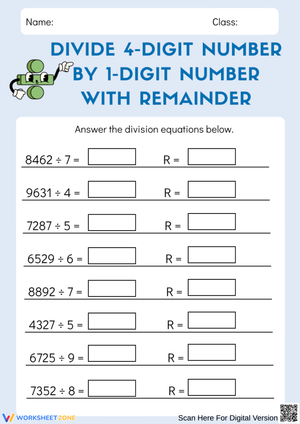
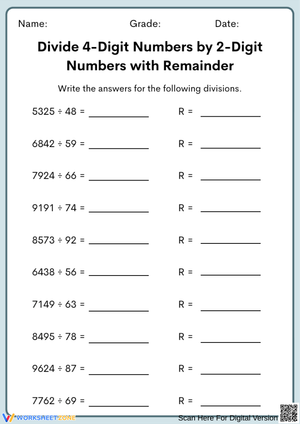
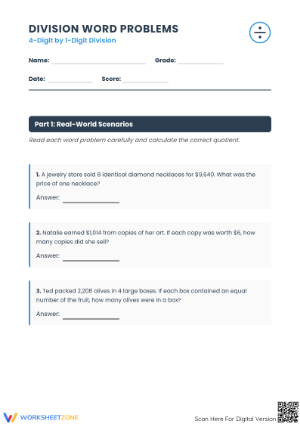
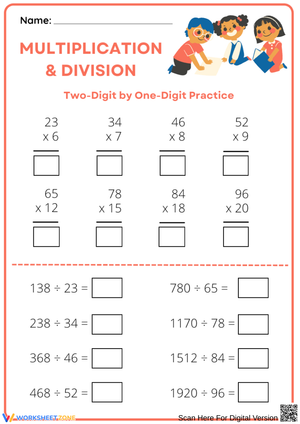
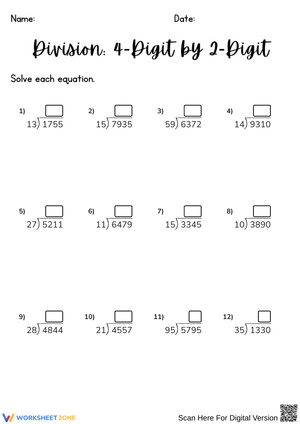
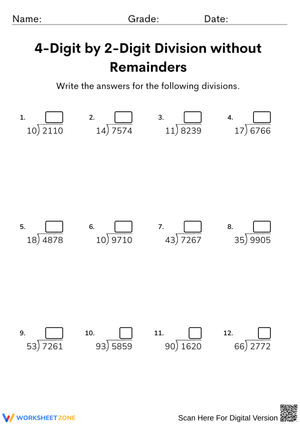
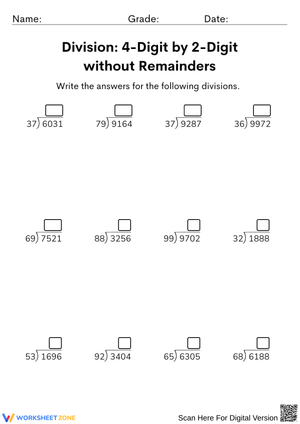
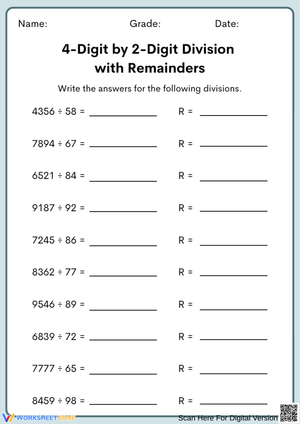
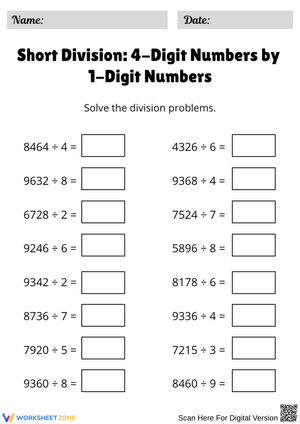
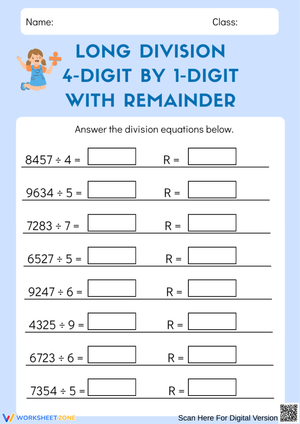
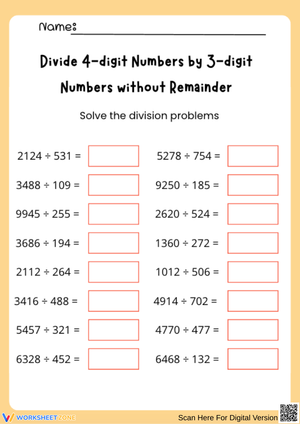
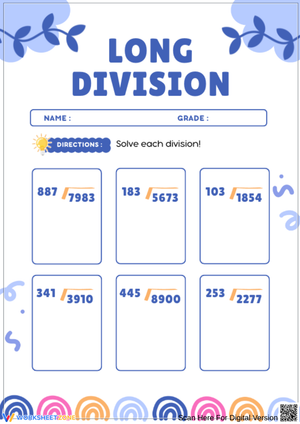
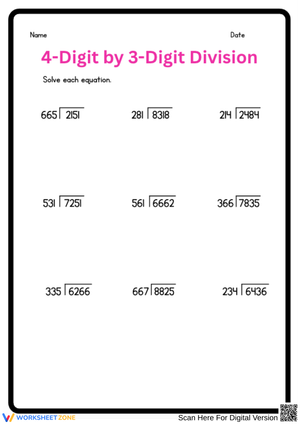
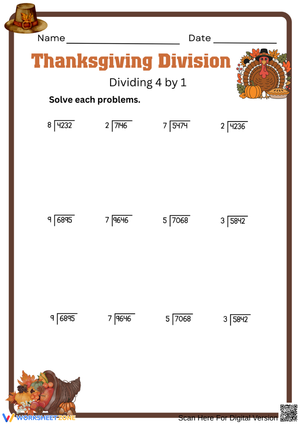
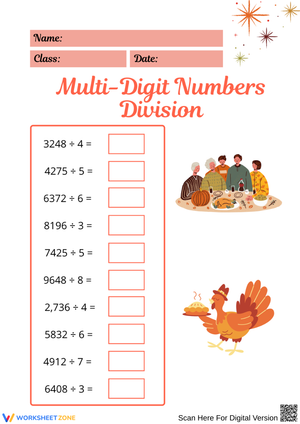
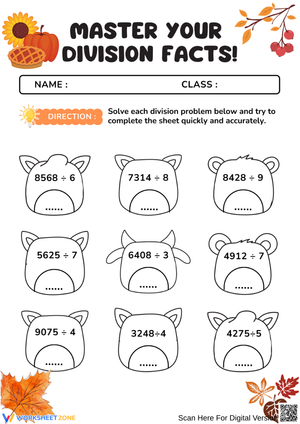
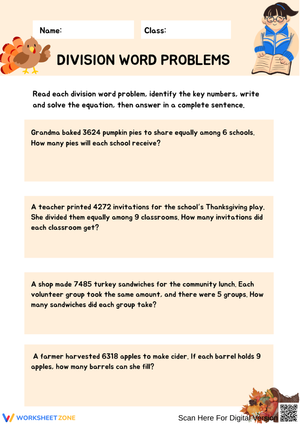
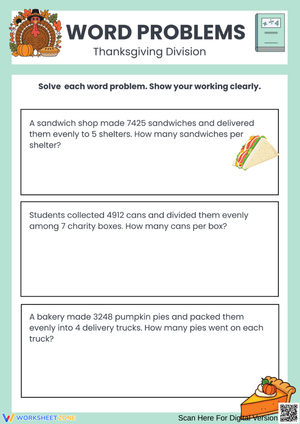
These 4 digit worksheets for 5th grade give teachers a direct way into one of the messiest procedural gaps in upper elementary math — the moment when a student who handles two- and three-digit dividends comfortably loses the thread because the number stretched one place too far. The set focuses on long division with four-digit dividends, moving from 4-digit by 1-digit problems into introductory 4-digit by 2-digit work, and including both exact quotients and remainders throughout.
The Specific Skills These Worksheets Build
Long division with four-digit dividends requires students to hold multiple operations in sequence: estimate the partial quotient, multiply, subtract, check the result, then bring down the next digit and repeat. That's not one skill — it's six or seven sub-skills running in a chain, and a weakness anywhere in that chain produces answers that look procedurally correct at first glance but are completely wrong.
- 4-digit by 1-digit division — the core fluency target for most 5th graders, requiring steady place-value management across all four positions of the dividend
- Introductory 4-digit by 2-digit division — for students who have the algorithm stable and are ready for the heavier estimation demands of a two-digit divisor
- Remainder problems — included because 5th graders need consistent practice writing remainders accurately, not just working through exact-quotient problems
- Estimation checks — prompts that ask students to name a close quotient before calculating, which builds the habit of checking whether an answer is reasonable
- Work-shown format — each worksheet provides space for full written steps so teachers can read the process, not just the final number
That last point matters more than it sounds. When a student writes only the quotient, there's no way to tell whether the error came from weak multiplication recall, a subtraction slip, or a place-value misalignment. Visible work turns each worksheet into a diagnostic tool rather than a completion check.
Student Errors Worth Catching Before They Calcify
The most persistent error isn't a missing multiplication fact — it's misplacing the first digit of the quotient. A student dividing 3,672 by 4 will sometimes write the first partial quotient digit above the tens column instead of the hundreds column, then carry through the remaining steps correctly and arrive at an answer that is off by a factor of ten. The written work shows a recognizable procedure. The answer is completely wrong. Without visible written steps and a teacher who actually reads them, this error repeats for weeks.
A second pattern appears when students have spent too much time on exact-quotient problems only: they subtract down to a remainder of 3 and keep trying to divide, pulling a phantom zero from somewhere to "finish" the problem cleanly. They aren't guessing — they genuinely believe every long division problem resolves without a remainder. Regular exposure to remainder worksheets corrects that assumption before it shows up on a unit test.
Fitting These Worksheets Into Your Lesson-Planning Rotation
The 4 digit worksheets for 5th grade in this set fit several standard classroom routines without much additional setup. The most practical entry point for most classes is a short daily warm-up: three to five problems from a 4-digit by 1-digit worksheet, reviewed on the document camera before instruction begins. That routine builds procedural memory without consuming a full lesson block.
In small-group intervention, six to eight problems from one worksheet usually produce enough evidence to identify the main error pattern. If a student misplaces the first partial quotient digit, that error appears early and consistently — there's no reason to wait through twenty problems to confirm it. Shorter sets in that context give cleaner diagnostic data than full-length worksheets where fatigue starts influencing accuracy somewhere around problem twelve or thirteen.
- Exit tickets: pull two or three problems from a mixed worksheet and look specifically at quotient placement and remainder handling
- Math centers: students solve independently, then swap papers and check each written step — not just the final answer — against a posted key
- Sub plans: 4-digit by 1-digit exact-quotient worksheets with visible work space and a short answer key run themselves and are easy to review afterward
- Spiral review: one remainder problem per week, starting a few weeks after initial instruction, keeps the skill sharp without requiring a full reteach
Standard Alignment
These resources address CCSS 5.NBT.B.6, which calls for finding whole-number quotients with up to four-digit dividends and two-digit divisors using strategies based on place value, properties of operations, and the relationship between multiplication and division. That standard explicitly covers both algorithmic procedure and the reasoning behind quotient choices — which is why estimation prompts and work-shown formats belong in this set, not just rows of bare computation problems.
In classroom terms, 5.NBT.B.6 sits near the top of the grade 5 number and operations in base ten progression. Students who finish this standard with real fluency carry it directly into fraction division and decimal computation in grades 6 and 7. A worksheet set that asks students to check reasonableness alongside computation — rather than just execute steps — builds the procedural understanding the standard is actually describing.
Differentiating These Worksheets Across Ability Levels
The mathematical target stays fixed: four-digit long division. What changes across student levels is the amount of support structure built around the computation.
- Students who need more support: begin with 4-digit by 1-digit problems only, use fewer items per worksheet, and model an estimation round before students work independently. Avoid mixing divisor sizes until the single-digit algorithm is steady.
- On-level students: use mixed exact-quotient and remainder worksheets with full written work required, and have students self-check against the answer key after each problem rather than at the end of the worksheet.
- Students ready for extension: introduce 4-digit by 2-digit problems and ask for a written reasonableness check — one sentence explaining why the quotient makes sense — before moving to the next problem.
- Intervention groups: sort worksheets by the specific error pattern visible in written work. A group struggling with multiplication recall needs different practice than a group that mismanages the bring-down step.
Sorting students by error type rather than by a vague sense of overall "level" usually produces faster progress. A student who handles every step correctly except the final subtraction before the remainder is not a "low" student — they have a precise, fixable gap, and the 4 digit worksheets for 5th grade in this set provide enough written-work evidence to locate it quickly.
Frequently Asked Questions
Do these worksheets include both exact quotients and remainder problems?
Yes. Each worksheet is labeled by problem type, so teachers can select exact-quotient worksheets for early instruction and remainder worksheets once the basic algorithm is stable. Mixed worksheets are also included for independent practice and review — a worksheet where every answer is exact can quietly reinforce the mistaken belief that long division always resolves without a leftover value.
What divisors are used across the set?
Most worksheets focus on 4-digit by 1-digit problems, which is where the majority of 5th graders need the most practice. A smaller portion of the set introduces 4-digit by 2-digit problems for students who have the single-digit algorithm stable and are ready for the greater estimation demands of a two-digit divisor. Teachers can sequence them independently based on where their class is in the unit.
Can students who are behind grade level use these resources?
The 4 digit worksheets for 5th grade in this collection work for intervention when teachers sequence them carefully. Start with exact-quotient, 4-digit by 1-digit worksheets, use fewer problems per session, and read the written work after each session rather than scoring only for a correct final answer. That approach keeps students working at the grade 5 standard while giving a precise picture of exactly where the algorithm breaks down for each student.
How long does it take students to finish a worksheet?
Most 5th graders finish eight to ten 4-digit by 1-digit problems in fifteen to twenty minutes when showing full work. Remainder problems run slightly longer because students tend to recheck their subtraction before committing to a remainder value. For exit-ticket use or small-group rotation, two to four problems from one worksheet give enough evidence without running into the next classroom activity.














 Interactive Worksheet Maker
 Quiz Maker
 Word Search Maker
 Crossword Puzzle Maker
 Word Scramble Generator
 Sentence Scramble Generator
 Handwriting Worksheet Generator
 Name Tracing Generator
 Fill In The Blank Generator




 BACK TOSCHOOL