


























Views
Downloads

Essential 2-Digit by 1-Digit Division Word Problems Grade 5
Paste this activity's link or code into your existing LMS (Google Classroom, Canvas, Teams, Schoology, Moodle, etc.).
Students can open and work on the activity right away, with no student login required.
You'll still be able to track student progress and results from your teacher account.
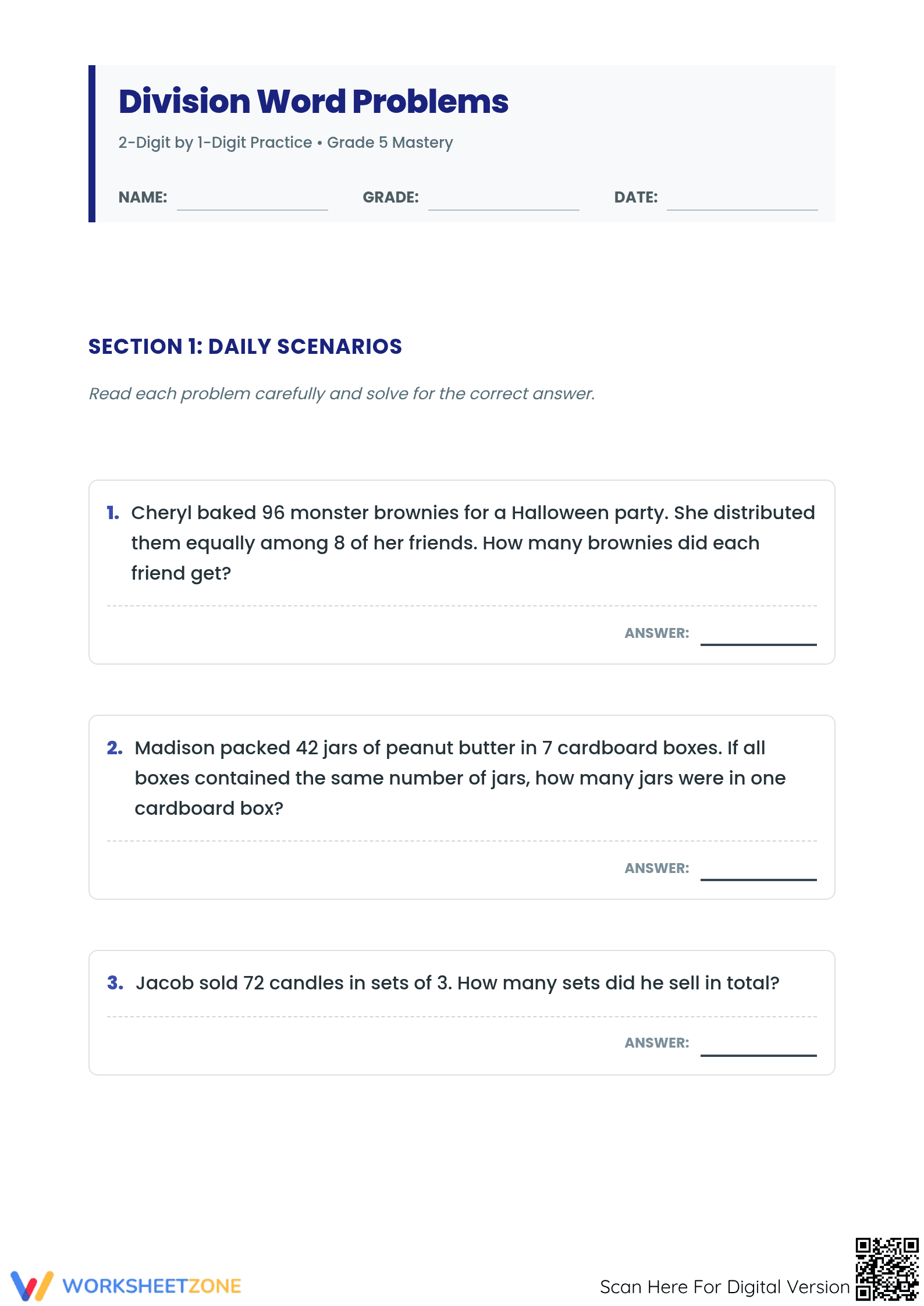
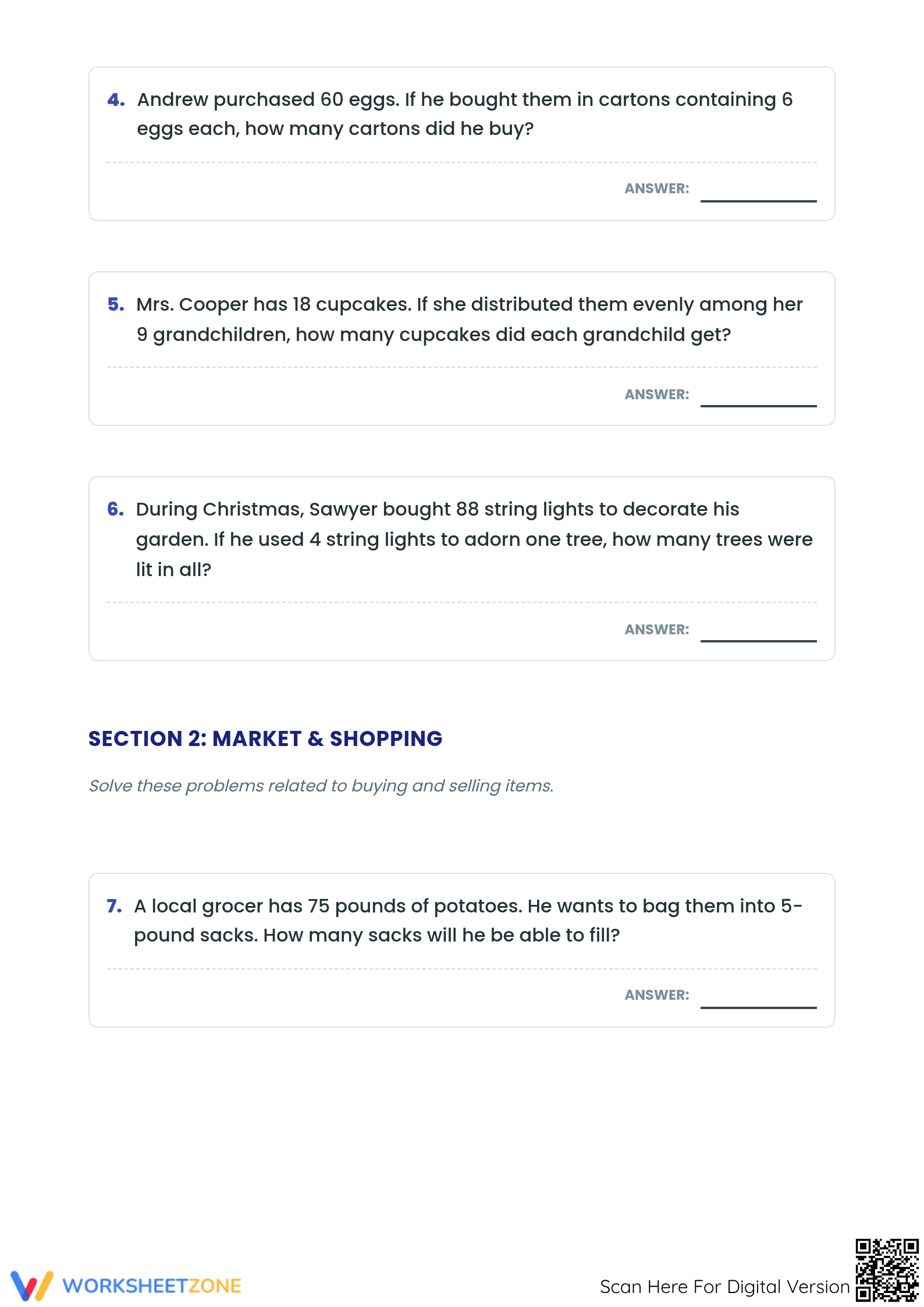
This comprehensive worksheet helps Grade 5 students master 2-digit by 1-digit division through realistic scenarios. By solving multi-step word problems involving daily life, shopping, and sports, learners bridge the gap between abstract calculation and practical application. Students build confidence in identifying divisors, dividends, and interpreting remainders in context for improved mathematical fluency.
At a Glance
- Grade: 5 · Subject: Math
- Standard:
4.NBT.B.6— Find whole-number quotients and remainders with up to four-digit dividends and one-digit divisors- Skill Focus: 2-Digit by 1-Digit Division Word Problems
- Format: 5 pages · 18 problems · Answer key included · PDF
- Best For: Homework, math centers, or small group intervention
- Time: 30–45 minutes
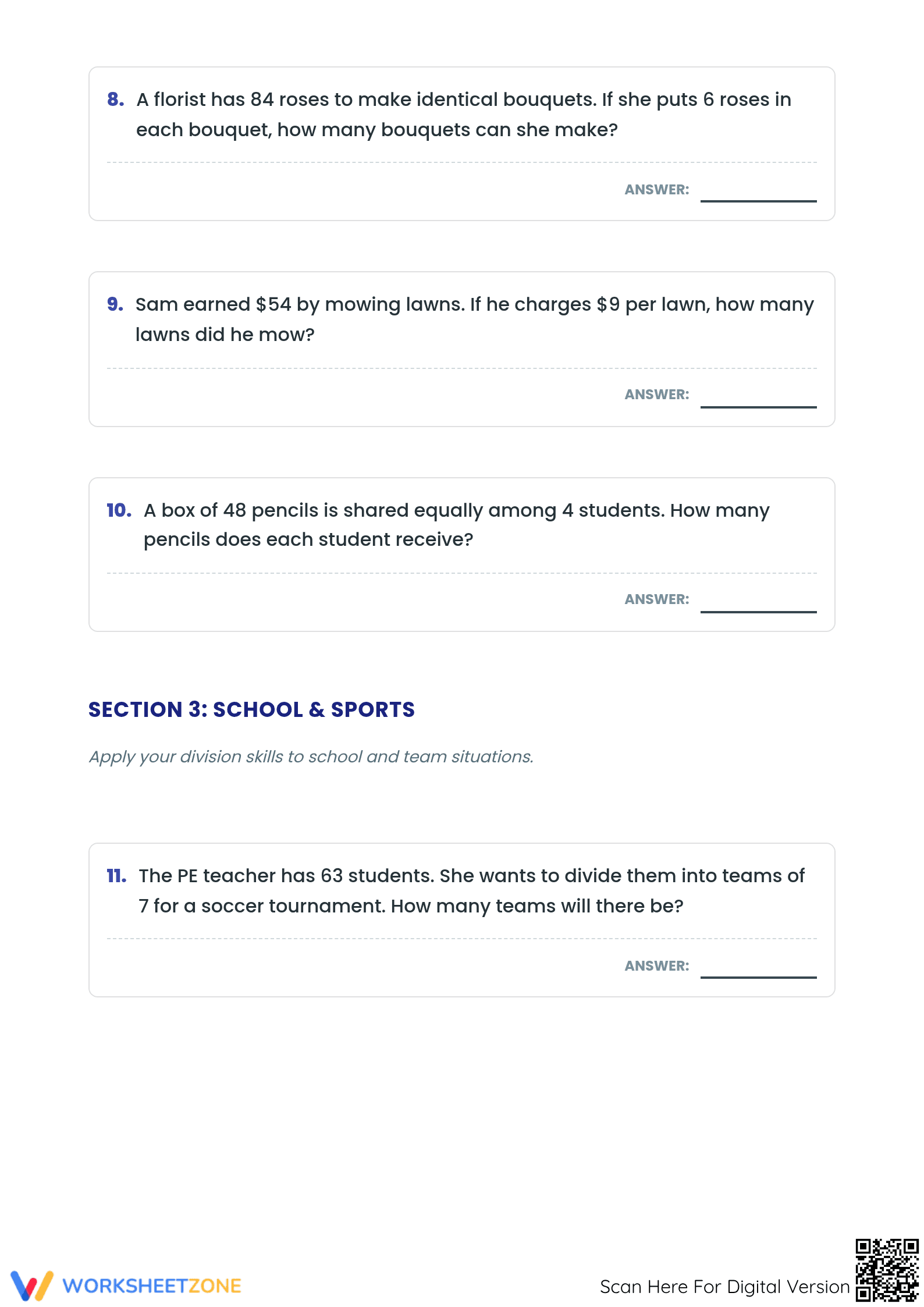
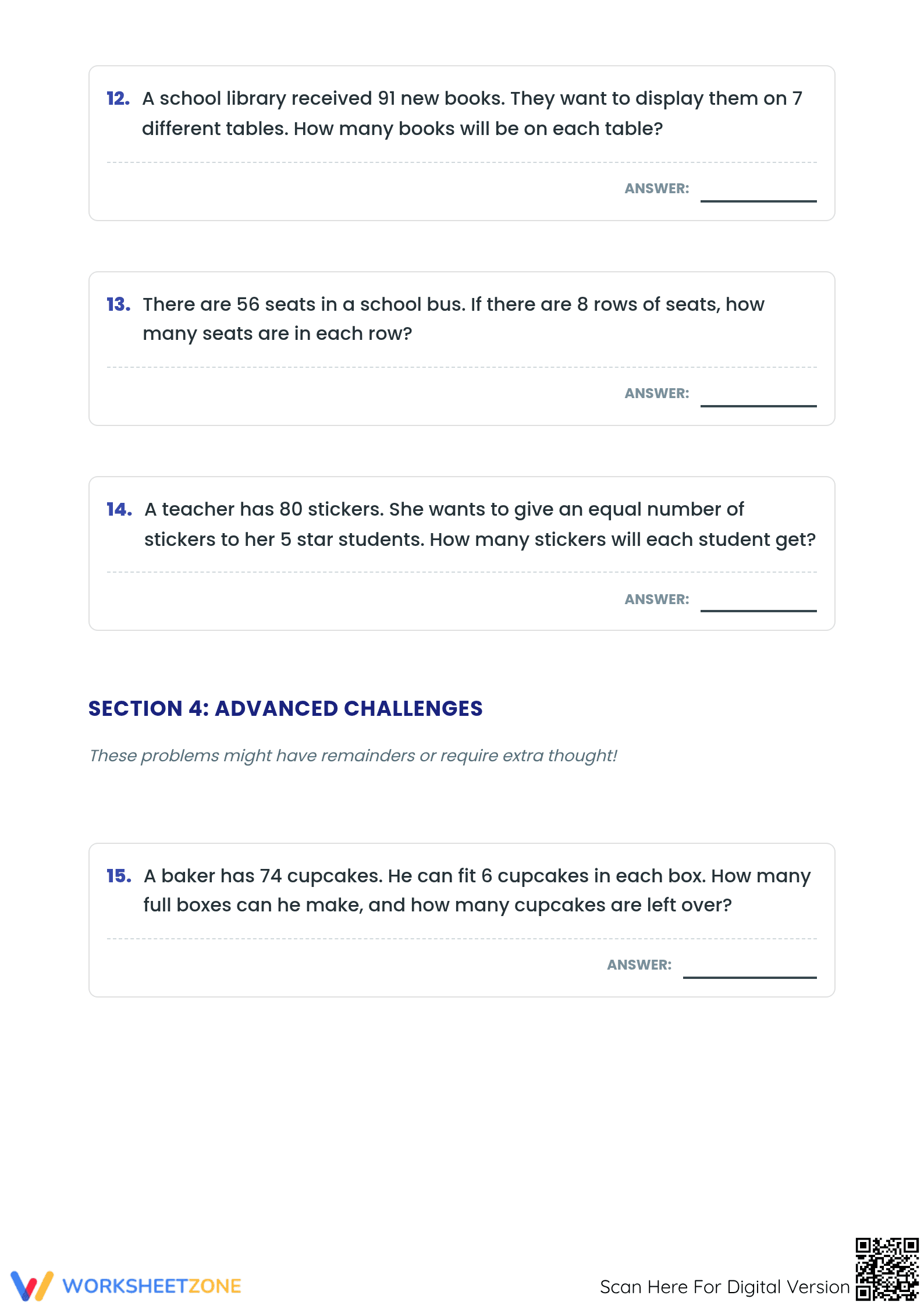
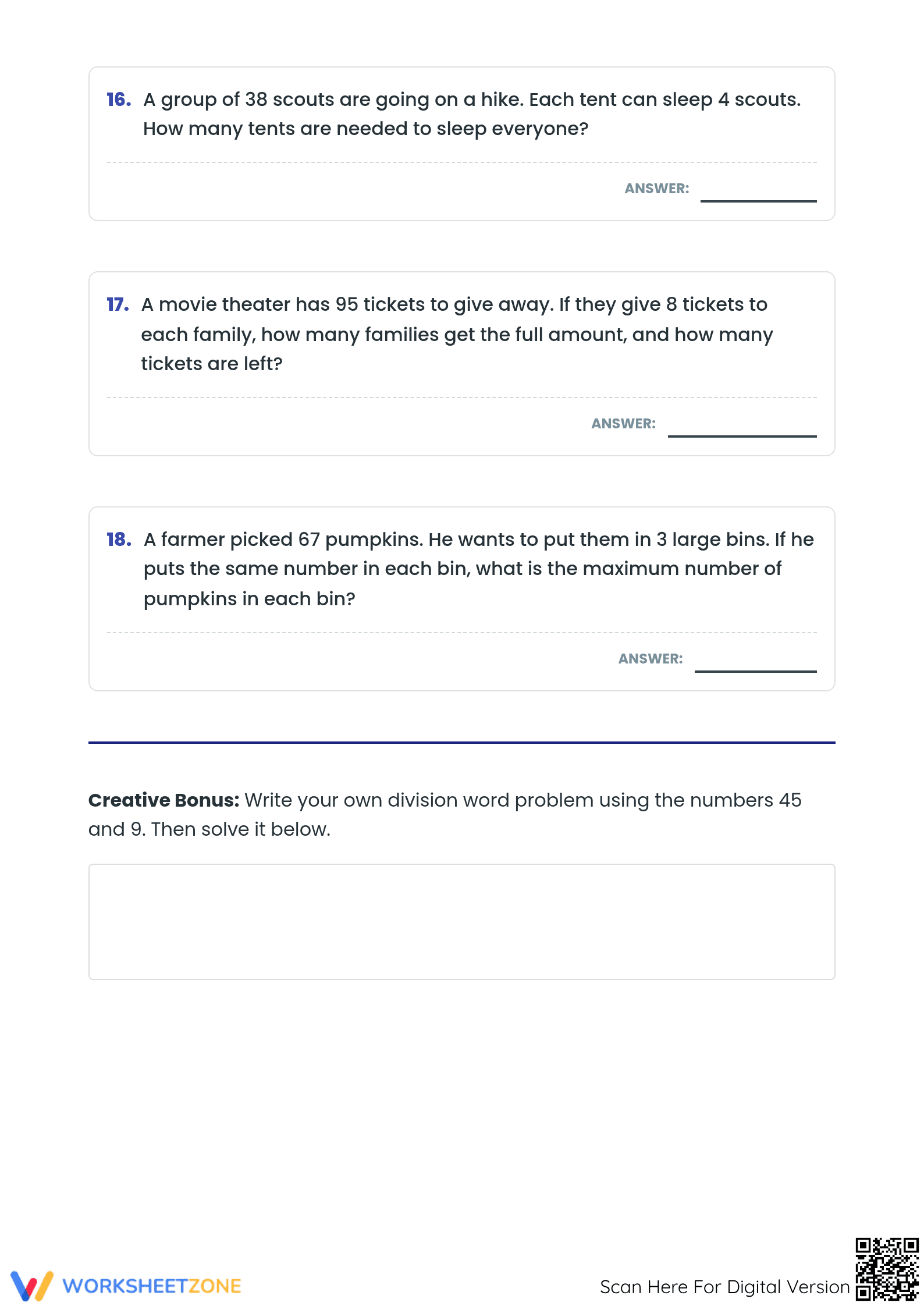
This 5-page printable collection features 18 structured word problems categorized into four thematic sections: Daily Scenarios, Market & Shopping, School & Sports, and Advanced Challenges. It also includes a Creative Bonus where students write and solve their own problems. A full answer key is provided to facilitate quick grading and immediate student feedback on division accuracy and situational reasoning.
Skill Progression
- Guided Practice: The first sections provide direct division scenarios with simple contexts to build initial confidence in identifying dividend and divisor.
- Supported Practice: The "School & Sports" section offers more complex sentences, requiring students to extract data and apply division within more detailed narratives.
- Independent Practice: The "Advanced Challenges" section promotes mastery by requiring students to correctly interpret remainders, fulfilling the gradual-release instructional framework.
The primary focus is CCSS.MATH.CONTENT.4.NBT.B.6, which requires students to find whole-number quotients and remainders using strategies based on place value and the properties of operations. It also supports CCSS.MATH.CONTENT.3.OA.A.3 by applying division to solve word problems in situations involving equal groups and arrays. Both standard codes can be copied directly into lesson plans, IEP goals, or district curriculum mapping tools.
Use this worksheet during the independent practice phase of a division lesson to reinforce conceptual understanding. It works exceptionally well as a formative assessment tool; observe how students handle the "Advanced Challenges" to identify who needs intervention with remainders. Expected completion time is 30 to 45 minutes, making it an ideal choice for a complete class period or sub plan.
Designed for Grade 5 students working toward mastery, this resource is also suitable for Grade 4 acceleration or Grade 6 remediation. The clean layout supports students with executive functioning needs, while the thematic sections provide natural differentiation. It pairs perfectly with a division anchor chart or a short passage about unit rates and fair sharing for a complete math experience.
According to the RAND AIRS 2024 analysis of mathematical instruction, situating operations within contextualized word problems significantly increases student engagement and long-term retention of procedural skills. This worksheet directly addresses the rigorous demands of 4.NBT.B.6, ensuring students can not only perform the 2-digit by 1-digit algorithm but also interpret the results in real-world environments. The inclusion of remainder-based challenges reflects the National Assessment of Educational Progress (NAEP) findings that high-performing students demonstrate superior ability in interpreting mathematical remainders within situational constraints. By moving from daily scenarios to advanced challenges, the resource provides the scaffolded "I Do, We Do, You Do" progression recommended by Fisher & Frey (2014) for effective gradual release of responsibility. This evidence-based approach ensures that learners develop the mental flexibility required for secondary mathematics while maintaining high accuracy in foundational division tasks across diverse classroom settings.


