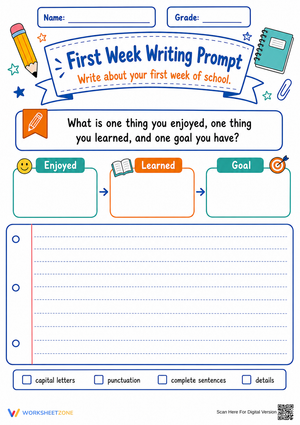
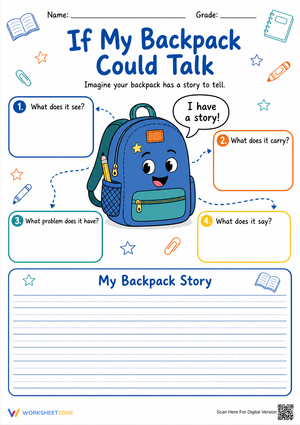
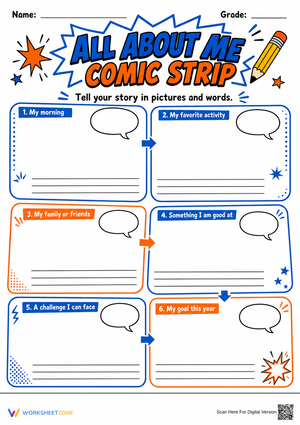
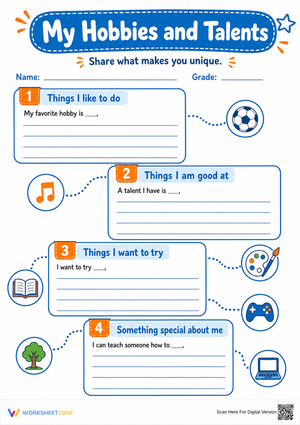
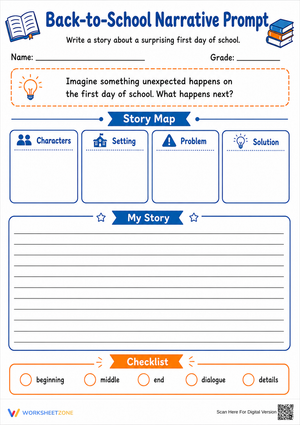
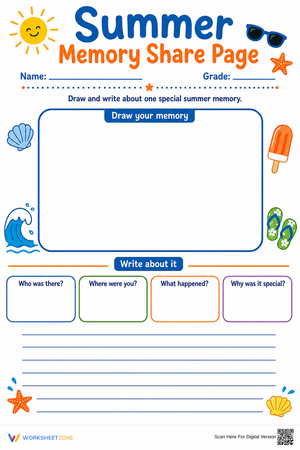
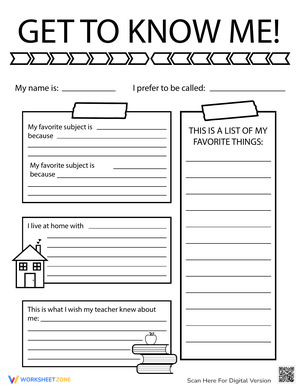
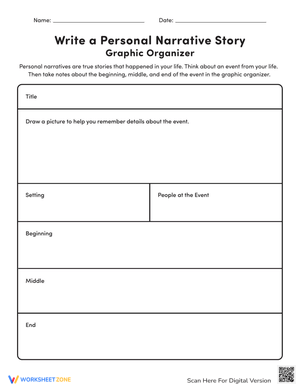
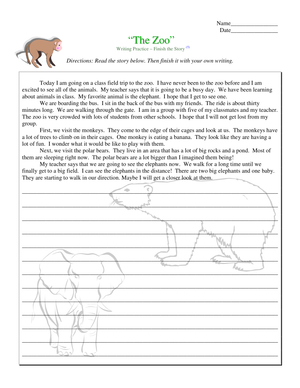
These 5th grade narrative writing worksheets give teachers ready-to-use printable practice that moves through the full writing process — from story planning and scene drafting to targeted revision work. Each worksheet focuses on one move: organizing an event sequence, developing a scene with dialogue and sensory detail, or tightening pacing and endings. That specificity is what makes each worksheet useful inside a writing unit rather than alongside it as a filler task.
What Each Worksheet Targets
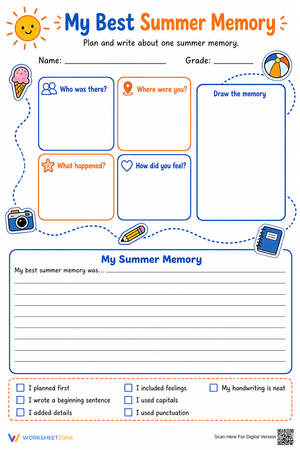
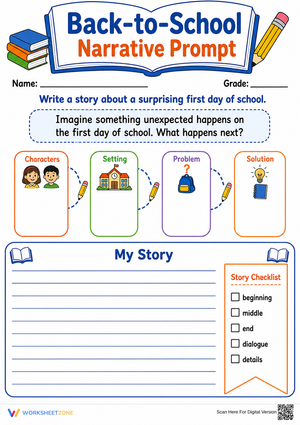
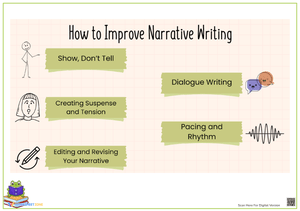
A well-built 5th grade narrative writing worksheets set covers three stages of the writing process, with distinct skill work at each stage. Planning worksheets ask students to identify the central event, the problem or turning point, and the characters involved — all before a draft sentence is written. Scene-drafting worksheets push students to slow down one moment and build it out with action, dialogue, and description rather than summarizing the whole story in two sentences. Revision worksheets isolate specific craft moves: strengthening an ending, varying sentence openings, or cutting sections where pacing stalls.
Within those three stages, the skills students work through include:
- Mapping a story arc across a clear beginning, middle, and end
- Identifying the central event and the change that results from it
- Writing dialogue that moves a scene forward rather than restating the action
- Adding sensory detail and precise word choice within a defined moment
- Revising pacing by slowing key moments and cutting repetitive ones
- Crafting endings that reflect what the narrator noticed, felt, or understood
Grade 5 is the right moment for this kind of structured narrative practice. Students in fourth grade focused mainly on producing complete narratives; fifth graders are expected to control them — shaping pacing, managing ideas across multiple paragraphs, and making deliberate choices about what belongs on the page. Each worksheet in the set asks students to do one of those things at a time, which keeps the cognitive demand on the writing decision rather than on managing the whole piece at once.
Narrative Mistakes These Worksheets Help You Catch Early
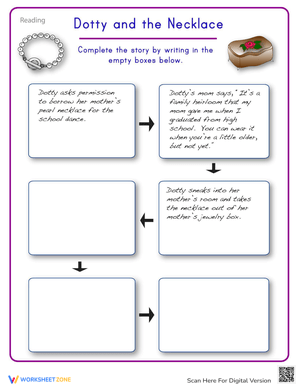
The most consistent problem in grade 5 narrative work is what teachers sometimes call the "and then" draft — a chain of events strung together with no pacing variation, no scene development, and no emotional weight. Every moment moves at the same speed. A well-placed storyboard worksheet reveals this pattern before the student commits it to a full draft. Teachers see it in the four-panel map: every box gets the same two sentences, nothing is slowed down, and the ending is an afterthought. That visual is far easier to address in a planning conference than in a fully marked-up draft returned a week later.
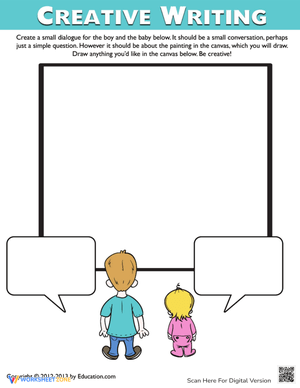
Dialogue is the second trouble zone. Fifth graders frequently write dialogue that reports action rather than creates it — "He said that they should go to the park" instead of "'Let's just go,' Marcus said, grabbing his bag." One worksheet that asks students to rewrite three reported-speech examples as direct dialogue quickly reveals who understands what dialogue actually does in a narrative. Punctuation errors show up predictably here: the missing comma before the closing quotation mark and the capitalized "Said" after a dialogue tag are the two most common, and both are worth flagging explicitly during the follow-up whole-class discussion.
Endings are the third consistent pattern. Most fifth graders close a narrative with a summary sentence — "We had so much fun and I will never forget that day" — rather than a closing image, action, or realization. A revision worksheet that presents two ending versions side by side and asks students to mark which one feels earned does more to change that habit than any general reminder about conclusions ever will.
Building These Worksheets Into Your Writing Week
A reliable cycle is to open the writing unit with a planning worksheet on Monday, move to a scene-drafting or elaboration worksheet in the middle of the week, and close with a revision worksheet by Friday. That rhythm keeps students inside the same narrative project without requiring a new routine each day. It also keeps teacher feedback focused: a conference on Wednesday addresses one skill — elaboration — rather than evaluating an entire draft in one sitting.
In literacy centers, individual worksheets work well as targeted stations. One table practices dialogue rewriting; another focuses on crafting endings; a third works on story mapping. Because each worksheet has a self-contained task structure, students work independently without constant redirection — which matters when the teacher is pulled to a small-group table across the room and cannot monitor the whole class.
- Use planning worksheets on Monday to map the story arc before any drafting begins.
- Use scene-writing worksheets midweek to practice elaboration and direct dialogue.
- Use revision worksheets at the end of the cycle to improve pacing and endings.
- For substitute plans, a planning worksheet followed by a scene-drafting task creates a complete writing block with no extra preparation required.
One scheduling note worth making: the revision worksheets produce stronger formative data than the planning worksheets do. A planning worksheet tells a teacher whether the student can organize an idea. A revision worksheet tells the teacher whether the student can control a piece — and that distinction surfaces clearly when you pull a small group and compare what students did and didn't change.
Standard Alignment
These worksheets align directly with CCSS.ELA-LITERACY.W.5.3, which requires fifth-grade writers to produce narratives using effective technique, descriptive details, and clear event sequences. The planning worksheets address W.5.3a (establishing a situation and narrator) and W.5.3b (organizing an event sequence with natural or logical progression). The scene-drafting worksheets address W.5.3c (using dialogue and description to develop experiences and characters) and W.5.3d (using transitional words and phrases to manage sequence and signal time shifts). The revision worksheets address W.5.3e (providing a conclusion that follows from the narrated experiences). The set also aligns with W.5.5, which asks students to develop and strengthen writing through planning, revising, and editing. A 5th grade narrative writing worksheets that delivers only a prompt box addresses W.5.3 but leaves W.5.5 entirely unaddressed — which means students never practice improving a piece, only producing one.
The IES What Works Clearinghouse practice guide for writing in grades 1–6 identifies daily writing time and explicit instruction in the writing process as having strong evidence of effectiveness. Using these worksheets as recurring tools across planning, drafting, and revision — rather than as one-time extras dropped into a unit — reflects that guidance directly.
Adjusting the Set for a Range of Fifth-Grade Writers
For reluctant writers, the planning worksheets reduce the number of decisions by breaking the story arc into labeled boxes with guiding questions. Students are not asked to invent a structure from scratch — they fill in what they already know about their story moment, and the format does the organizational work. That keeps the cognitive demand on the narrative thinking rather than on managing a blank sheet of paper.
Multilingual learners benefit from receiving the transition word bank and dialogue verb list before drafting, not as an afterthought. Preteaching terms like "suddenly," "without warning," and "meanwhile" — alongside dialogue verbs beyond "said" (whispered, insisted, called out, announced) — gives students the language to show pacing shifts rather than just stating them. A printed reference card used alongside each worksheet keeps the task intact without modifying what students are expected to produce.
Students who finish early should not simply move on to the next worksheet in the set. The stronger move is to raise the complexity on the same task: rewrite one paragraph from reported action to a slowed-down scene, vary every sentence opener in a passage, or draft two different endings and annotate which one works and why. A 5th grade narrative writing worksheets used at that level of analysis gives advanced writers genuine challenge without pulling them into entirely separate materials or disrupting the class's shared focus.
Frequently Asked Questions
Can individual worksheets be used on their own, or do they only work as a full set?
Each worksheet functions as a standalone resource. A teacher can assign the dialogue revision worksheet without ever using the story-mapping worksheet. That said, teachers who use planning, drafting, and revision worksheets across a single narrative unit tend to see stronger final drafts because students have practiced each stage before writing the culminating piece. Both approaches are reasonable depending on where the class is in its unit.
How do small-moment prompts differ from standard story starters?
Standard story starters give students an invented situation: "You find a mysterious key." Small-moment prompts narrow the scope to a real slice of experience — a time you waited for something, a decision you made without thinking, a moment something changed. Fifth graders produce more developed narratives from a specific, bounded memory than from an invented scenario because the details already exist. The planning work then focuses on shape and pacing rather than invention from scratch.
How should these worksheets be used during a small-group intervention block?
Choose one worksheet that targets a visible skill gap — weak sequencing, underdeveloped scenes, or rushed endings — and use it as the group's shared task. Keep the group to that one skill for the full session rather than trying to address everything at once. That focus gives the teacher cleaner evidence of whether the skill improved and makes it easier to decide who needs another session and who is ready to practice independently.
Are the worksheets formatted for standard classroom printing?
Every worksheet in the set prints cleanly in black and white on standard 8.5 x 11-inch paper. No color ink is required, and the files open in any standard PDF reader with no additional software needed.












 Interactive Worksheet Maker
 Quiz Maker
 Word Search Maker
 Crossword Puzzle Maker
 Word Scramble Generator
 Sentence Scramble Generator
 Handwriting Worksheet Generator
 Name Tracing Generator
 Fill In The Blank Generator