


























Views
Downloads

Printable Finish the Story Worksheet | Grade 4 Writing
Paste this activity's link or code into your existing LMS (Google Classroom, Canvas, Teams, Schoology, Moodle, etc.).
Students can open and work on the activity right away, with no student login required.
You'll still be able to track student progress and results from your teacher account.
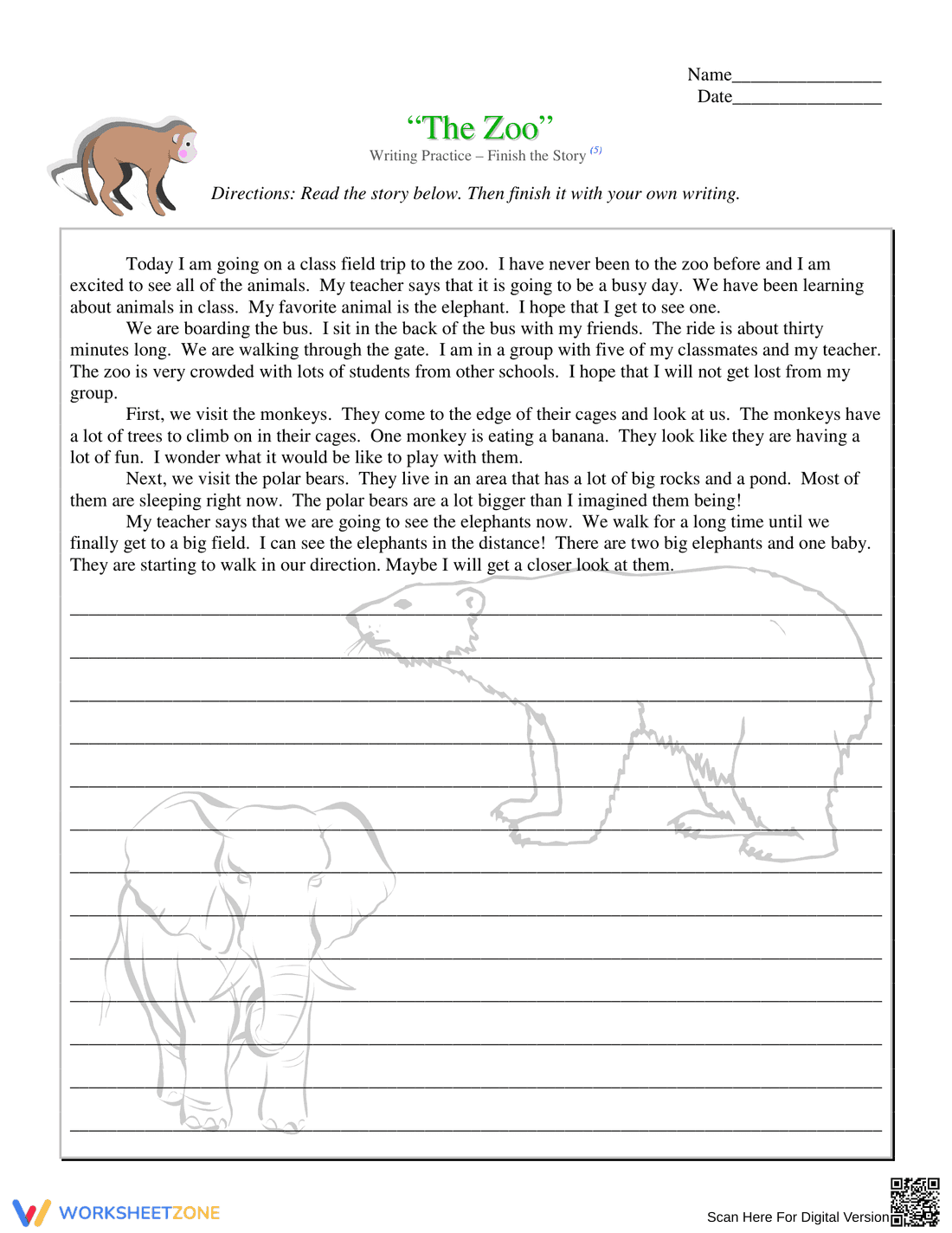
This narrative writing worksheet gives students a structured story starter to develop creative writing skills. Students read a three-paragraph introduction about a zoo field trip, then use their imagination to finish the story. This builds narrative sequencing and descriptive writing abilities in a highly engaging format.
At a Glance
- Grade: 4 · Subject: ELA
- Standard:
CCSS.ELA-LITERACY.W.4.3— Write narratives to develop real or imagined experiences.- Skill Focus: Narrative Writing
- Format: 1 page · 1 problem · No answer key · PDF
- Best For: Independent writing practice
- Time: 20–30 minutes
Inside this single-page resource, educators find a narrative prompt titled "The Zoo." The page features a three-paragraph story starter detailing a class field trip encountering monkeys, polar bears, and elephants. Below the text, the worksheet provides lined space for students to continue the plot and conclude the narrative. Faded background illustrations provide visual interest. Because this is an open-ended creative writing exercise, no answer key is required.
This resource requires zero teacher preparation.
- Print (1 minute): Download the PDF and print a class set.
- Distribute (1 minute): Hand the page to students. Directions are explicitly stated at the top.
- Review (0 minutes): Students can begin writing immediately. Total teacher prep time is under two minutes.
This seamless workflow makes the worksheet an ideal emergency sub plan, morning work activity, or fast-finisher task.
This worksheet aligns directly to CCSS.ELA-LITERACY.W.4.3: Write narratives to develop real or imagined experiences or events using effective technique, descriptive details, and clear event sequences. It also supports CCSS.ELA-LITERACY.W.5.3 by encouraging students to orient the reader and establish a situation. Both standard codes can be copied directly into lesson plans, IEP goals, or district curriculum mapping tools.
Deploy this worksheet during independent writing blocks to build narrative stamina. Introduce the activity after a mini-lesson on descriptive language, challenging students to incorporate sensory details. Alternatively, use it as a formative assessment tool to gauge baseline narrative skills. While students write, observe their ability to maintain point of view and verb tense. Expected completion time ranges from twenty to thirty minutes.
Designed for fourth and fifth-grade students developing narrative writing capabilities. It serves as an excellent scaffold for reluctant writers struggling with blank page syndrome, as the introduction eliminates the hardest part of starting. Advanced writers can be challenged to fill the entire page. Pair this worksheet with an anchor chart on transition words to help students connect new paragraphs to the existing text.
Effective narrative writing instruction requires structured opportunities for students to practice sequencing and descriptive techniques. Aligning with CCSS.ELA-LITERACY.W.4.3, this resource prompts students to write narratives to develop real or imagined experiences. Providing a story starter reduces cognitive load, allowing learners to focus entirely on plot development and descriptive language rather than initial ideation. According to a recent RAND AIRS 2024 report on literacy instruction, providing scaffolded writing prompts significantly increases student engagement and total word count produced during independent practice sessions. By removing the barrier of starting from scratch, students demonstrate higher levels of creativity and better adherence to narrative structures. This targeted practice helps solidify foundational writing skills necessary for advanced composition tasks in later grades, ensuring students can effectively communicate complex sequences of events.


