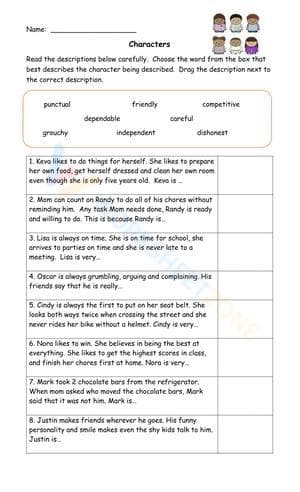
Short story printable worksheets for 5th grade give teachers a reading format that fits the real constraints of an upper elementary block — text long enough to demand genuine analysis, short enough for a student to read, reread, and respond to in a single lesson. Grade 5 is the point where students are expected to stop retelling and start proving: citing exact lines, tracing how a character's choices push the plot forward, pulling a theme from specific events rather than just naming a feeling. These worksheets put that work in students' hands without the pacing problem a longer selection creates.
The Specific Skills Each Worksheet Targets
A well-constructed set of short story printable worksheets for 5th grade keeps each worksheet focused on a distinct literature standard rather than sampling loosely across everything at once. The texts are brief enough for close reading within a single class block, but the questions demand layered thinking — not just recall of what happened, but explanation of why it matters and what evidence proves it.
- Citing text evidence: Students underline relevant lines and use direct quotes or specific details to ground written answers, rather than relying on general impressions of what "seemed like" the right answer.
- Making inferences: Prompts ask students to explain what a character likely thought or felt based on actions and dialogue — not stated feelings the author handed them directly.
- Determining theme: Students identify a central message and trace it to specific story moments, going beyond single-word topic answers like "friendship" or "courage."
- Story structure analysis: Questions walk students through conflict, character response, turning point, and resolution, then ask how those pieces connect to one another and to larger meaning.
- Summarizing: Students practice writing a tight, focused summary — capturing the problem, key decision, and outcome without inflating the response with every minor detail along the way.
The short-text format helps here in a specific way. When the story is brief, students can return to the passage for every question without losing the thread. That repeated return to the text is what makes evidence work stick. Teachers can observe exactly which lines a student chose to underline and immediately see whether the evidence selection was precise or merely adjacent to the right answer.
Fitting These Worksheets Into Your Teaching Week
The most effective approach many teachers use with short story printable worksheets for 5th grade is a two-day cycle. Day one: students read the story independently, marking the text as they go — underlining where the conflict sharpens, circling words that signal a character shift, noting where they're uncertain. Day two: they return to those marks and draft written responses. Splitting it that way reduces the cognitive load of trying to hold the whole story in working memory while writing at the same time, and the written answers improve noticeably as a result.
For Monday warm-ups after the weekend reading gap, a worksheet launches well in the first 10–12 minutes — quick enough for students to read and post a first-pass answer before whole-group discussion opens up. Centers work because a partner pair can read the story, compare their underlined evidence, and reach a negotiated final answer without much teacher setup once the routine is running. Sub plans and review days are covered: the prompts are clear enough to hold up without live teacher explanation, which matters more than it sounds when instructions have to carry the lesson on their own.
Student Mistakes Worth Anticipating Before You Assign
The most predictable error in grade 5 short story work isn't misreading the text — it's misreading the question. Students who identify the protagonist's problem accurately will still write a plot retelling when asked to explain how the resolution connects to the theme. They've answered a question that wasn't asked, and they don't recognize the gap because retelling feels like analysis to them at this stage.
Theme responses are where the sharpest gaps become visible. A student writes "the theme is kindness" and stops, treating a topic word as a complete answer. The actual target is a full statement: "People who extend kindness to strangers often find that trust comes back to them unexpectedly." Reaching that statement requires tracing a specific moment in the story back to the claim — exactly the move these worksheets push students to make. Watch also for evidence that's technically in the text but too surface-level: a student quotes "she felt terrible" when the stronger line is the one describing what she did next. That substitution tells you the student found the text but hasn't yet learned to evaluate which details carry explanatory weight.
Summaries balloon because fifth graders don't yet trust themselves to decide what counts. When a prompt leaves the selection criteria open — "write a summary of the story" — students include everything to be safe. A directed frame like "write a three-sentence summary using the problem, one key decision, and the outcome" gives students a decision structure rather than a blank slate, and the worksheets in this set use that kind of directed framing consistently.
Standard Alignment
These worksheets address RL.5.1 (citing textual evidence to support analysis of and inferences from the text), RL.5.2 (determining theme and summarizing the text), and RL.5.3 (comparing and contrasting characters, settings, or events using specific details). In classroom terms, RL.5.1 functions as the anchor skill for most written response tasks — a student can't fully address theme or story structure if they haven't grounded their reading in the actual text first. Teachers who use these worksheets formatively before a unit assessment can catch that specific gap early: a student whose evidence selection is imprecise will show that trouble in their theme and summary responses as well, even when their overall story comprehension seems solid.
Supporting Every Reader With the Same Story Text
Because the passage stays the same for every student, teachers can keep the whole class on the same grade-level story and adjust only the response task. For students who need more support, narrow the written prompt and add a sentence starter. Instead of "Explain how the theme develops across the story," try "The story's message is ___. The event that shows this most clearly is ___." That keeps the conceptual demand in place while giving the student a visible entry point into the writing.
Short story printable worksheets for 5th grade hold up just as well at the higher end. Students who finish the core questions quickly can extend by comparing the story's theme to a second text from earlier in the unit, writing an alternate ending that would shift the theme entirely, or identifying which single story element carries the most weight in building meaning. These extensions apply the same RL.5 skills at greater depth — no separate worksheet required. For intervention groups, the text length is an asset in itself: a brief passage can be reread paragraph by paragraph with teacher coaching without anyone losing track of the full story arc.
Frequently Asked Questions
What reading standards do these worksheets address?
The worksheets target RL.5.1, RL.5.2, and RL.5.3 — citing evidence, determining theme and summarizing, and analyzing story elements including character, setting, conflict, and resolution. Each worksheet focuses on one or two of those standards, so teachers can select based on the specific skill they're reinforcing or formally checking.
How long does each worksheet take students to complete?
Most students finish the reading and written response within 20–30 minutes. A focused lesson block allows time for an independent read, a second pass for evidence marking, and a written response. Teachers who need a quicker formative check can assign the evidence and story-element questions only and hold the theme or summary prompt for a whole-group follow-up discussion.
Do these work for centers and small-group intervention?
Both. The self-contained format means students can read the story and respond without needing live teacher setup, which makes center use straightforward. For small-group intervention, the brief text lets a teacher pause mid-story, prompt students to name what just changed, and coach specific reading moves — like locating the moment a character's choice becomes irreversible — before students write independently.
Can these worksheets serve as formative assessment?
Yes. Because each passage is short and the questions are targeted, student responses reveal specific skill gaps rather than general confusion. A student who cites the wrong line as evidence is showing something different from a student who cites the right line but explains it vaguely — and both distinctions come through clearly when the text is brief enough for a teacher to check responses against the source in real time.















 Interactive Worksheet Maker
 Quiz Maker
 Word Search Maker
 Crossword Puzzle Maker
 Word Scramble Generator
 Sentence Scramble Generator
 Handwriting Worksheet Generator
 Name Tracing Generator
 Fill In The Blank Generator