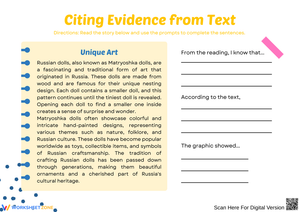
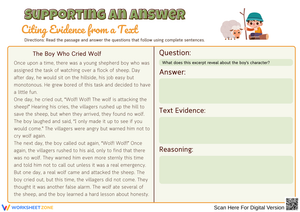
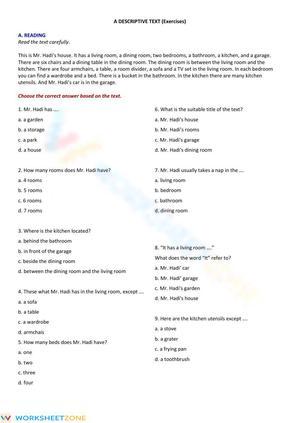
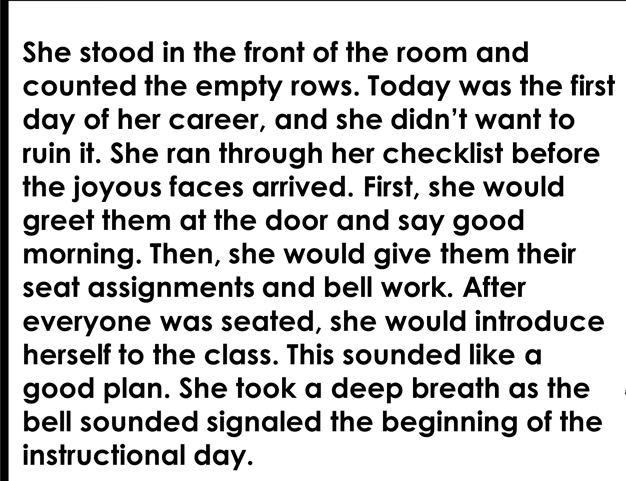
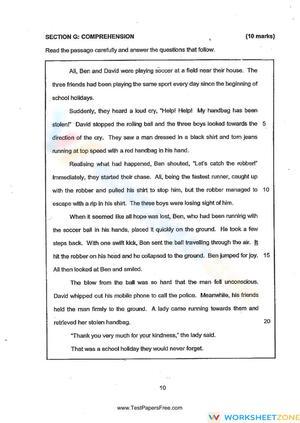
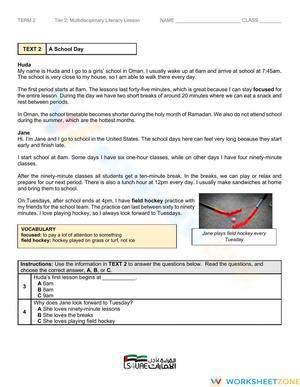
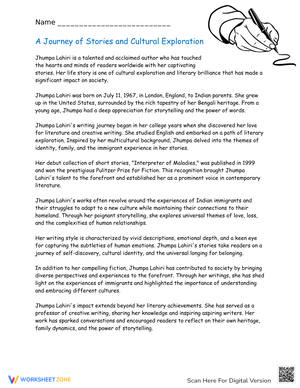
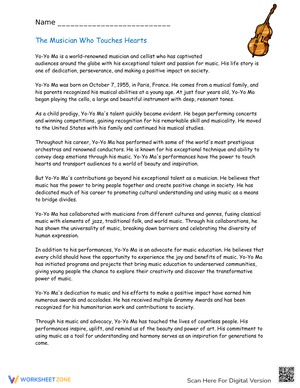
These 5th grade citing evidence from the text worksheets give students focused practice with the specific move that trips up most grade-level readers: selecting the strongest detail from a passage and explaining how it actually proves the answer — not just a detail that's vaguely related to the topic. Each worksheet pairs a short text with two or three text-dependent questions and writing space calibrated so students show both their evidence and their reasoning without turning the task into an endurance exercise. The format stays consistent enough that once students learn it, they spend their energy on the evidence work itself rather than figuring out what the directions are asking.
What's Inside the Set
By fifth grade, citing evidence requires three distinct steps that students tend to collapse into one: reading the question carefully enough to know what kind of detail to look for, returning to the passage with that lens, and selecting a specific proof rather than a general observation. The worksheets target all three moves. Each question stays anchored in the text — answers have to come from what the passage says, not from prior knowledge or personal reaction.
The 5th grade citing evidence from the text worksheets in this set draw from both literature and informational passages. Literature prompts ask students to support thinking about character motivation, the development of a central conflict, what a line of dialogue reveals, or why a particular moment matters to the story. Informational prompts shift the task toward identifying what an author directly states, explaining the evidence an author uses to support a claim, or distinguishing a main point from the detail that backs it up. Building practice with both text types within the same month prevents students from treating evidence work as a skill that belongs only to fiction — a mistake that surfaces clearly on mixed standardized assessments.
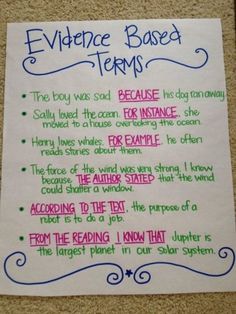
- Underline the key word or phrase in the question before searching the passage for proof
- Select a quote or paraphrase that directly addresses the prompt — not just something on the same topic
- Write an explanation that connects the chosen evidence to the answer rather than restating the quote in different words
- In higher-demand items, compare two candidate details and defend which one fits the question more precisely
Frequent Student Errors Worth Watching For
The most common problem in grade 5 evidence responses isn't that students can't find something — it's that they grab the first plausible detail and stop looking. A student asked to explain why a character trusted a stranger might quote "she smiled and took a deep breath," when the passage contains a sharper detail two paragraphs later about the stranger returning the character's lost wallet without being asked. Both details are textual. Only one is the strongest proof for that specific question. Worksheets that ask students to justify why they chose a particular detail — not just produce one — force that comparison to happen on purpose rather than by accident.
A second pattern teachers see constantly is explanation-free quoting. The student writes a quote, adds "this shows...", and then either restates the quote in different words or stops writing entirely. Nothing is explained. A three-part response structure — answer, evidence, reason the evidence connects — exposes this gap immediately because the writing space makes the missing piece visible before the student finishes. Short targeted worksheets are more useful for catching this than longer assignments, because there's less room to bury the gap inside bulk.
Fitting These Worksheets Into Your Instructional Week
The most reliable sequence is a brief model, guided practice, then independent work — not a cold handout. Project a passage and show the actual thought process out loud: read the question first, mark the word or phrase that tells you what kind of evidence to look for, scan with that specific lens, and choose the strongest option rather than the first useful one. That setup takes about ten minutes and changes what students do when they eventually work alone.
Within the week, these worksheets fit multiple spots. A teacher might use one as the anchor task after guided reading, as a Monday warm-up to reactivate the skill after the weekend, or as a quick exit check following small-group instruction. In intervention settings, using 5th grade citing evidence from the text worksheets with a single focused question per session makes it easier to isolate where a student's difficulty actually lives — comprehension of the passage, selecting relevant evidence, or writing the connection. Each of those points toward a different instructional move the following day.
Sentence stems help when the format is new: The text shows this when... or One detail that proves this is... Once students internalize the structure, those prompts can come off so responses arrive in their own words. The goal is unprompted, independent evidence use — not permanent reliance on a frame.
Standard Alignment
The primary anchors are CCSS.ELA-LITERACY.RL.5.1 and CCSS.ELA-LITERACY.RI.5.1, both of which require students to quote accurately from a text when explaining what it says explicitly and to support inferences with textual evidence. In classroom terms, those standards appear every time a teacher asks students to prove an answer rather than guess or react. Every question in these worksheets requires students to return to the passage — there are no answer-from-experience prompts, which is exactly what those standards demand at this grade level.
RI.5.8 adds useful extension on the informational side: students explain how an author uses reasons and evidence to support particular points in a text. That standard fits naturally into worksheets where the prompt asks not just what the author says, but what support the author provides for a claim. Rotating literature and informational worksheets through the same unit keeps both standards active without requiring two separate instructional routines.
The What Works Clearinghouse guidance for reading interventions in grades 4 through 9 supports explicit instruction in asking and answering text-based questions and using challenging passages — both of which these worksheets put into practice. The brief, focused format aligns with the principle that students benefit most when guided question-answering is followed by supported independent practice that makes their thinking visible to the teacher.
Differentiating the Worksheets Across Ability Levels
On-level students typically work well with a grade-appropriate passage and a mix of explicit and inferential questions on the same worksheet. Students who need additional support often do better with shorter or more accessible passages so that decoding difficulty doesn't block the evidence work itself. For those groups, repeating one consistent three-part response structure across several worksheets before moving to open-ended formats gives them the repetition needed to build fluency with the habit rather than the mechanics of the format.
The amount of required writing is a practical lever teachers can adjust without rewriting questions. Some students benefit from annotating or listing potential evidence first, then turning the best option into a sentence. Others can move directly to a full written response that includes a quote or paraphrase and a clear explanation. For students working above level, the most useful adjustment isn't a longer passage — it's asking them to compare two pieces of evidence and argue which one is stronger, pushing the task from retrieval toward analysis.
The 5th grade citing evidence from the text worksheets in this set vary enough in passage demand and question type that teachers can assign different worksheets to different groups without rebuilding materials. One worksheet can anchor a reteaching session with students who answer without returning to the text. A different one can push a stronger group toward evaluating competing evidence. The core skill stays constant; the cognitive load of the task adjusts.
Frequently Asked Questions
What does a complete evidence response look like at fifth grade?
A complete response names the answer, points to a specific detail from the passage — quoted or paraphrased — and explains how that detail proves the point. It doesn't restate the quote; it connects it. Students who can do all three parts consistently are on track. Students who skip the explanation, or whose explanation is just the quote restated in different words, are showing the most common gap at this grade level.
How do these worksheets work differently for literature versus informational text?
With literature, questions typically ask students to support thinking about a character's choices, how a conflict develops, what a particular line of dialogue reveals, or why a moment matters to the theme. The evidence is usually in service of an interpretive claim. With informational text, questions more often ask students to identify what the author directly states, explain what support is provided for a specific claim, or show how a detail connects to the central idea. The evidence habit is identical; what the evidence has to prove changes based on text type and what the question asks.
Can these worksheets be used in small-group intervention with below-level readers?
Yes, and they work best in intervention when teachers select worksheets with shorter or more accessible passages so decoding isn't the primary obstacle. The aim in intervention is to isolate the evidence skill itself: Can the student identify a relevant detail? Can they explain why it fits the question? A brief worksheet with one well-framed question gives enough material to target either move without overloading a student who is also working on fluency. A short think-aloud before independent work increases what students can do on their own.
How frequently should teachers use these in a reading unit?
Once or twice a week builds consistency without burning out the format. In units where text evidence is the focus standard, several sessions in the first week followed by two or three per week as students gain competence is a sequence many teachers use effectively. What matters most is that each worksheet follows instruction — it shouldn't be the lesson itself, only the practice that shows whether the lesson actually transferred.












 Interactive Worksheet Maker
 Quiz Maker
 Word Search Maker
 Crossword Puzzle Maker
 Word Scramble Generator
 Sentence Scramble Generator
 Handwriting Worksheet Generator
 Name Tracing Generator
 Fill In The Blank Generator