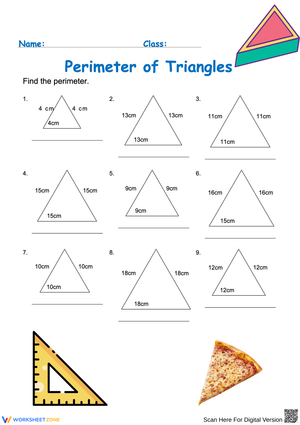
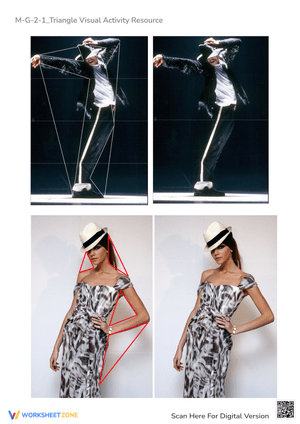
A strong set of grade 4 triangle worksheets should let students practice two related but distinct skills: naming a triangle by its angle type and naming a triangle by its side lengths. Keeping both skills visible on the same page, or across a short worksheet set, helps students see that a single triangle can be described two different ways at once.
Classifying Triangles by Angle: Right, Acute, and Obtuse
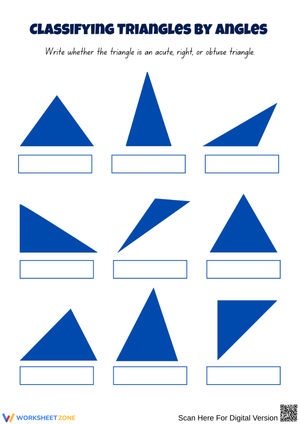
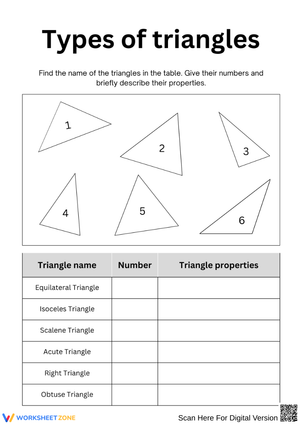
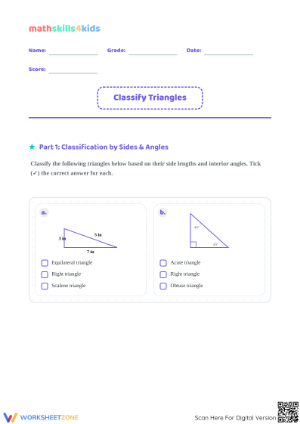
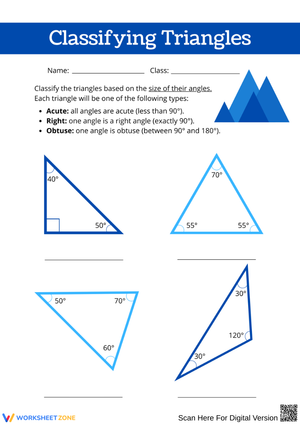
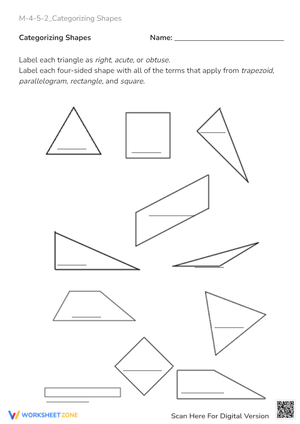
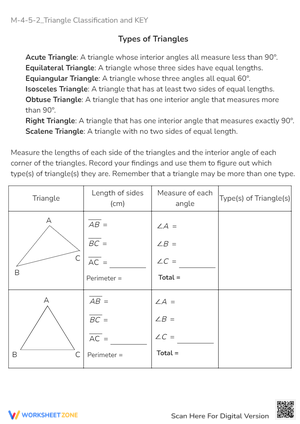
Grade 4 triangle classification by angle covers three categories. A right triangle contains exactly one 90-degree angle. An acute triangle has all three angles measuring less than 90 degrees. An obtuse triangle contains one angle greater than 90 degrees.
The three-category structure (right, acute, obtuse) is what makes triangle sorting worksheets so useful for quick checks: a student who can correctly bucket 10 mixed triangles in under five minutes is showing you real command of angle classification, not just memorized vocabulary. Worksheets that mix all three types on one page, rather than practicing one type at a time, force students to actually look at each angle instead of guessing from a pattern.
For grade 4 practice sets, it helps to include a few triangles drawn at unusual orientations. Students who only see right triangles drawn with the right angle in the bottom corner sometimes struggle to identify a right angle when the triangle is rotated. Worksheets that vary orientation build a more durable understanding of the angle type itself, not just a visual shortcut.
Classifying Triangles by Side Length: Scalene, Isosceles, and Equilateral
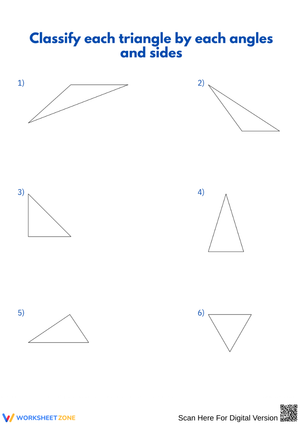
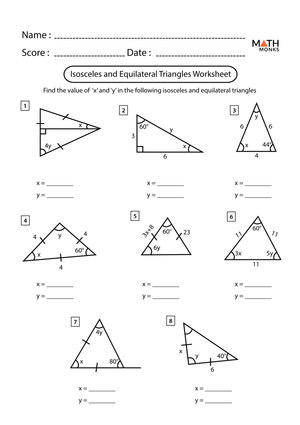
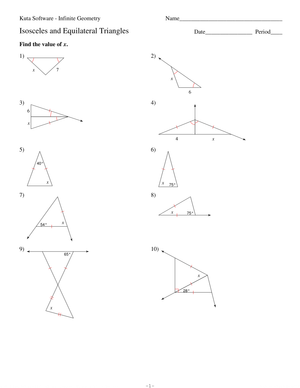
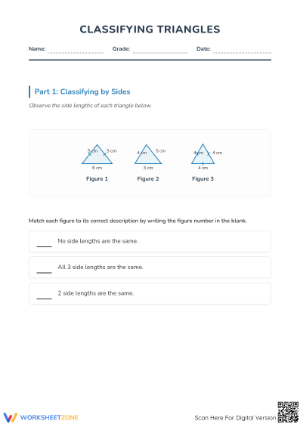
Triangle classification by sides, scalene, isosceles, and equilateral, is commonly paired with angle classification in grade 4 geometry practice sets. A scalene triangle has three sides of different lengths, an isosceles triangle has at least two equal sides, and an equilateral triangle has three equal sides.
Pairing the two systems on one worksheet lets a student practice describing a single triangle with both labels, for example an acute isosceles triangle. This kind of combined labeling task pushes students past simple recall and toward genuinely reading the figure in front of them, which matches the level of precision grade 4 geometry standards expect.
Scaffolding from 4.G.A.1 Angle Identification into 4.G.A.2 Classification
Before students can classify triangles under 4.G.A.2, they need the angle identification skills built in 4.G.A.1, which asks students to draw and identify points, lines, line segments, rays, and angles, including right, acute, and obtuse angles. A worksheet sequence that opens with plain angle identification and then moves into triangle sorting mirrors how the standards themselves build on each other.
According to the Common Core State Standards Initiative, grade 4 students working under CCSS.MATH.CONTENT.4.G.A.2 must classify two-dimensional figures based on the presence or absence of parallel or perpendicular lines and on angles of a specified size, a requirement that explicitly includes recognizing right triangles as their own category within triangle classification.
For a unit plan, this means a teacher can start the week with worksheets isolating single angles, move midweek into triangle angle-sorting pages, and end with combined angle-and-side classification sheets. Each worksheet becomes a checkpoint rather than a stand-alone activity.
Teacher Tips
A few practical moves make triangle worksheets more effective in a grade 4 classroom:
- Mix triangle orientations on every worksheet so students cannot rely on a single visual pattern.
- Pair angle-based and side-based classification on the same page once students are comfortable with each system separately.
- Use a short estimation warm-up before any worksheet that requires measuring or precise angle judgments.
- Rotate triangle worksheets into math workshop stations for review or enrichment, not only as homework.
- Keep an answer key visible at a self-check station so students get immediate feedback during independent practice.
Frequently Asked Questions
1. What triangle skills does grade 4 geometry cover under CCSS?
Grade 4 geometry standards require students to classify two-dimensional figures, including triangles, based on the presence or absence of parallel or perpendicular lines and by angles of a specified size, which covers right, acute, and obtuse triangle categories.
2. How do teachers differentiate triangle classification practice for students who struggle with angle types?
Many teachers start struggling students with single-angle estimation practice before moving to full triangle sorting, and use worksheets with varied triangle orientations so students build genuine angle recognition rather than a visual shortcut.
3. What is the difference between classifying triangles by angles versus by sides in grade 4?
Classifying by angle groups triangles as right, acute, or obtuse based on the largest angle in the figure. Classifying by side length groups triangles as scalene, isosceles, or equilateral based on how many sides share the same length.
4. How can triangle worksheets be used for formative assessment before a geometry test?
Short, frequent triangle sorting worksheets let teachers see exactly where a student's classification errors are concentrated, whether in one angle type, one side-length category, or triangles drawn at unfamiliar orientations, so reteaching can target the actual gap.













 Interactive Worksheet Maker
 Quiz Maker
 Word Search Maker
 Crossword Puzzle Maker
 Word Scramble Generator
 Sentence Scramble Generator
 Handwriting Worksheet Generator
 Name Tracing Generator
 Fill In The Blank Generator